Aircraft noise around Chicago O'Hare in November 2026
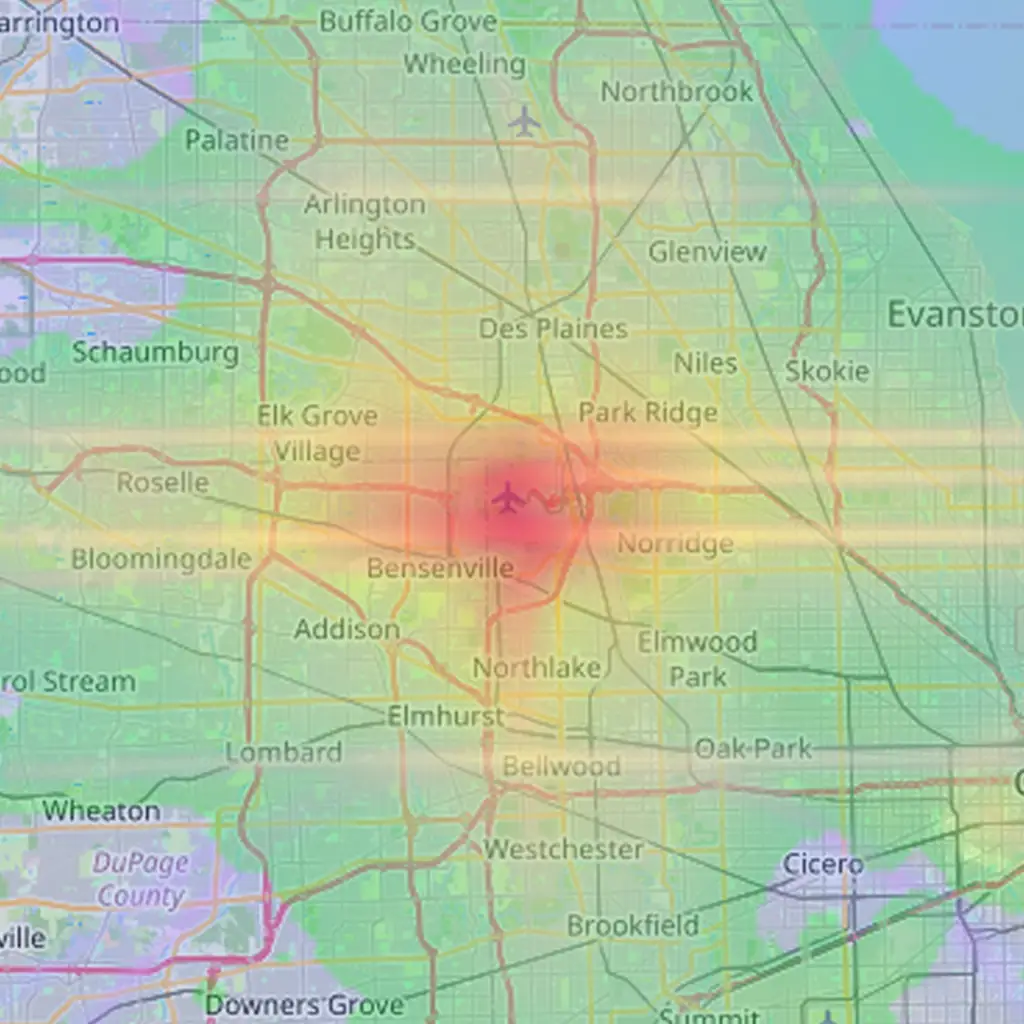
Loudest neighborhoods near Chicago O'Hare: Bensenville, Norwood Park, Edison Park, Schiller Park, Elk Grove Village. Quietest: Itasca, Niles, Mount Prospect. Busiest around 4 PM local time averaging 2831 flights/day. Source: Flight Path Noise monitoring data, 30 days to 2026-11-23.

Does Chicago O'Hare Airport have a curfew?
No — Chicago O'Hare has no formal curfew.
O’Hare operates 24 hours a day with no mandatory curfew, unlike airports such as Sydney or London Heathrow. The only nighttime relief is the voluntary Fly Quiet program, which runs 10 PM to 7 AM and designates preferential overnight runways and flight tracks aimed at the least-populated areas. Because participation by pilots and controllers is encouraged but not enforced, aircraft can and do operate overnight.
Chicago O’Hare International Airport (ORD/KORD) is one of the world’s busiest hubs, set on the city’s Northwest Side where Chicago meets Park Ridge, Bensenville, Elk Grove Village and Schiller Park. Its noise story was rewritten by the O’Hare Modernization Program (OMP), which between 2008 and 2021 demolished the old intersecting diagonal runway layout and rebuilt the airfield as two banks of parallel east-west runways. That shift concentrated almost all traffic into a narrow east-west corridor, dumping new, relentless overflight on neighborhoods that had previously been quiet — most infamously Norwood Park, Edison Park and Sauganash on the east side and Bensenville and Elk Grove Village to the west. The backlash produced one of America’s most organized airport-noise fights, fought through the O’Hare Noise Compatibility Commission, the Fly Quiet runway-rotation program, and a federally funded soundproofing campaign covering tens of thousands of homes. Uniquely for an airport this size, O’Hare has no mandatory curfew — nighttime relief depends entirely on a voluntary program.
Which neighborhoods are quietest — and which aren’t
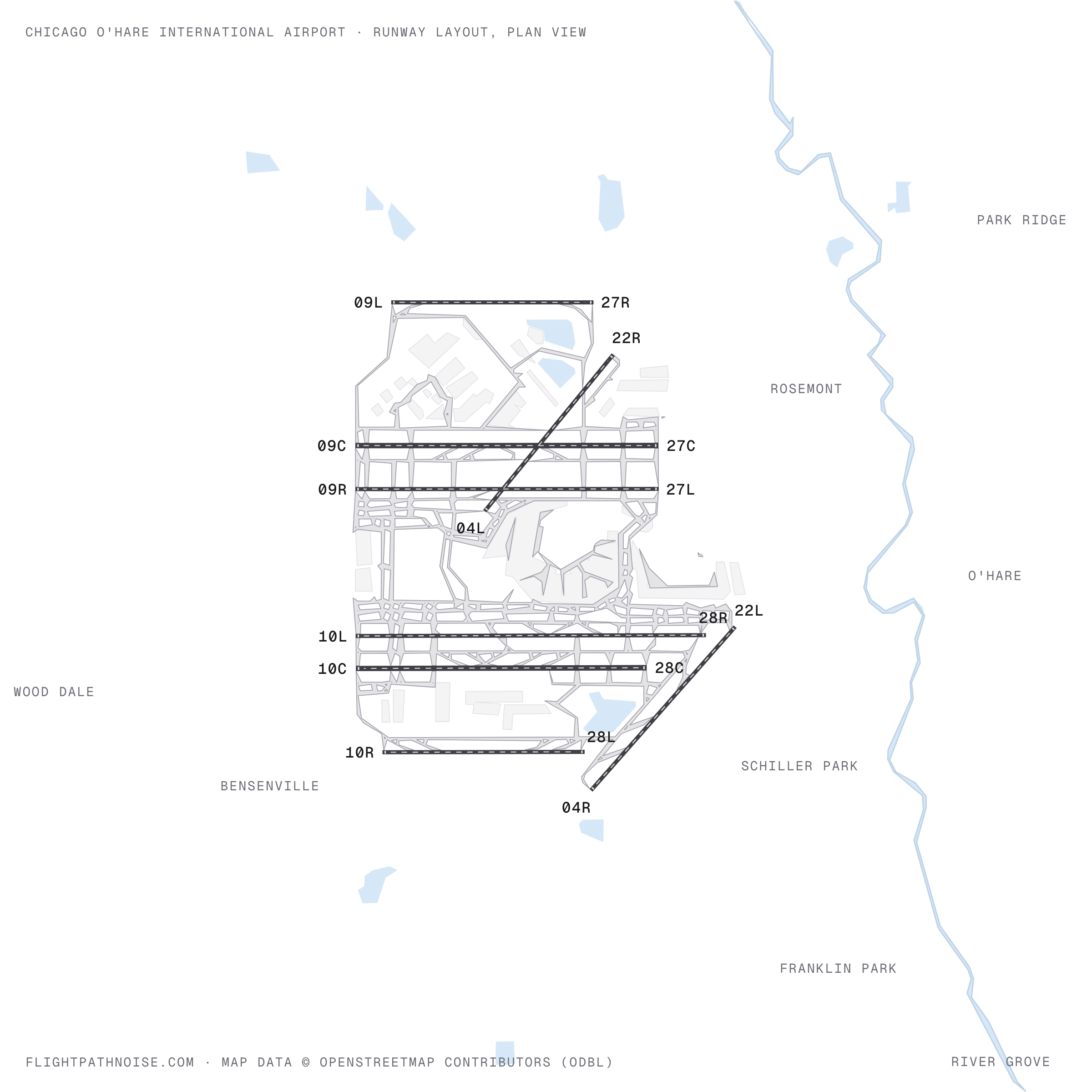
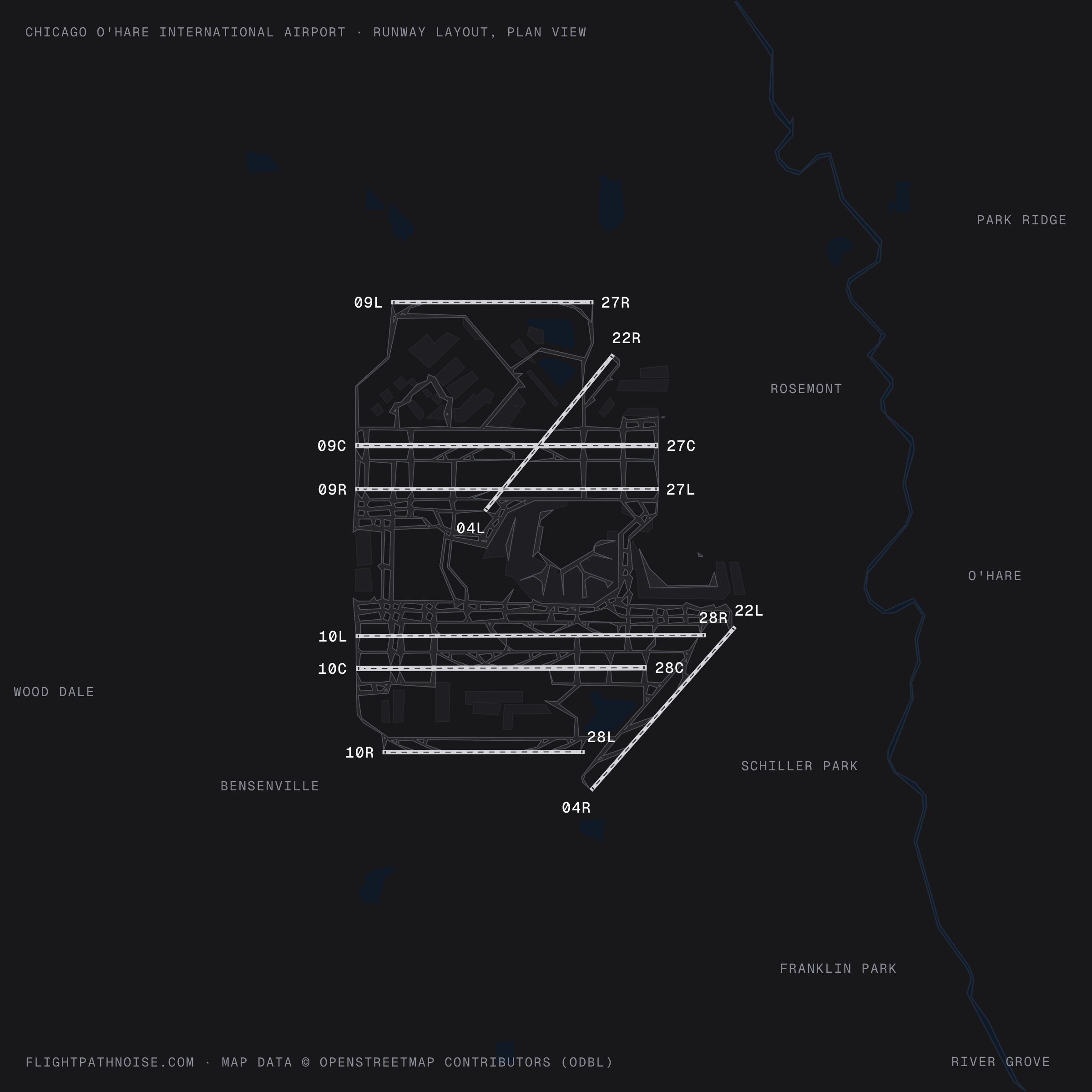
O’Hare runs almost entirely on its two banks of parallel east-west runways. The north complex is 9L/27R, 9C/27C and 9R/27L; the south complex is 10L/28R, 10C/28C and 10R/28L. Two NE-SW diagonal crosswind runways (4L/22R and 4R/22L) see limited use because they intersect the main parallels. Because the whole field points east-west, the noise burden falls in two lobes — one west over the suburbs, one east over the city — and which lobe is louder on a given day depends on the wind.
If aircraft noise is your top concern, the practical move around O’Hare is to get off the east-west centerlines — north toward Mount Prospect or northern Park Ridge, or southwest away from the runway ends. The near-field communities squarely on the axis (Bensenville, Schiller Park, Norwood Park, Edison Park, Elk Grove Village) are the most consistently affected, and the east-west geometry means there is no fully “quiet side” the way a single-direction airport offers — when one lobe gets a break, the other is carrying the traffic. If you’re weighing a specific block, drop a pin on the map above.
| Area | Noise | Why |
|---|---|---|
| Bensenville | ✈︎✈︎✈︎ | Off the west runway ends; low traffic in both flows |
| Norwood Park | ✈︎✈︎✈︎ | East-side corridor; hardest-hit city neighborhood post-OMP |
| Edison Park | ✈︎✈︎✈︎ | Directly under east-end tracks; federally soundproofed |
| Schiller Park | ✈︎✈︎✈︎ | Hugs the southeast edge, under low east-west traffic |
| Elk Grove Village | ✈︎✈︎✈︎ | Southern parts under the new west-end flight path |
| Park Ridge | ✈︎✈︎ | Southern areas hit harder since 9C/27C opened |
| Sauganash | ✈︎✈︎ | On the east-flow arrival stream, higher altitude |
| Des Plaines | ✈︎✈︎ | North of the field, inside the broad noise contour |
| Wood Dale | ✈︎✈︎ | Near the western extended centerlines |
| West Ridge | ✈︎✈︎ | Under east arrivals, but well east and higher up |
| Rosemont | ✈︎✈︎ | Northeast edge; largely commercial footprint |
| Itasca | ✈︎ | West beyond the densest corridor; intermittent |
| Niles | ✈︎ | Off the east-west centerlines; higher, less frequent |
| Mount Prospect | ✈︎ | Northwest, largely off the flight tracks |
Flight patterns and runway use
O’Hare operates in two dominant configurations. East flow lands and departs toward the east, roughly on the 9s and 10s; west flow does the same toward the west, on the 27s and 28s. The operating direction follows the prevailing wind, which is variable but frequently from the west or northwest, so west flow is common.
In west flow, arrivals stream in from the east over the city — West Ridge, Sauganash, Norwood Park and Edison Park — while departures climb out west over Bensenville and Elk Grove Village. In east flow the pattern reverses: arrivals cross the western suburbs and departures push east over the city neighborhoods. The two diagonal crosswind runways (4L/22R, 4R/22L) are used sparingly because they cross the main parallels, though 22L is commonly used for departures during west flow.
The newest runway, 9C/27C, opened in 2021 as the final OMP runway. It is built to FAA Group V standard to take the largest aircraft, and its opening drew a fresh wave of complaints from Norwood Park, Edison Park and Park Ridge as it added capacity to the north airfield. The longest runway, 10L/28R at 13,000 ft, anchors the south complex and sends heavy traffic over Bensenville and Elk Grove Village to the west and Sauganash and Norwood Park to the east.
The route-density layer on the map above makes the post-OMP geometry obvious: two bright east-west bands extending from the runway ends, with the densest overflight stacked directly off the eastern and western thresholds and thinning quickly to the north and south of the corridor.
When is it quietest?
The single most important fact about O’Hare’s daily rhythm is that there is no mandatory curfew — the airport runs 24 hours, and the only overnight relief is the voluntary Fly Quiet program (10 PM – 7 AM, sometimes cited as a 22:00–07:00 noise-abatement window).
- Overnight (10 PM – 7 AM): Fly Quiet is in effect, but it is voluntary. Preferential runways and flight tracks steer traffic over the least-populated areas, and the current plan rotates through six runway configurations on a weekly cycle, alternating between the north and south airfields and between east and west flow. The practical effect is that a given community may get a quiet week followed by a noisier one, rather than guaranteed silence on any single night.
- Morning bank (7 AM – 9 AM): heavy departures as the connecting-hub schedule ramps up; one of the loudest stretches of the day.
- Midday (10 AM – 3 PM): sustained, busy flow typical of a major connecting hub.
- Evening arrival bank (5 PM – 9 PM): peak, with stacked arrivals from across the domestic network and international long-haul.
The biggest variable is the wind. A shift that flips the airport between east and west flow will suddenly move the arrival stream from over the eastern city neighborhoods to over the western suburbs, or vice versa — so a quiet afternoon in Edison Park can turn into a busy evening when the flow changes. Whether your address is under the active runways tonight depends on both the wind and which Fly Quiet configuration is scheduled that week.
How to check noise at your specific address
The map above answers the question general descriptions can’t — is this address loud? Three steps:
- Search your address or postcode in the bar at the bottom of the map.
- Drop a pin — click the location marker that appears.
- Read the noise report in the panel below the map: average daily noise (Leq), peak observed dB, flights per day loud enough to hear there, and an hourly breakdown.
Toggle the Noise Heatmap layer (orange/red = louder) and the Route Density layer (purple/magenta = busier corridors) to see the east-west banks for yourself. Addresses on the runway centerlines — Bensenville and Elk Grove Village to the west, Schiller Park, Norwood Park and Edison Park to the east — will sit in the hottest zones; blocks north or south of the corridor cool off quickly.
To report noise or check soundproofing eligibility, contact the O’Hare Noise Compatibility Commission at 1-800-435-9569 or oharenoise.org (the city also takes complaints via 311). Because O’Hare has no curfew, the Fly Quiet rotation is the only lever shaping overnight noise — and it shifts week to week, so the map’s hourly profile for your pin is the most reliable read on what to expect.
Frequently asked questions
- How does the O'Hare Fly Quiet runway rotation work?
- Fly Quiet is a voluntary 10 PM–7 AM program run by the Chicago Department of Aviation, the O'Hare Noise Compatibility Commission (ONCC), the airlines and the FAA. The current plan rotates through six runway configurations on a weekly cycle, alternating overnight traffic between the north and south airfields and between east and west flow, so the same community is not overflown every single night. Which configuration is active determines whether the eastern city neighborhoods or the western suburbs get the overnight traffic that week.
- Is Park Ridge loud from O'Hare planes?
- Southern Park Ridge gets noticeable overflight from the east-west runways, and noise increased there after the new 9C/27C runway opened in 2021. Northern Park Ridge sits more off-corridor and is quieter. Because it depends heavily on which runways are in use, drop a pin on the map above to see the overflight pattern for your specific street.
- Why are planes suddenly so loud over Norwood Park, Edison Park and Sauganash?
- The O'Hare Modernization Program (2008–2021) replaced the old diagonal runway layout with banks of parallel east-west runways. That concentrated arrivals and departures into a narrow east-west corridor, putting new, relentless overflight on east-side neighborhoods that had previously been quiet. Norwood Park and Edison Park were among the hardest hit and later received federally funded soundproofing; Sauganash and West Ridge sit further out on the same east-flow arrival stream at higher altitude.
- Which areas around O'Hare get the most jet noise?
- The heaviest exposure is directly off the runway ends along the east-west axis: Bensenville and Elk Grove Village to the west, and Schiller Park, Norwood Park and Edison Park to the east. These sit under low traffic in both flow directions. Communities off the centerlines — Mount Prospect, Niles, Itasca — see higher, more intermittent overflight.
- How do I file an O'Hare noise complaint?
- Aircraft noise complaints go to the O'Hare Noise Compatibility Commission (ONCC) and the Chicago Department of Aviation noise complaint line at 1-800-435-9569, or online at oharenoise.org. You can also reach the city via 311. Logged complaints feed into ONCC's monitoring and the Fly Quiet program reviews.
- Am I eligible for O'Hare home soundproofing?
- The residential soundproofing program covers tens of thousands of homes inside O'Hare's noise contour, and neighborhoods including Edison Park, Norwood Park, Des Plaines and Wood Dale have been part of it. Eligibility is tied to whether your address falls within the eligible noise contour; the ONCC (oharenoise.org) administers the program and can confirm your block's status.
- What's the difference between O'Hare's east flow and west flow?
- In west flow, aircraft land and depart toward the west: arrivals stream in from the east over the city (West Ridge, Sauganash, Norwood Park, Edison Park) and departures climb out west over Bensenville and Elk Grove Village. East flow reverses this, sending arrivals over the western suburbs and departures over the east-side neighborhoods. The direction depends on wind, which is frequently from the west or northwest.
Sources and further reading
- O'Hare International Airport — Wikipedia — Wikipedia
- Fly Quiet Program — O'Hare Noise Compatibility Commission
- Plan for Nightly Runway Rotation — City of Chicago
- Aircraft Noise Complaints — City of Chicago Department of Aviation
- Edison Park, Norwood Park Homes To Be Soundproofed With $20M Federal Grant — DNAinfo Chicago
Data updated 2026-11-23 — live ADS-B monitoring, rolling 30-day statistics (methodology). Article text revised 2026-06-12.
Other airports we track
All 174 airports →No airports in this region yet.