
Aircraft noise around Sofia in October 2026
Loudest neighborhoods near Sofia: Druzhba, Iskar. Quietest: Iztok, Lozenets, Centre / Vitosha Boulevard, Boyana / Vitosha foothills. Busiest around noon local time averaging 196 flights/day. Source: Flight Path Noise monitoring data, 30 days to 2026-10-26.

Does Sofia Airport have a curfew?
No — Sofia has no formal curfew.
SOF runs 24/7. There are restrictions on test and training flights between 23:00 and 06:00, but commercial passenger and cargo flights operate around the clock. Most overnight traffic is cargo or seasonal charter operations.
Sofia is unusual among European capitals: by long-standing regulation, aircraft cannot overfly the central city. Departures turn out to the east before climbing, and arrivals are routed to approach the airport from the east as well — keeping the densely populated central districts mostly out of the corridor. This page combines a live ADS-B map of every flight passing SOF with notes on which districts catch the (limited) noise.
Which neighborhoods are quietest — and which aren’t
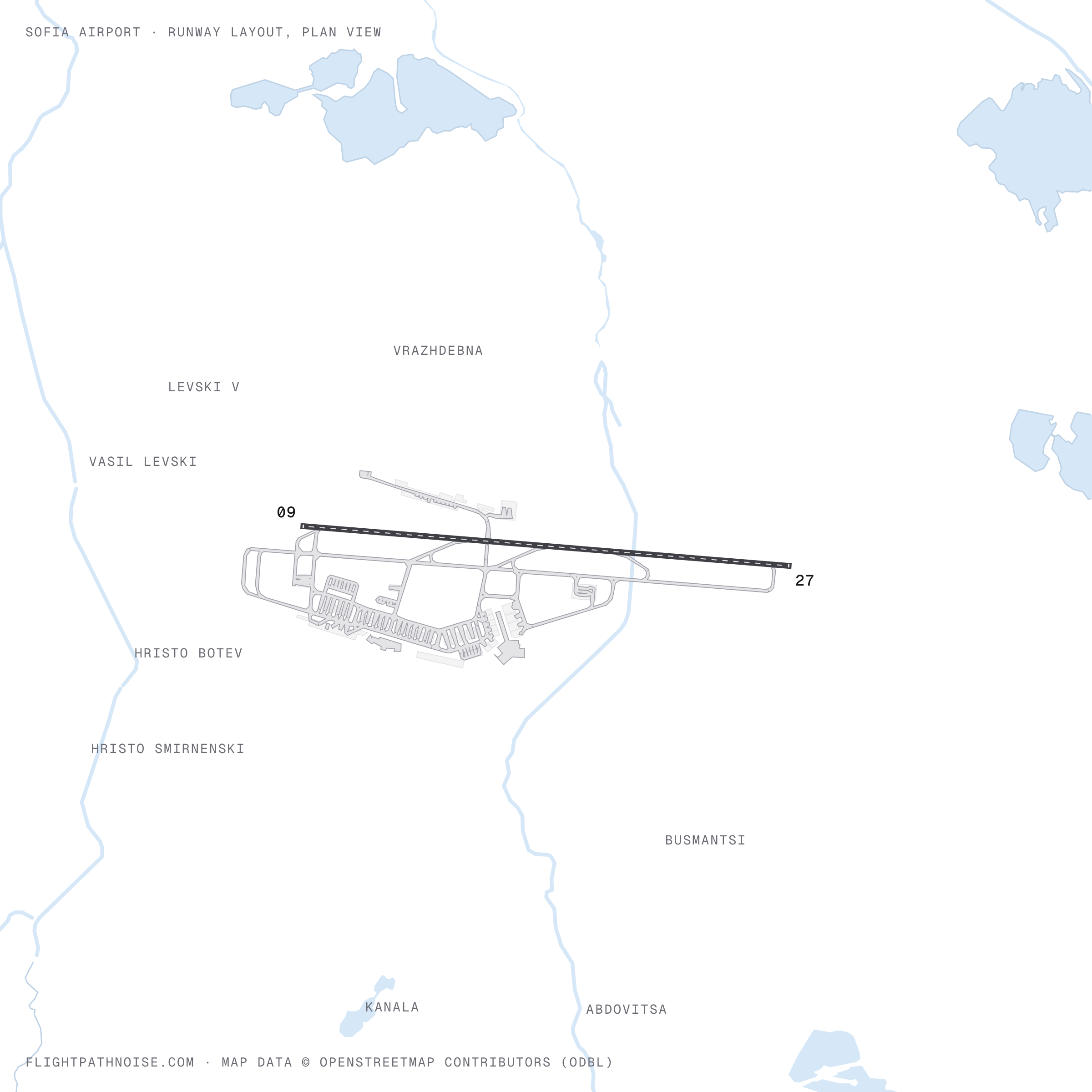
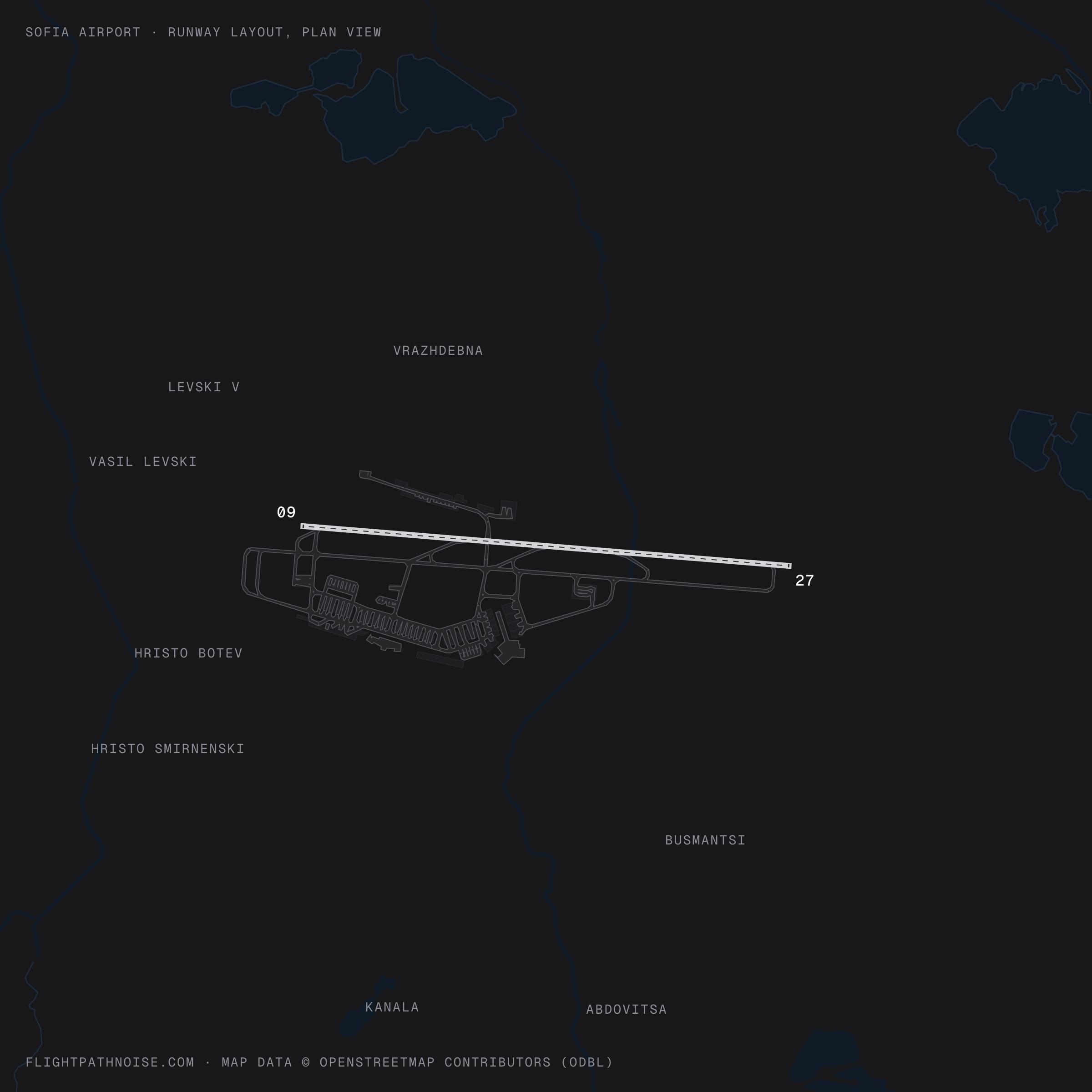
SOF has a single east-west runway (09/27) sitting 10 km east of central Sofia. Runway 09 is preferential for takeoff (heading east, away from the city) and runway 27 for landing (approaching from the east, also away from the city). The combined effect is that most of Sofia proper is genuinely well off the flight path:
If you’re moving to Sofia, the headline takeaway is that the city’s noise abatement rules already do most of the work for you. Lozenets, the Centre, Boyana, and the Vitosha mountain districts are all comfortably quiet for aircraft. Druzhba is the only popular residential area that’s notably affected; everywhere else in Sofia is easier on aircraft noise than equivalent neighborhoods at airports without the overflight prohibition.
| Area | Noise | Why |
|---|---|---|
| Druzhba | ✈︎✈︎✈︎ | Directly adjacent to the airport; loudest residential district |
| Iskar | ✈︎✈︎✈︎ | Between airport and city centre, on the runway corridor |
| Mladost | ✈︎✈︎ | South-west of airport; some lateral aircraft noise |
| Slatina | ✈︎✈︎ | West, on corridor edge |
| Iztok | ✈︎ | Eastern central Sofia, off the corridor |
| Lozenets | ✈︎ | South-central Sofia; protected by overflight ban |
| Centre / Vitosha | ✈︎ | Central Sofia; aircraft routed away by regulation |
| Boyana | ✈︎ | South-west foothills; quietest mountain-side residential |
Flight patterns and runway use
SOF uses a single east-west runway (09/27). Operating procedure prefers runway 09 for takeoffs (climbing east, away from Sofia) and runway 27 for landings (approaching from the east, also away from the city). When wind shifts, the runway flips but the noise abatement procedures still route aircraft around central Sofia rather than over it.
The airport sits at 531 m elevation — Bulgaria’s high plateau — which makes takeoffs marginally louder per event because engines must produce more thrust in thinner air. The total noise footprint remains small thanks to routing rules.
The route-density layer above shows the cumulative pattern: a bright corridor extending east from the runway, fading rapidly within a few kilometres west. Central Sofia sits visibly outside the bright zone.
When is it quietest?
SOF runs 24/7 but is much lower-volume than Western European hubs. Test and training flights are prohibited between 23:00 and 06:00. Commercial scheduled traffic clusters between 6 AM and midnight, with the quietest stretch around 1–4 AM. Even at peak hours, most of Sofia hears only distant lateral aircraft noise rather than overhead traffic — the routing rules keep the corridor narrow.
For your specific address, drop a pin on the map above to see the hourly profile. Most central Sofia addresses will show a near-flat profile — a handful of audible flyovers per day, mostly during peak hours.
How to check noise at your specific address
The map above is the answer to “is this spot loud?” Three steps:
- Search your address or postcode in the bar at the bottom of the map.
- Drop a pin — click the location marker that appears.
- Read the noise report that opens in a panel below the map: average daily noise (Leq), peak observed dB, flights per day passing within 2 km, and an hourly breakdown.
The Noise Heatmap layer (orange/red = louder) and the Route Density layer (purple/magenta = busier flight corridors) make the eastward corridor obvious — the bright band sits firmly to the east of the city centre. Most addresses west of Iskar Boulevard land in the green/quiet zone.
Frequently asked questions
- Which Sofia neighborhoods are quietest for aircraft noise?
- Most of central and western Sofia is quiet — Bulgarian noise rules prohibit overflying the city centre, so Lozenets, the Centre / Vitosha Boulevard area, Boyana and the southern Vitosha foothills are all comfortably off the flight path. The audible aircraft activity sits east of the city core.
- Is Lozenets a good area for aircraft noise?
- Yes — Lozenets sits 9 km west of the airport and benefits from the central-Sofia overflight ban. Aircraft are at altitude or routed away from overhead. The bigger noise concerns in Lozenets are city traffic and weekend nightlife rather than aircraft.
- Does Sofia airport prohibit overflying the city?
- Yes — this is unusual and worth noting. Strict noise abatement procedures since the mid-1970s prohibit overflying central Sofia by departing traffic, and arriving aircraft are routed to approach the field from the east, clear of the city. The result is a much smaller noise footprint than airports of comparable size.
- Is Druzhba loud from planes?
- Yes — Druzhba is the directly-adjacent district and catches the bulk of takeoff and landing noise. If you're looking at apartments in Druzhba, drop a pin on the map above to see the level for that exact spot. Other affected areas (Iskar, eastern Mladost, Slatina) are all worth checking similarly.
- How does Sofia's aircraft noise compare to other European capitals?
- Sofia is unusually well-protected for a capital city — the routing rules prohibiting overflight of central Sofia mean residential areas in the city core get far less aircraft noise than equivalent districts in Lisbon, Athens, or Vienna. Plus the airport is at high elevation (531 m), which makes takeoffs slightly louder per event but doesn't change the overall pattern.
- Should I avoid Mladost or Druzhba if I work from home?
- Druzhba — yes, if aircraft noise is a primary concern. Mladost is more nuanced — the eastern half catches lateral aircraft noise but most of Mladost is acceptable. The much bigger noise question for Mladost addresses is the proximity to Tsarigradsko Shose (the main airport-bound boulevard) and its traffic.
- Does aircraft noise affect Sofia property values?
- Yes, in Druzhba and the immediate corridor, though less than at airports without the central-overflight ban. Properties in Druzhba and parts of Iskar trade at a measurable discount versus comparable properties in Lozenets or central Sofia.
Sources and further reading
- Sofia Airport overview — Wikipedia
- Vasil Levski Sofia Airport (full name + history) — Wikipedia
- Sofia neighborhoods for digital nomads — Flatio
- Living in Sofia as an expat (neighborhoods) — Innovires
Data updated 2026-10-26 — live ADS-B monitoring, rolling 30-day statistics (methodology). Article text revised 2026-04-29.
Other airports we track
All 173 airports →No airports in this region yet.