
Aircraft noise around Billy Bishop in November 2026
Loudest neighborhoods near Billy Bishop: Bathurst Quay, Niagara (Toronto), Harbourfront. Quietest: Annex, Yorkville, Leslieville, Cabbagetown. Busiest around 3 PM local time averaging 191 flights/day. Source: Flight Path Noise monitoring data, 30 days to 2026-11-23.

Does Billy Bishop Airport have a curfew?
Yes — a strict curfew; no flights outside roughly 6:45 AM–11 PM (shorter on weekends).
Billy Bishop operates between 6:45 AM and 11 PM weekdays (slightly different on weekends), with no operations outside these hours. The curfew is part of the tripartite agreement and is strictly enforced. Combined with the turboprop-only restriction, this gives lakefront residents a guaranteed quiet overnight window.
Billy Bishop Toronto City Airport (YTZ/CYTZ) is one of the most unusual major-city airports in North America — a single short runway on the Toronto Islands, just 3 km from downtown. Only turboprops are permitted (jets are banned by tripartite agreement), and operations are confined to 6:45 AM – 11 PM. The combination of quieter aircraft + strict curfew makes Billy Bishop more livable for nearby residents than a typical major city airport would be, but the corridor still passes directly over Harbourfront, Bathurst Quay, and the Financial District at very low altitude.
Which neighborhoods are quietest — and which aren’t
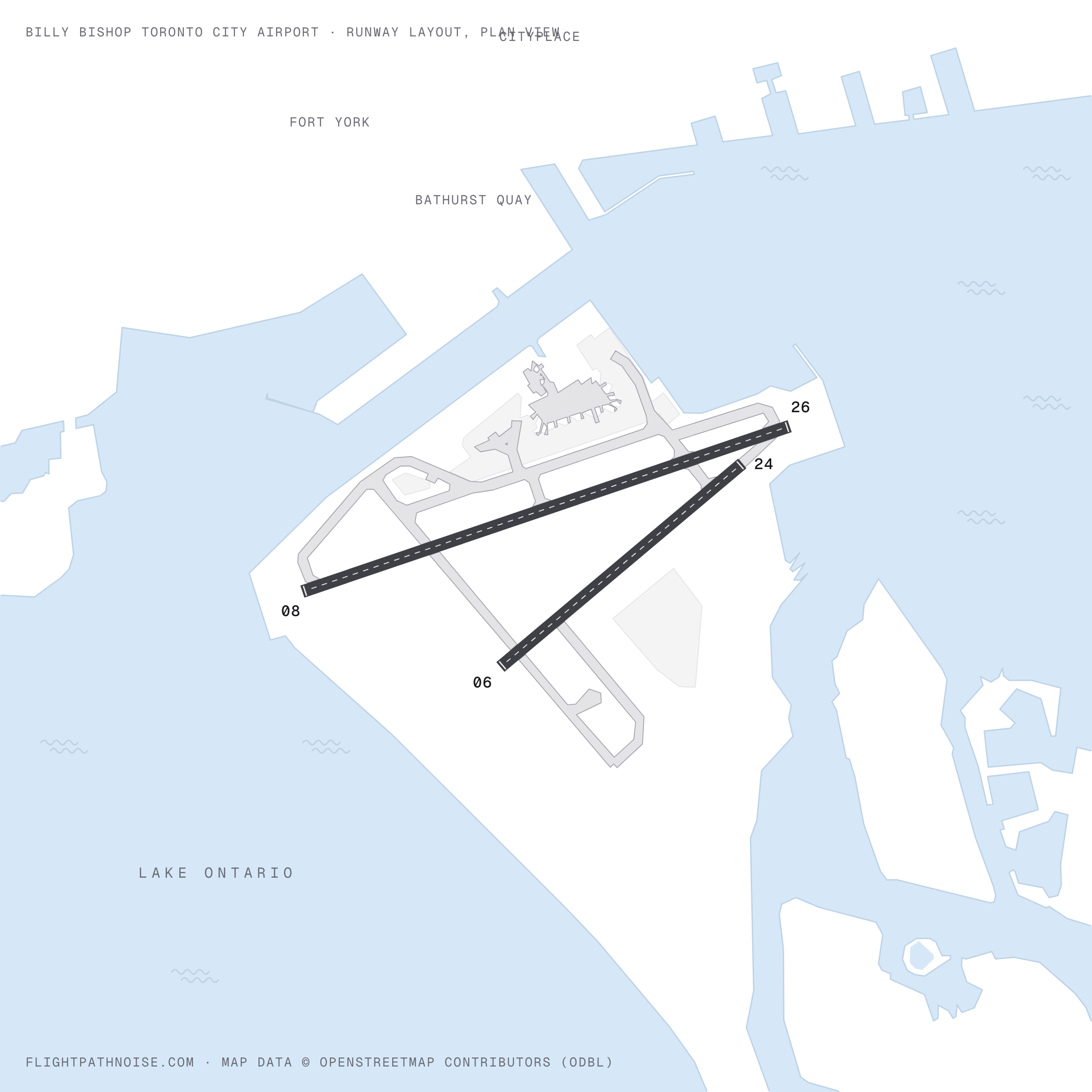
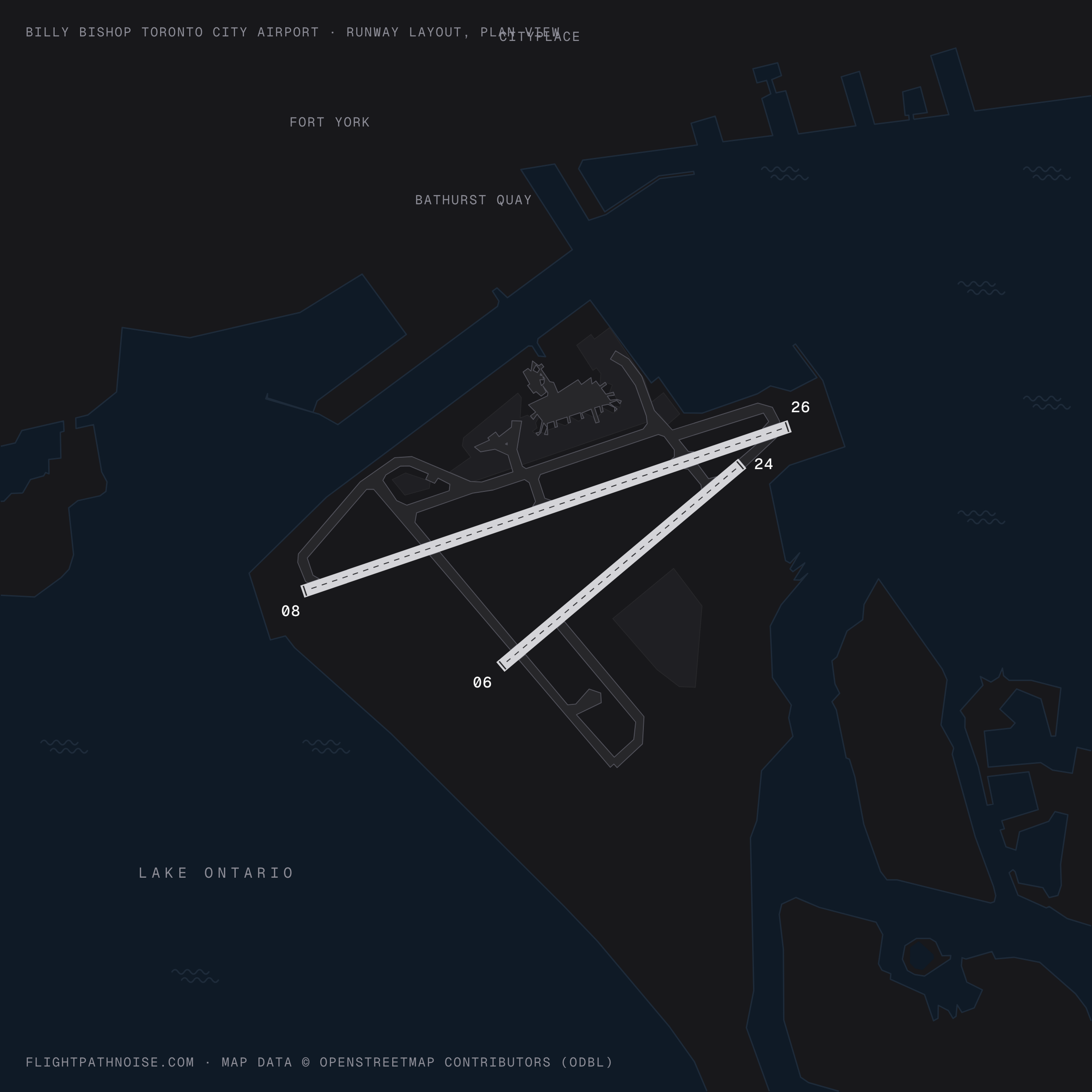
YTZ has just one runway: 08/26, oriented east-west along the Toronto Islands’ western edge. There’s no alternate — every arrival and departure uses this corridor. The runway is short (1,216 m), which restricts the aircraft to turboprops and the smallest regional jets. Approaches and departures both pass over the lakefront condo district.
The practical move at Toronto is anything north of King Street — Yorkville, the Annex, Cabbagetown, Trinity Bellwoods, and the entire east-end (Leslieville, Riverside, the Beaches) all sit clear of the Billy Bishop corridor. The lakefront condo district is where the impact is concentrated. Most Toronto neighborhoods are unaffected by Billy Bishop entirely.
| Area | Noise | Why |
|---|---|---|
| Bathurst Quay | ✈︎✈︎✈︎ | Across western channel from runway |
| Niagara | ✈︎✈︎✈︎ | Inner-west condos under corridor |
| Harbourfront | ✈︎✈︎✈︎ | Direct overflight at low altitude |
| Liberty Village | ✈︎✈︎ | Lateral noise + ground |
| Financial District | ✈︎✈︎ | Downtown towers under approach |
| King West | ✈︎✈︎ | Trendy district lateral noise |
| Distillery District | ✈︎✈︎ | Departure climb-out |
| St. Lawrence | ✈︎✈︎ | Lateral overflight |
| Toronto Islands | ✈︎✈︎ | Small island community; varies |
| Annex | ✈︎ | Off corridor |
| Yorkville | ✈︎ | Upscale, well clear |
| Cabbagetown | ✈︎ | Historic, off corridor |
| Leslieville | ✈︎ | East-end, minimal impact |
Flight patterns and runway use
YTZ operates on runway 08/26 in both directions based on wind. With prevailing westerly winds (most common), arrivals use runway 26 from the east, passing over the Distillery District / St. Lawrence / Harbourfront / Bathurst Quay before touching down. Departures from runway 08 climb east over the same corridor in reverse.
With easterly winds, the operation reverses: arrivals on 08 from the west (climbing first over Liberty Village / Bathurst Quay), departures on 26 to the east. The Toronto Islands catch some lateral noise in both configurations.
The route-density layer on the map above shows the tight east-west corridor pattern: bright over Harbourfront and the lakefront, fading rapidly as you move north of King Street. The small operational footprint reflects the single-runway constraint and the strict 6:45 AM – 11 PM operating hours.
When is it quietest?
YTZ’s strict curfew makes overnight noise a non-issue:
- Curfew (11 PM – 6:45 AM weekdays, 7 AM – 11 PM weekends): no operations. Lakefront residents enjoy silence.
- 6:45 AM – 9 AM: morning departure bank. Porter and other carriers launching short-haul flights to Montreal, Boston, NYC, Ottawa.
- Midday (10 AM – 3 PM): moderate, sustained turboprop operations.
- Evening arrival bank (5 PM – 8 PM): peak. Return business flights from the same destinations.
- Late evening (9 PM – 11 PM): tapers as flights race to land before the 11 PM curfew.
For your specific address, drop a pin on the map above to see the hourly profile.
A note on the tripartite agreement
YTZ’s operations are governed by a 1983 tripartite agreement between Transport Canada (federal), the City of Toronto, and the Toronto Port Authority. The agreement bans jet aircraft, fixes operating hours, caps annual movements, and constrains runway expansion. A 2013-2015 attempt to extend the runway and allow jets (driven by Porter’s request to add international destinations) was ultimately rejected by Toronto City Council after extensive community opposition. The current agreement runs through 2033 and keeps Billy Bishop as a quieter regional airport than it would otherwise be.
How to check noise at your specific address
The map above is the answer to “is this spot loud?” Three steps:
- Search your address or postcode in the bar at the bottom of the map.
- Drop a pin — click the location marker that appears.
- Read the noise report that opens in a panel below the map: average daily noise (Leq), peak observed dB, flights per day loud enough to hear there, and an hourly breakdown.
For lakefront condos, the difference between a building at Bathurst Quay vs. one at Yonge & Queens Quay can be 5+ dB — worth checking specifically rather than relying on the neighborhood name.
Frequently asked questions
- Why is there aircraft noise around Billy Bishop Airport?
- Billy Bishop Toronto City Airport (YTZ/CYTZ) is one of the most unusual major-city airports in North America — located on the Toronto Islands just 3 km from downtown. The single short runway (08/26) lies along the lakefront, with approaches and departures passing directly over Harbourfront, Bathurst Quay, and the central waterfront condo district. While Billy Bishop only operates turboprops (no jets), the high frequency of flights to short-haul Canadian and US destinations means consistent overflight during operating hours. The proximity to dense downtown condos makes it controversial despite the relatively quiet aircraft.
- Does Billy Bishop allow jets?
- No — Billy Bishop is restricted to turboprop aircraft only. The short runway (1,216 m) and the tripartite agreement between the federal government, the city, and the port authority prohibit jet operations. Porter Airlines (the dominant carrier) operates Bombardier Q400 turboprops, and other carriers use ATR 42 / 72 and similar small aircraft. Periodic proposals to extend the runway and allow jets have been rejected after community opposition. This means Billy Bishop is significantly quieter per movement than a typical jet airport — the noise impact is more about frequency than peak loudness.
- Which downtown Toronto neighborhoods are quietest from Billy Bishop?
- Anything north of King Street is mostly clear — Yorkville, the Annex, Cabbagetown, Leslieville, Riverside, and most of east-end Toronto sit clear of the airport corridor. The Distillery District catches some departure climb-out noise but at altitude. The lakefront condo district (Harbourfront, Bathurst Quay, Niagara, Liberty Village waterfront) and the inner Financial District are the consistently affected areas.
- Is Harbourfront loud from planes?
- Yes — Harbourfront sits directly under the Billy Bishop approach and departure corridor at the western and eastern ends of the runway. Turboprops pass overhead at low altitude (200-500 ft) on approach. The frequency is high during operating hours but the aircraft are quieter than jets would be — and the airport curfew means the overnight is silent. Bathurst Quay residents typically describe the noise as 'constant but not deafening'. Drop a pin on the map above to see your specific building.
- What about Toronto Pearson (YYZ)?
- Pearson (YYZ/CYYZ) is Toronto's main international airport, 24 km west of downtown. It handles all jet traffic and most international flights. Its noise corridor affects Mississauga, Etobicoke, and parts of west Toronto — not downtown. For most downtown Toronto residents, Pearson is not a noise factor; Billy Bishop is. The two airports have very different impact profiles: Pearson is loud per movement (heavy jets) but its corridor doesn't reach downtown; Billy Bishop is quieter per movement (turboprops only) but flies directly over downtown.
- How do I report aircraft noise at Billy Bishop?
- Submit complaints to the Toronto Port Authority / PortsToronto noise office via portstoronto.com or call 416-203-6942. Each complaint feeds into the airport's quarterly community meetings. The TPA also publishes a flight tracker showing real-time aircraft activity at the airport.
- Does coverage on this map include all aircraft?
- Yes — Porter's Q400 fleet and most other regional turboprops at Billy Bishop carry ADS-B Out transponders, so the heatmap reflects actual traffic. Some smaller general-aviation aircraft (Cessnas, Pipers) and helicopters operating from Billy Bishop or nearby may not be ADS-B equipped, but those represent a small fraction of total movements.
Sources and further reading
- Billy Bishop Toronto City Airport — Wikipedia — Wikipedia
- PortsToronto — Billy Bishop noise and environment — PortsToronto / Toronto Port Authority
- NavCanada — Toronto airspace — NavCanada
- CommunityAIR — Billy Bishop community advocacy — CommunityAIR
Data updated 2026-11-23 — live ADS-B monitoring, rolling 30-day statistics (methodology). Article text revised 2026-05-23.
Other airports we track
All 174 airports →No airports in this region yet.