
Aircraft noise around Berlin in November 2026
Loudest neighborhoods near Berlin: Blankenfelde-Mahlow, Bohnsdorf (Berlin-Treptow-Köpenick), Diepensee / Selchow / Waßmannsdorf, Müggelheim (Berlin-Köpenick), Schönefeld. Quietest: Ludwigsfelde, Rangsdorf, Köpenick (central, Berlin). Busiest around 1 PM local time averaging 534 flights/day. Source: Flight Path Noise monitoring data, 30 days to 2026-11-23.

Does Berlin Airport have a curfew?
Yes — a mandatory night curfew, 11:30 PM – 5:30 AM.
A core night ban (Kernnacht) runs 00:00–05:00 with no scheduled take-offs or landings — only justified exceptions such as emergencies, mail, and government or police flights. The operating-licence ban is wider, 23:30–05:30, when in principle no aircraft may take off or land. The fringe periods (22:00–23:30 and 05:30–06:00) are restricted and capped — delayed evening flights scheduled before 23:30 may still land toward midnight, and particularly loud aircraft are barred 22:00–06:00. The ban is set in the operating licence, was upheld by Germany’s Federal Administrative Court in 2011, and remains politically contested.
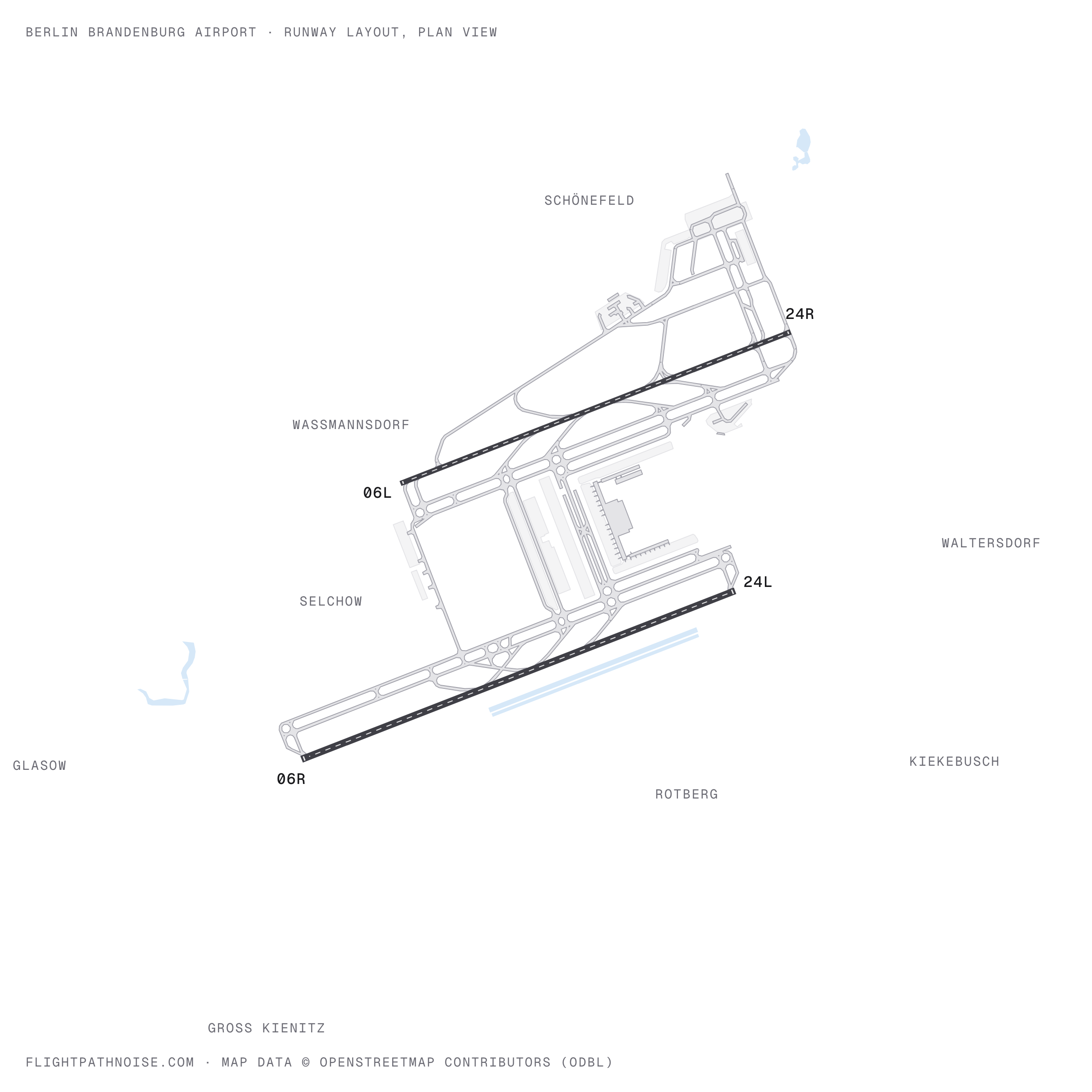
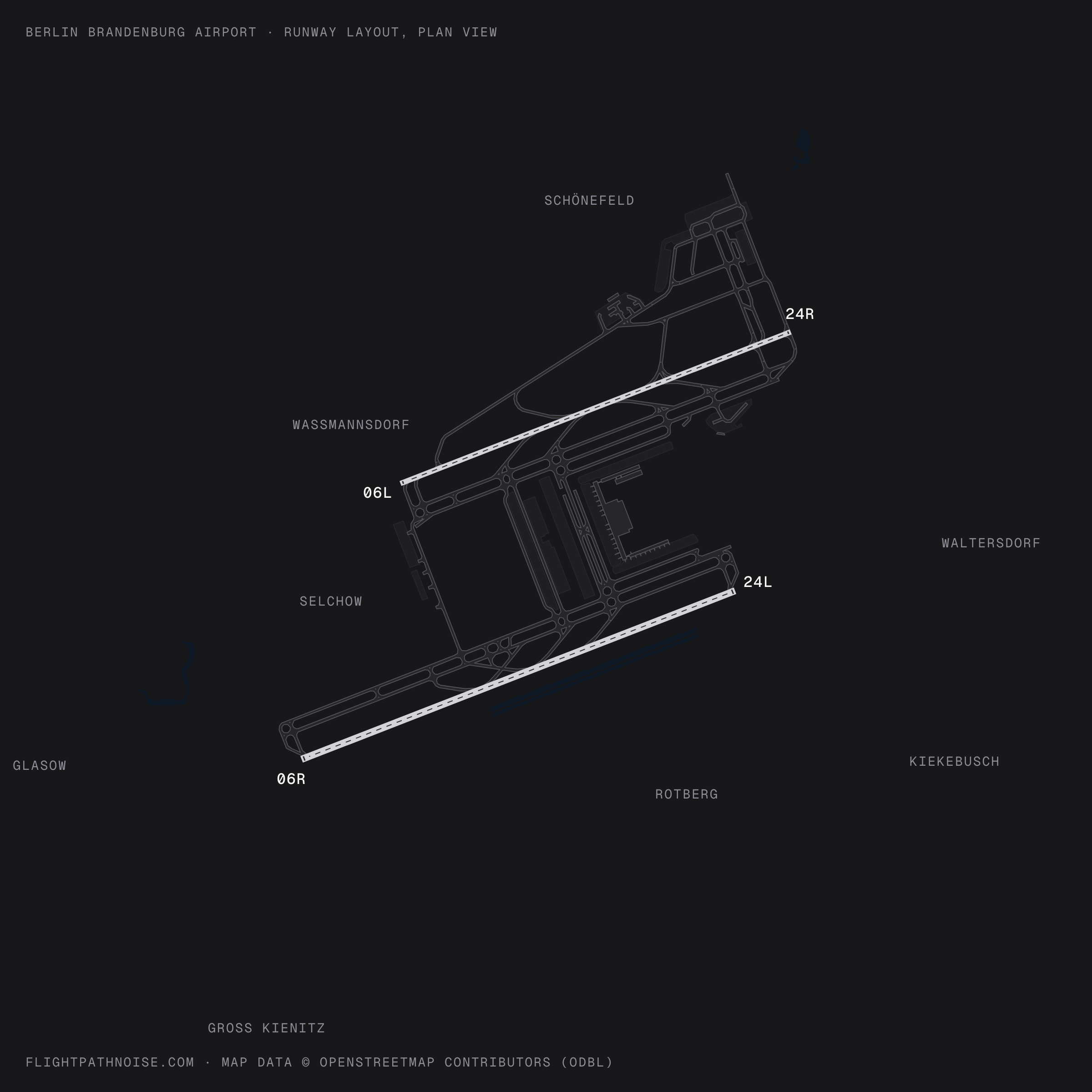
Berlin Brandenburg Airport (BER/EDDB) is unusual among major European airports: it is brand new — opened in October 2020 after a notorious decade of delays — yet it immediately concentrated all of the capital’s air traffic onto one site about 18 km south-east of central Berlin in Schönefeld. There is no longer any Tegel or Tempelhof to share the load. Its two long parallel runways run almost exactly east-west, spaced 1.9 km apart so they can be worked independently, which puts a wide but well-defined noise corridor over the lake-and-forest belt of south-east Berlin and the northern Brandenburg suburbs. A firm core-night ban (00:00–05:00) plus tight shoulder-hour limits make the night curfew one of the airport’s defining — and most fought-over — features.
Which neighborhoods are quietest — and which aren’t
BER runs two parallel runways that are almost exactly east-west. The north runway is 06L/24R (3,600 m, the refurbished original Schönefeld runway) and the south runway is 06R/24L (4,000 m, the longer, purpose-built one that opened with BER). Both were re-designated from the old 07/25 numbers on 3 October 2024 because of magnetic drift — the runways themselves did not move.
Because the runways point east-west, the heaviest noise sits in two bands: west of the field (the prevailing configuration) and east of the field (when easterly winds flip operations). Areas off that axis are markedly quieter.
If aircraft noise is a primary concern, the practical move around BER is to get off the east-west axis — areas to the south-west (Rangsdorf) or well north of the corridor (central Köpenick) catch far less direct overflight, and far-western towns like Ludwigsfelde see only higher-altitude departures. The close-in places — Blankenfelde-Mahlow, Bohnsdorf, Schönefeld and the Diepensee/Selchow/Waßmannsdorf cluster — are the most consistently affected. If you’re looking at a specific address, drop a pin on the map above.
| Area | Noise | Why |
|---|---|---|
| Blankenfelde-Mahlow | ✈︎✈︎✈︎ | Off the west runway ends, under the main west-operation corridor |
| Bohnsdorf | ✈︎✈︎✈︎ | Closest Berlin neighbourhood; hard under low tracks just north of the runways |
| Diepensee / Selchow / Waßmannsdorf | ✈︎✈︎✈︎ | Immediately west of the runways under west-operation paths |
| Müggelheim | ✈︎✈︎✈︎ | Under the contested east-operation routes; own measurement station No. 19 |
| Schönefeld | ✈︎✈︎✈︎ | The airport village itself, flanking the runways |
| Eichwalde | ✈︎✈︎ | East of the field; exposed on 06 arrivals and east-operation departures |
| Zeuthen | ✈︎✈︎ | On the Dahme lakes within the east-operation spread |
| Wildau | ✈︎✈︎ | South-east; affected on easterly operations and turning departures |
| Königs Wusterhausen | ✈︎✈︎ | South-east, under wider departure/arrival fans |
| Schmöckwitz / Grünau | ✈︎✈︎ | Overflown on east-operation tracks toward the Müggelsee |
| Erkner | ✈︎✈︎ | Named in the disputed easterly routes; off-centreline but a recurring complaint area |
| Ludwigsfelde | ✈︎ | Further west along the fan; higher altitude |
| Rangsdorf | ✈︎ | South-west, off the main east-west corridors |
| Köpenick (central) | ✈︎ | Mostly north of the corridor; higher-altitude overflight only |
Flight patterns and runway use
The prevailing wind in the Berlin region is westerly, so the airport most often runs in west operation (Betriebsrichtung West): aircraft land from the east toward the 24 ends and depart westward over Brandenburg. Departures fan out over Blankenfelde-Mahlow, Diepensee and Selchow, with arrivals descending over the opposite, eastern side. The airport describes its layout as “two runways and eleven different flight routes,” and the two runways — 1.9 km apart — are operated independently.
When easterly winds set in, operations flip to east operation (Betriebsrichtung Ost), toward the 06 ends. This is the configuration that produces the most-complained-about tracks: eastbound departures from the north runway curve out over the Müggelsee and toward Erkner and Müggelheim, the routes that have been the single most politically charged element of BER’s noise story since before the airport even opened. The airport’s measurement station No. 19 in Müggelheim monitors this corridor directly.
Active noise-abatement measures include noise-dependent landing and take-off charges (in force since 1 September 2022) that reward quieter aircraft, and a 34-station permanent noise-monitoring network across the surrounding communities. There is no confirmed over-water or mandatory steep-approach procedure unique to BER — the route geometry is what drives the local pattern.
The route-density layer on the map above shows this east-west signature clearly: bright corridors running roughly east and west of the field from both runway ends, broadening into the departure fans over Brandenburg to the west and the south-east Berlin lakes to the east. Far-field density drops off as aircraft climb toward cruise.
When is it quietest?
BER’s night rules are strict and layered, and they shape the daily noise profile more than at most German airports:
- Core night, 00:00–05:00 (Kernnacht): no scheduled take-offs or landings — only justified exceptions such as emergencies, mail, and government or police flights. This is the guaranteed quiet window.
- Operating-licence ban, 23:30–05:30: wider still — in principle no aircraft may take off or land at all.
- Fringe periods, 22:00–23:30 and 05:30–06:00: restricted and capped. Delayed evening flights scheduled before 23:30 may still land toward midnight, and early flights scheduled after 05:30 may begin landing from 05:00. Particularly loud aircraft are barred across the whole 22:00–06:00 window.
- Daytime (06:00–22:00): the bulk of movements, with a heavy morning departure bank from about 06:00 and an evening arrival bank in the late afternoon and early evening.
Two things change the picture on any given day. First, wind direction: a shift from west to east operation suddenly moves the noise from the Brandenburg side to the south-east Berlin lakes side — Müggelheim and Erkner residents feel this most. Second, the night ban is politically contested — Berlin’s city government has pushed to relax it while Brandenburg has rejected relaxation — so the exact rules are worth checking against the airport’s current published regulation. For your specific address, drop a pin on the map above to see the hourly profile.
How to check noise at your specific address
The map above answers the question “is this spot loud?” Three steps:
- Search your address or postcode in the bar at the bottom of the map.
- Drop a pin — click the location marker that appears.
- Read the noise report that opens in a panel below the map: average daily noise (Leq), peak observed dB, flights per day loud enough to hear there, and an hourly breakdown.
The Noise Heatmap layer (orange/red = louder) and the Route Density layer (purple/magenta = busier corridors) make BER’s east-west pattern obvious — and they show clearly whether your address sits under the west-operation fan, the disputed east-operation routes toward the Müggelsee, or comfortably off the axis.
To file a formal complaint or flight-route enquiry, use Berlin Airport’s FLIBS noise enquiry form at msform.berlin-airport.de. Statutory matters are handled by the Flight Noise Protection Officer (Fluglärmschutzbeauftragter) for BER, with the Fluglärmkommission Berlin-Brandenburg advising on flight-route and noise policy.
Frequently asked questions
- Why is there aircraft noise around Berlin Brandenburg Airport?
- Berlin Brandenburg (BER/EDDB) opened in October 2020 and immediately became Berlin's only commercial airport after Tegel and Tempelhof closed — so all of the capital's air traffic now concentrates on one site about 18 km south-east of the centre in Schönefeld. Its two long parallel runways run almost exactly east-west, putting a wide but well-defined noise corridor over south-east Berlin and the northern Brandenburg suburbs. Blankenfelde-Mahlow, Bohnsdorf, Schönefeld and the Diepensee/Selchow area sit closest to the runway ends; Müggelheim and Erkner sit under the contested easterly departure routes.
- Is Bohnsdorf loud from planes?
- Yes — Bohnsdorf is the closest Berlin neighbourhood to BER, sitting just north of the runways and hard under the low approach and departure tracks. It is one of the most consistently affected residential areas in the city for aircraft noise. Drop a pin on the map above to see the exposure for your specific street.
- What are the disputed flight routes over the Müggelsee and Erkner?
- When easterly winds set in, BER flips to east operation (Betriebsrichtung Ost): aircraft depart toward the 06 direction, and eastbound departures off the north runway curve out over the Müggelsee toward Müggelheim and Erkner. These easterly departure tracks have been the single most politically charged part of BER's noise story since before the airport opened. The airport monitors Müggelheim with its own measurement station No. 19. West operation (the prevailing configuration) sends departures the other way, over Blankenfelde-Mahlow and Diepensee.
- Which Berlin and Brandenburg areas are quietest for aircraft noise?
- Because BER's runways run east-west, the heaviest exposure is a band to the east and west of the field. Areas off that axis — to the south-west (Rangsdorf) or well north of the corridor (central Köpenick) — see far less direct overflight, and far-western towns like Ludwigsfelde catch only higher-altitude departures. The most consistently affected places are the close-in ones: Blankenfelde-Mahlow, Bohnsdorf, Schönefeld and Diepensee/Selchow/Waßmannsdorf. The map above lets you check any address.
- Why did BER's runways change from 07/25 to 06/24?
- On 3 October 2024 both parallel runways were re-designated from the 07/25 family to the 06/24 family. Runway designations are based on magnetic compass heading, and the Earth's magnetic field had drifted enough that the old numbers no longer matched. The physical runways did not move — the orientation and the runway ends are unchanged, only the painted numbers and the labels changed. The north runway is now 06L/24R and the south runway 06R/24L.
- How do I report aircraft noise at BER?
- Berlin Airport (FBB) runs the Flight Noise Information System (FLIBS), an online noise and flight-route enquiry form at msform.berlin-airport.de. Statutory complaints are handled by the Flight Noise Protection Officer for BER (Fluglärmschutzbeauftragter), and the Fluglärmkommission Berlin-Brandenburg, hosted by the joint upper aviation authority (Gemeinsame Obere Luftfahrtbehörde, LuBB), advises on flight-route and noise matters. The FLIBS form is the most direct route for individual enquiries.
- Does coverage on this map include all aircraft at BER?
- Commercial jets at BER carry ADS-B transponders, so the heatmap and route-density layers reflect actual scheduled traffic accurately. The main gaps are a small amount of light general-aviation and state traffic that may not be ADS-B-equipped, but those make up a tiny share of movements at what is now Berlin's sole commercial airport.
Sources and further reading
- Berlin Brandenburg Airport — Wikipedia — Wikipedia
- Nachtflugregelung am BER (Night flight regulation at BER) — Flughafen Berlin Brandenburg (BER Corporate)
- BER runways to be renamed (effective 3 October 2024) — Flughafen Berlin Brandenburg (BER Corporate)
- Ihr Kontakt zu uns / FLIBS — aircraft noise and flight-route enquiries — Flughafen Berlin Brandenburg (BER Corporate)
- Fluglärmkommission Berlin-Brandenburg — Gemeinsame Obere Luftfahrtbehörde Berlin-Brandenburg (LuBB)
- Aircraft noise measurement report Müggelheim — Flughafen Berlin Brandenburg (BER Corporate)
Data updated 2026-11-23 — live ADS-B monitoring, rolling 30-day statistics (methodology). Article text revised 2026-06-12.
Other airports we track
All 174 airports →No airports in this region yet.