
Aircraft noise around Gold Coast in November 2026
Loudest neighborhoods near Gold Coast: Bilinga, Tweed Heads, Tugun, Currumbin, Coolangatta. Quietest: Kingscliff, Miami, Mermaid Beach. Busiest around 9 AM local time averaging 171 flights/day. Source: Flight Path Noise monitoring data, 30 days to 2026-11-23.

Does Gold Coast Airport have a curfew?
Yes — a mandatory night curfew, 11 PM – 6 AM.
There is a legislated curfew from 11 PM to 6 AM (Queensland local time) under the Air Navigation (Gold Coast Airport Curfew) Regulations 2018. It does not ban all movements — it permits business jets and small propeller aircraft under 34,000 kg that meet the latest international noise standards, plus emergency services aircraft (police, aeromedical, search and rescue). In practice curfew movements average fewer than one per night.
Gold Coast Airport (OOL/YBCG) is one of the few airports anywhere whose single main runway physically crosses a state border — it runs north-west to south-east across the Queensland–New South Wales line at Bilinga, with the NSW town of Tweed Heads sitting just off the southern threshold. The defining noise issue here is the runway-14 Instrument Landing System (ILS): introduced for poor-weather landings, it concentrates arriving jets into a narrow corridor over the densely populated coastal strip from Palm Beach up toward Surfers Paradise — suburbs that historically heard little aircraft noise because planes used to track out over the ocean. In June 2025 the Aircraft Noise Ombudsman reported a large, unexplained rise in ILS usage (roughly a 50% increase across 2019–2024) and found Airservices Australia was not adequately monitoring compliance with the procedure meant to limit ILS use to genuine bad weather or emergencies. That finding has galvanised the ‘Stop Flight Path Impacts’ campaign, set against a 2024 Master Plan proposing more jet movements. A legislated 11 PM – 6 AM curfew makes this one of only a handful of Australian airports with a statutory night limit.
Which neighborhoods are quietest — and which aren’t
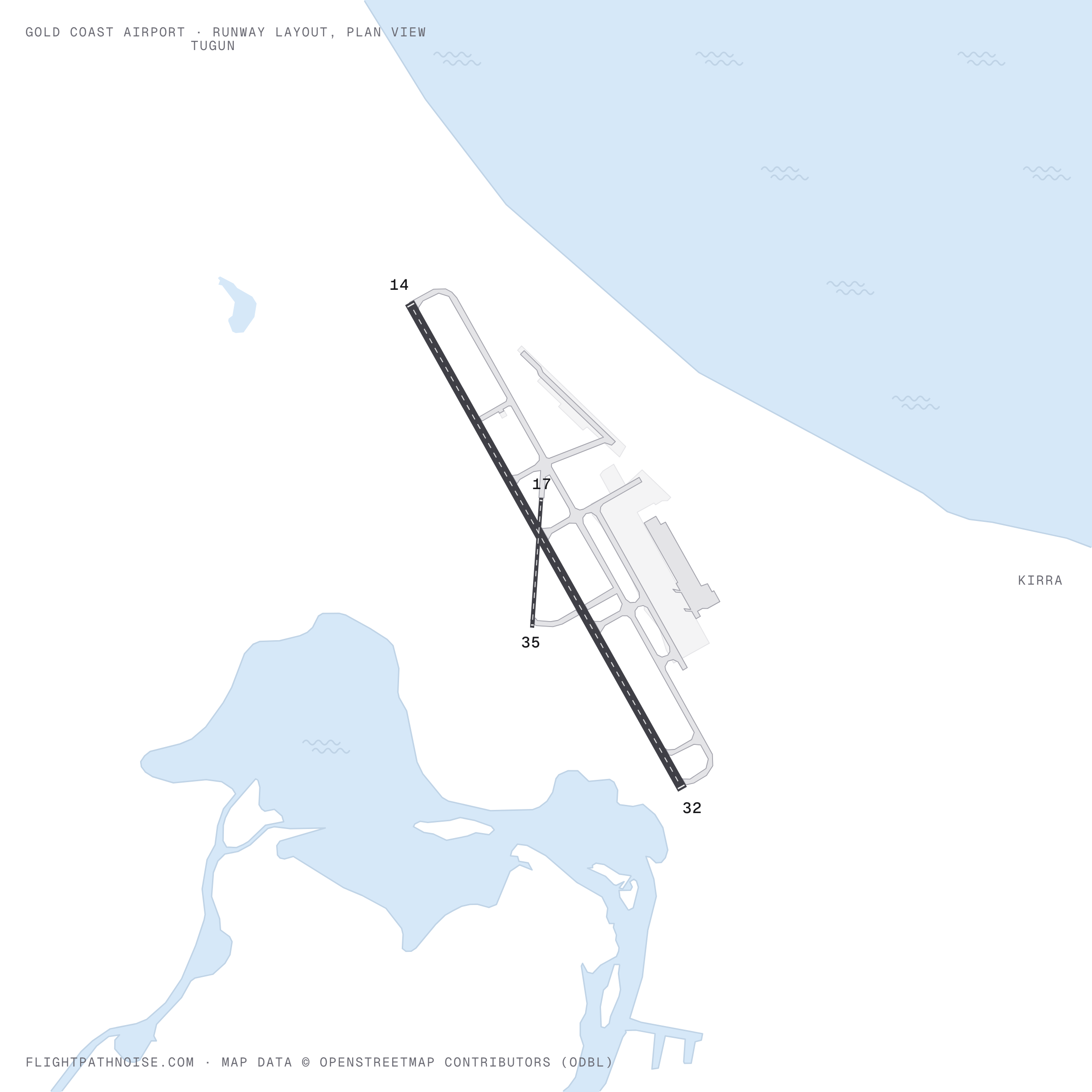
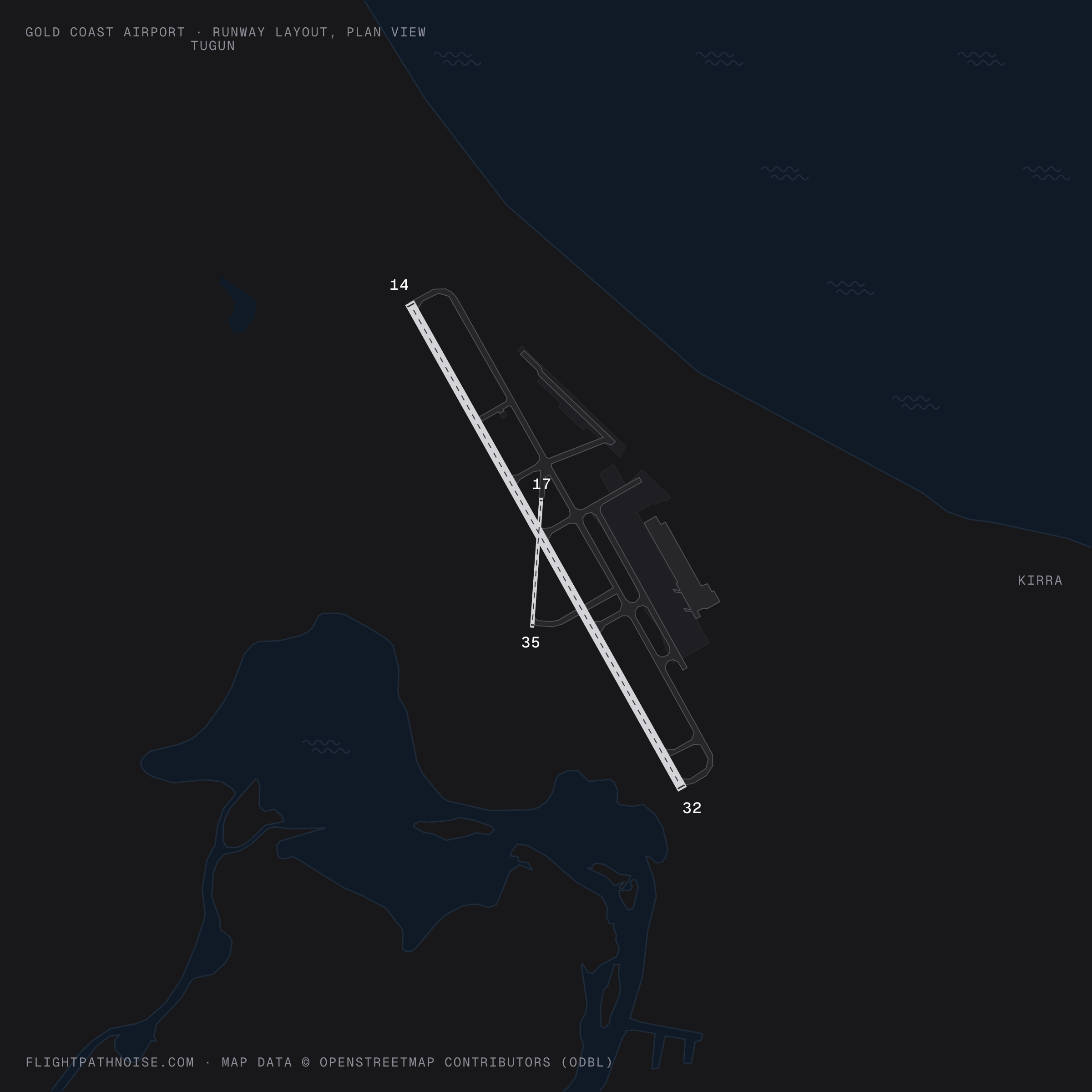
Gold Coast has one jet runway — 14/32 (2,492 m long, 45 m wide, asphalt) — oriented north-west/south-east, the strip that physically crosses the QLD/NSW border. A short secondary runway, 17/35 (582 m), is used by light general-aviation aircraft only and carries no jet or regular passenger traffic. Because there’s effectively a single jet runway, the noise footprint is a fairly tight line through the suburbs off each end, plus the newer ILS corridor running north up the coast.
If aircraft noise is a primary concern, the quietest options are well north up the coast (Mermaid Beach, Miami) or further south in NSW (Kingscliff) — these sit off the main corridor and only catch higher-altitude traffic. The suburbs ringing the runway (Bilinga, Tugun, Coolangatta, Tweed Heads) are unavoidably the most affected, and the Palm Beach-to-Surfers strip has become much louder since the runway-aligned ILS came in. If you’re looking at a home anywhere along that band, drop a pin on the map above to see your specific street.
| Area | Noise | Why |
|---|---|---|
| Bilinga | ✈︎✈︎✈︎ | Runway is at Bilinga; directly under both thresholds |
| Tugun | ✈︎✈︎✈︎ | Off the north-west end; under runway-14 finals and runway-32 departures |
| Currumbin | ✈︎✈︎✈︎ | Runway-14 approach crosses the coast near here |
| Coolangatta | ✈︎✈︎✈︎ | Beside the south-east end; landing rolls and runway-32 approaches |
| Tweed Heads | ✈︎✈︎✈︎ | Just south in NSW; runway-32 approaches and runway-14 departures |
| Palm Beach | ✈︎✈︎✈︎ | Newly concentrated runway-14 ILS corridor |
| Currumbin Waters | ✈︎✈︎ | Inland of the approach corridor; slightly off centreline |
| Bilambil Heights | ✈︎✈︎ | Elevated; catches departures and circuit turns |
| Banora Point | ✈︎✈︎ | South of Tweed Heads under departure climb-out |
| Elanora | ✈︎✈︎ | Under the broader arrival corridor |
| Burleigh Heads | ✈︎✈︎ | Outer edge of the historic approach spread |
| Kingscliff | ✈︎ | South in NSW; mostly off-corridor |
| Miami | ✈︎ | North up the coast; aircraft are higher here |
| Mermaid Beach | ✈︎ | Northern limit of the ILS-affected strip |
Flight patterns and runway use
The jet runway, 14/32, runs north-west to south-east. Under the airport’s Noise Abatement Procedures (NAPs), runway 14 is the preferred runway for both arrivals and departures — chosen so arriving aircraft (quieter close to the field) and departing aircraft (climbing and tracking away) together minimise community noise. Runway 14 arrivals approach from the north-west over the northern coastal suburbs and land to the south-east; runway 14 departures climb out to the south, over Tweed Heads and Banora Point. Runway 32 is the opposite flow: arrivals come in from the south-east over the ocean and Tweed Heads.
A core NAP is that inbound aircraft should fly over water for as long as possible before turning onto final. Historically, runway-14 arrivals flew a curved over-ocean approach that crossed the coast around Currumbin, roughly 4 km from the airport, spreading traffic between Burleigh Heads and Currumbin. The runway-aligned ILS — replacing a path previously offset about 12 degrees — concentrates arrivals into a single narrow corridor that crosses the coast nearer Palm Beach and runs over the suburbs from Palm Beach toward Surfers Paradise to the north. That shift is the heart of the dispute: places like Currumbin, Tugun and Bilinga were already overflown, so the ILS adds little there, but the Palm Beach strip went from quiet to a regular jet corridor. The ILS was meant to be reserved for poor weather or emergencies, and the Ombudsman’s 2025 review found its use had risen far beyond what weather would explain.
There is also a voluntary ‘Fly Neighbourly’ program, and circuit training is prohibited between 10 PM and 6 AM (and otherwise split evenly between left and right circuits). The route-density layer on the map above shows the cumulative pattern: a strong line through Tugun and Coolangatta off each runway end, plus the brighter, narrower northern arm tracing the ILS corridor up the coast.
When is it quietest?
The legislated curfew gives the day a clear shape:
- Curfew (11 PM – 6 AM): near-silent. Only quiet, lighter aircraft under 34,000 kg meeting the latest noise standards, and emergency flights, may operate — fewer than one movement a night on average.
- 6 AM – 9 AM: morning departure bank as the curfew lifts; back-to-back domestic jets to Sydney, Melbourne and beyond.
- Midday (10 AM – 3 PM): moderate and sustained.
- Evening (4 PM – 9 PM): the busiest arrival period, with domestic returns and the day’s later inbound traffic stacking up.
- 9 PM – 11 PM: tapers as flights land before the curfew.
Two local quirks matter. First, the runway direction changes who’s affected hour to hour: a switch from runway 14 to runway 32 flips arrivals from over the northern suburbs to over the ocean and Tweed Heads. Second, because the airport runs on Queensland time and QLD doesn’t observe daylight saving, during the DST months an 11 PM curfew start is effectively midnight for NSW residents across the border in Tweed Heads and Banora Point — so the “quiet window” starts an hour later than the clock suggests for them.
For your specific address, drop a pin on the map above to see the hourly profile and how it changes with runway direction.
How to check noise at your specific address
The map above answers “is this spot loud?” Three steps:
- Search your address or postcode in the bar at the bottom of the map.
- Drop a pin — click the location marker that appears.
- Read the noise report in the panel below the map: average daily noise (Leq), peak observed dB, flights per day loud enough to hear there, and an hourly breakdown.
The Noise Heatmap layer (orange/red = louder) and the Route Density layer (purple/magenta = busier corridors) make the single-runway pattern obvious — a strong line through Tugun and Coolangatta, with the newer runway-14 ILS arm running north over Palm Beach. If you’re weighing up a move along the coast or assessing the impact of the ILS change near Palm Beach, Currumbin or Tweed Heads, the pin-drop report is the quickest way to see what your exact street actually gets, in each runway direction.
Frequently asked questions
- Is Tugun loud from aircraft noise?
- Yes — Tugun sits directly off the north-west end of runway 14/32 and is one of the most consistently overflown suburbs. It's squarely under the runway-14 final approach and runway-32 departures, so aircraft pass low overhead in both runway directions. Drop a pin on the map above to see the exact flights-per-day and noise level for your street.
- Why are planes suddenly flying over Palm Beach on the Gold Coast?
- Because of the runway-14 Instrument Landing System (ILS). It replaced an approach that was offset about 12 degrees and previously had arrivals tracking east over the ocean, and it concentrates landing jets into a single narrow corridor crossing the coast near Palm Beach and running north toward Surfers Paradise. These suburbs historically heard little aircraft noise, which is why the change has driven the local campaign. The 'Stop Flight Path Impacts' group formed largely over this corridor.
- Why do I still hear planes after 11 PM in Tweed Heads when there's a curfew?
- A couple of reasons. First, the curfew permits a small number of quiet, lighter aircraft and all emergency flights, so it's not total silence. Second, the airport runs on Queensland time, which does not observe daylight saving. During the daylight-saving months, NSW is an hour ahead, so an 11 PM Queensland curfew start is effectively midnight for NSW residents in Tweed Heads and Banora Point.
- What's the deal with the runway-14 ILS and the noise complaints?
- The ILS was meant to be used only in poor weather or emergencies, under a Noise Abatement Procedure imposed as a condition of the airport's development plan. In June 2025 the Aircraft Noise Ombudsman reported a large, unexplained increase in ILS usage — roughly a 50% rise across 2019–2024 — and found Airservices Australia was not adequately monitoring compliance with that procedure. That finding is the core of the current dispute, set against a 2024 Master Plan proposing more jet movements.
- Which Gold Coast suburbs are quietest for aircraft noise?
- Suburbs well north up the coast (Mermaid Beach, Miami) and further south in NSW (Kingscliff) are mostly off the main corridor and only catch high-altitude traffic. The most affected areas are the suburbs immediately around the runway — Bilinga, Tugun, Coolangatta, Tweed Heads — and now the runway-14 ILS strip from Palm Beach toward Surfers Paradise. Use the pin-drop tool above to check any specific address.
- How do I make an aircraft noise complaint about Gold Coast Airport?
- Aircraft noise and flight paths are a federal Airservices Australia responsibility, not something the airport handles directly. Submit complaints to Airservices' Noise Complaints and Information Service (NCIS) at airservicesaustralia.com or by phone on 1800 802 584. Logging complaints also helps build the public record that bodies like the Aircraft Noise Ombudsman draw on.
- Is this Gold Coast Airport or Brisbane Airport?
- This page is Gold Coast Airport (OOL / YBCG) at Bilinga and Coolangatta, on the Queensland–NSW border. It is a different facility from Brisbane Airport (BNE / YBBN), which is about 90 km north and has its own separate flight-path and noise issues.
Sources and further reading
- Gold Coast Airport — Wikipedia — Wikipedia
- Gold Coast curfew and noise abatement procedures — Airservices Australia
- Gold Coast Airport Curfew Factsheet — Australian Government Department of Infrastructure, Transport, Regional Development, Communications and the Arts
- Review of Airservices' systems and processes for reporting and monitoring on Noise Abatement Procedures (Gold Coast ILS) — Aircraft Noise Ombudsman
- ILS Proposal — Gold Coast — Stop Flight Path Impacts (community campaign)
- Airservices Australia — Noise Complaints and Information Service — Airservices Australia
Data updated 2026-11-23 — live ADS-B monitoring, rolling 30-day statistics (methodology). Article text revised 2026-06-12.
Other airports we track
All 174 airports →No airports in this region yet.