
Aircraft noise around Sunshine Coast in November 2026
Loudest neighborhoods near Sunshine Coast: Marcoola, Mudjimba, Pacific Paradise, Twin Waters, Bli Bli. Quietest: Tewantin, Tinbeerwah, Cooroy, Caloundra. Busiest around 10 AM local time averaging 89 flights/day. Source: Flight Path Noise monitoring data, 30 days to 2026-11-24.

Does Sunshine Coast Airport have a curfew?
No — Sunshine Coast has no formal curfew.
there is no legislated or mandatory curfew. Sunshine Coast is a 24/7 airport. The operator applies a Noise Abatement Procedure under which commercial aircraft over 5,700 kg need prior airport approval to take off or land between 11 PM and 5:30 AM, assessed case-by-case. The absence of a hard statutory curfew (only Sydney, Adelaide, Gold Coast and Essendon have one) remains a genuine community grievance, and Noosa Council has called for a legislated curfew.
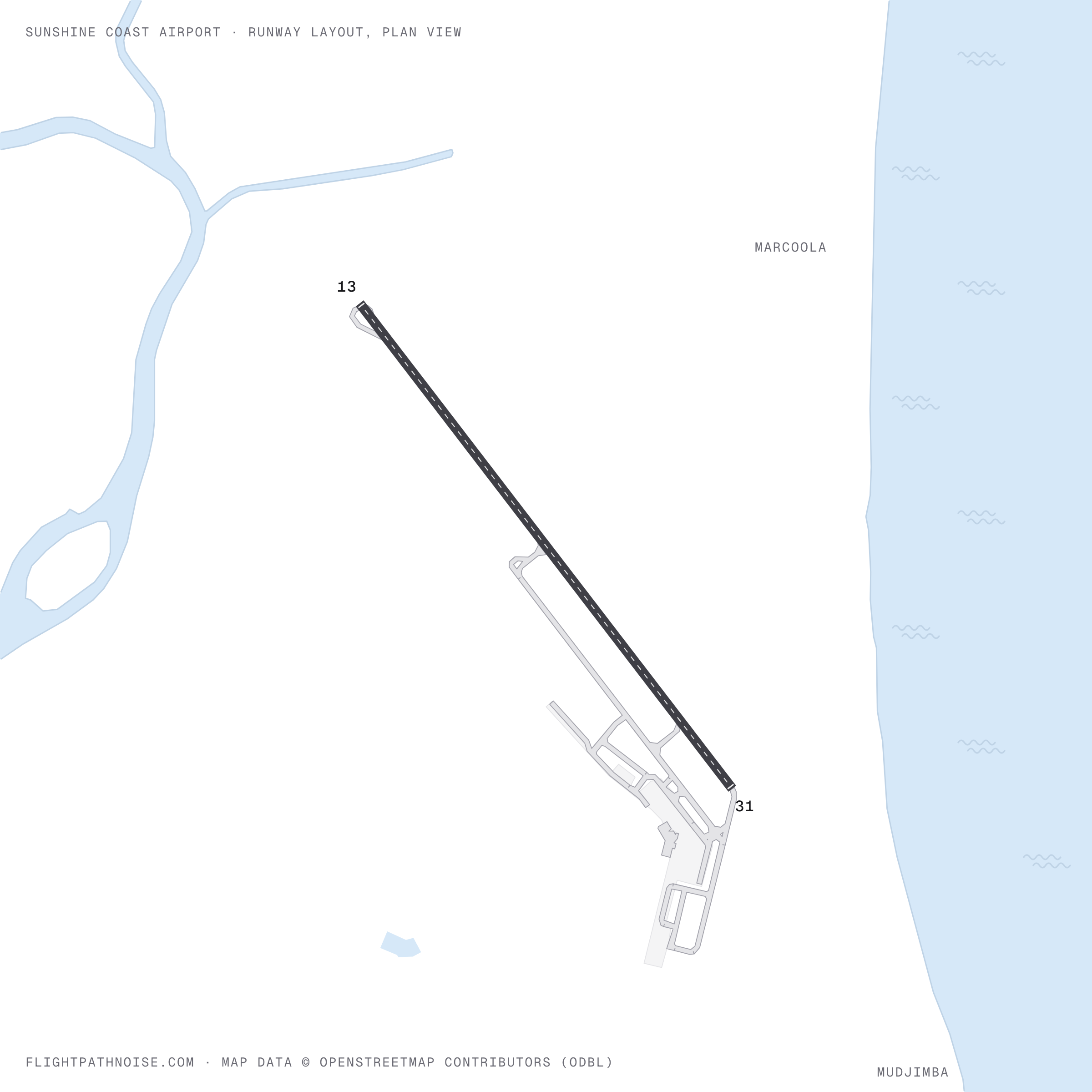
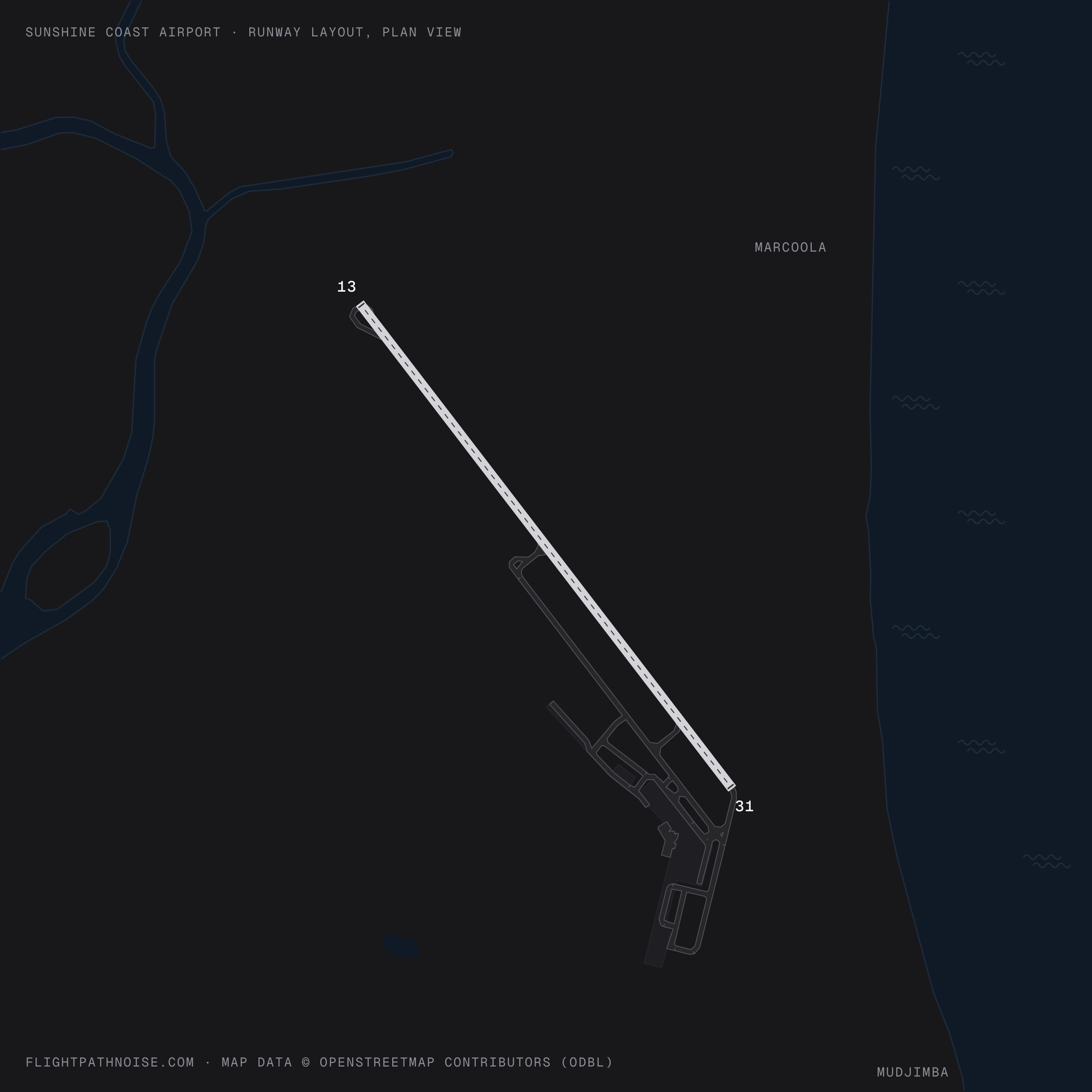
Sunshine Coast Airport’s noise story is essentially the story of one runway. On 14 June 2020 the airport switched from its old north–south runway 18/36 to a brand-new, reoriented north-west/south-east runway 13/31, and overnight whole communities that had never heard a jet found themselves under flight paths — most dramatically across the Noosa hinterland (Doonan, Tinbeerwah, Tewantin, Cooroy) on the inland side and the beachside strip from Marcoola to Mudjimba near the field. The change triggered an Aircraft Noise Ombudsman investigation, a formal Post-Implementation Review of the flight paths finalised in October 2023, and ongoing community engagement into 2025. Because the airport sits right on the coast, the operational logic is unusually clean: in the prevailing easterlies jets depart south-east straight out over the Pacific (Runway 13, ~77% of the time), while in westerlies they arrive over the ocean and climb out overland to the north-west (Runway 31, ~23%). There is no legislated curfew, leaving the night-noise question one of the community’s enduring grievances.
Which neighborhoods are quietest — and which aren’t
Sunshine Coast operates a single runway, 13/31 (2,450 m × 45 m, asphalt), reoriented to a NW–SE alignment when it opened in June 2020. The old N–S runway 18/36 (1,797 m) was decommissioned and turned into a taxiway. With only one runway and a coastline running roughly north–south, the exposure pattern is straightforward: the suburbs that hug the runway ends — Marcoola on the field, and Mudjimba, Twin Waters and Pacific Paradise just to the south — bear the brunt, while the hinterland to the north-west catches the overland departures only when the wind switches to a westerly.
If aircraft noise is a primary concern, the quietest options are well south of Maroochydore (Caloundra and beyond) or back from the coastal strip near the field. Caloundra sits clear of both the southern departure corridor and the NW hinterland spread. The suburbs to avoid if you want quiet are the threshold communities — Marcoola, Mudjimba, Twin Waters and Pacific Paradise — which are under the busiest Runway 13 departures whenever the wind is from the east. The Noosa hinterland sits in a middle tier: real overflight, but intermittent and at altitude. If you’re weighing a specific property, drop a pin on the map above to see its exposure.
| Area | Noise | Why |
|---|---|---|
| Marcoola | ✈︎✈︎✈︎ | On the field; under Runway 13 climb-out and Runway 31 threshold ops |
| Mudjimba | ✈︎✈︎✈︎ | South of the Runway 13 departure end, under early climb-out |
| Pacific Paradise | ✈︎✈︎✈︎ | Just inland of the southern runway end, under the 13/31 corridor |
| Twin Waters | ✈︎✈︎✈︎ | Coastal, south of the field, under 13 departures turning to sea |
| Bli Bli | ✈︎✈︎✈︎ | Inland under the NW–SE corridor; 31 departures and 13 arrivals |
| Coolum Beach | ✈︎✈︎ | ~11 km north along the coast; 13 arrivals / 31 ops, less intense |
| Maroochydore | ✈︎✈︎ | Urban centre south of the field, on the fringe of the corridor |
| Yandina | ✈︎✈︎ | Inland on the NW Runway 31 overland departure track (westerlies) |
| Doonan | ✈︎✈︎ | Noosa hinterland PIR area under the reshaped NW arrival corridor |
| Nambour | ✈︎✈︎ | Inland under the broader NW spread for Runway 31 operations |
| Tewantin | ✈︎ | Outer edge of the hinterland spread; higher-altitude overflight |
| Tinbeerwah | ✈︎ | Noosa hinterland; intermittent overflight at altitude |
| Cooroy | ✈︎ | ~20 km hinterland edge; high-altitude, lower exposure |
| Caloundra | ✈︎ | Well south, largely off the primary corridors |
Flight patterns and runway use
Sunshine Coast’s single runway and coastal position make its operations easy to predict from the wind. The prevailing winds are easterly, so Runway 13 is the dominant direction: roughly 77% of departures climb out to the south-east directly over the Pacific Ocean, while arrivals to Runway 13 approach from the north-west, overland. Pushing the busiest departures out to sea was a deliberate design goal of the new flight paths.
When the wind turns westerly — about 23% of the time — operations reverse to Runway 31: aircraft now arrive from the south-east over the ocean and depart to the north-west, overland, carrying departure noise inland over the Maroochy River flats, Bli Bli, Yandina and the Noosa hinterland. This is the configuration that puts the previously unaffected hinterland suburbs under jets, and it is the core of the post-2020 noise controversy.
The reorientation prompted an Aircraft Noise Ombudsman investigation and a formal Airservices Australia Post-Implementation Review, whose final report (October 2023) carried five recommendations. The RNP/RNAV approaches were specifically reshaped through 13 hinterland consultation areas after the original environmental impact statement, and engagement on implementing the PIR’s recommendations — better information sharing, an improved noise action plan, and a possible permanent or temporary noise-monitoring program — continued through 2025. Noise Abatement Procedures and Fly Neighbourly Agreements (for general-aviation fixed-wing and helicopters) also apply.
The route-density layer on the map above shows the result: a bright corridor running south-east out to sea from the runway (the dominant Runway 13 departures) and a second band stretching north-west over the hinterland for the westerly-wind days.
When is it quietest?
Without a hard curfew, Sunshine Coast doesn’t have the guaranteed overnight silence that Sydney or the Gold Coast enjoy — but heavy night movements are restricted, so genuine late-night jet noise is rare rather than absent:
- 11 PM – 5:30 AM: managed night-operations window. Commercial aircraft over 5,700 kg need prior airport approval to take off or land; approved overnight movements are published in monthly reports. Quiet most nights, but not a legislated curfew.
- 5:30 AM – 7 AM: early departures begin as the restriction lifts.
- 7 AM – 9 AM: morning departure peak — domestic flights to Sydney, Melbourne and beyond, mostly off Runway 13 over the ocean.
- Midday: moderate, sustained traffic.
- Late afternoon / evening (4 PM – 8 PM): arrival bank as interstate flights return.
- 9 PM – 11 PM: tapers ahead of the night-operations window.
The variable that matters most here isn’t the hour — it’s the wind. A westerly change flips the airport to Runway 31 and suddenly sends departures overland to the north-west, putting Bli Bli, Yandina and the Noosa hinterland under traffic that was previously routing out to sea. On an east-wind day those same suburbs may hear almost nothing. For the hourly profile at your address, drop a pin on the map above.
How to check noise at your specific address
The map above is the answer to “is this spot loud?” Three steps:
- Search your address or postcode in the bar at the bottom of the map.
- Drop a pin — click the location marker that appears.
- Read the noise report in the panel below the map: average daily noise (Leq), peak observed dB, flights per day loud enough to hear there, and an hourly breakdown.
The Noise Heatmap layer (orange/red = louder) and the Route Density layer (purple/magenta = busier corridors) make the single-runway pattern obvious: a strong south-east band out over the ocean and a north-west band over the hinterland. Most addresses south of Maroochydore or well back from the runway ends will land in the green/quiet zone, while the threshold suburbs — Marcoola, Mudjimba, Twin Waters and Pacific Paradise — show up clearly under the departure corridor. Because the flight paths shift with the wind, check the report on both a description of east-wind and west-wind days if your address is anywhere near the north-west hinterland track.
Frequently asked questions
- Is Marcoola loud from aircraft noise?
- Yes — Marcoola is the single most affected suburb because the runway runs right along its western/inland edge. It sits directly under Runway 13 departure climb-out and Runway 31 threshold operations, so you get both the loudest departures and low arrivals. Drop a pin on the map above to see your exact street's exposure.
- Why did the flight paths change in 2020?
- On 14 June 2020 the airport replaced its old north–south runway 18/36 with a brand-new, reoriented north-west/south-east runway 13/31. The new alignment was designed to push the busiest departures out over the Pacific, but it also put whole communities — from Marcoola and Mudjimba near the field to the Noosa hinterland (Doonan, Tinbeerwah, Tewantin, Cooroy) — under flight paths for the first time. That triggered an Aircraft Noise Ombudsman investigation and a formal Post-Implementation Review.
- Which way do planes fly at Sunshine Coast Airport?
- It depends on the wind. In the prevailing easterlies, Runway 13 is dominant (~77% of departures): jets climb out to the south-east directly over the ocean, while arrivals approach from the north-west overland. In westerlies (~23%), operations reverse to Runway 31: aircraft arrive from the south-east over the ocean and depart to the north-west overland, taking departure noise inland toward Bli Bli, Yandina and the Noosa hinterland.
- Is Mudjimba or Twin Waters under the flight path?
- Yes — both sit just south of the Runway 13 (south-east) departure end on the coast, under the early climb-out before jets turn out to sea. They are among the high-exposure suburbs. Note that the open Pacific lies to the south-east of the field, so the populated overflight is to the south, not over the water.
- Are the Noosa hinterland suburbs (Doonan, Tinbeerwah, Cooroy) affected?
- Yes, but less than the suburbs near the field. When operations run on Runway 31 in westerly winds, departures climb out to the north-west overland and the reshaped RNP/RNAV approaches for Runway 13 also track in from that direction. These suburbs — Doonan, Tinbeerwah, Tewantin and Cooroy — were named consultation areas in the Post-Implementation Review, but overflight there is intermittent and at higher altitude.
- What is the Post-Implementation Review?
- After the 2020 runway reorientation drew complaints, Airservices Australia ran a formal Post-Implementation Review (PIR) of the new flight paths, finalised in October 2023 with five recommendations. Community engagement on implementing them — including information sharing, noise-action-plan improvements and a possible noise-monitoring program — continued through 2025. An Aircraft Noise Ombudsman investigation also examined the original rollout.
- How do I report aircraft noise at Sunshine Coast?
- Submit complaints to Airservices Australia's Noise Complaints and Information Service (NCIS) at airservicesaustralia.com or by phone on 1800 802 584. Air traffic control and flight paths are a federal Airservices responsibility; the airport operator handles its own Noise Abatement Procedures and publishes monthly reports on approved overnight operations.
Sources and further reading
- Sunshine Coast Airport — Wikipedia — Wikipedia
- Managing noise impacts at Sunshine Coast Airport — Sunshine Coast Airport
- Sunshine Coast Airport Airspace Changes Runway 13/31 (PIR & FAQs) — Airservices Australia
- Investigation into complaints about the introduction of new flight paths in Sunshine Coast — Aircraft Noise Ombudsman (ANO)
- About making a noise complaint — Airservices Australia
Data updated 2026-11-24 — live ADS-B monitoring, rolling 30-day statistics (methodology). Article text revised 2026-06-12.
Other airports we track
All 174 airports →No airports in this region yet.