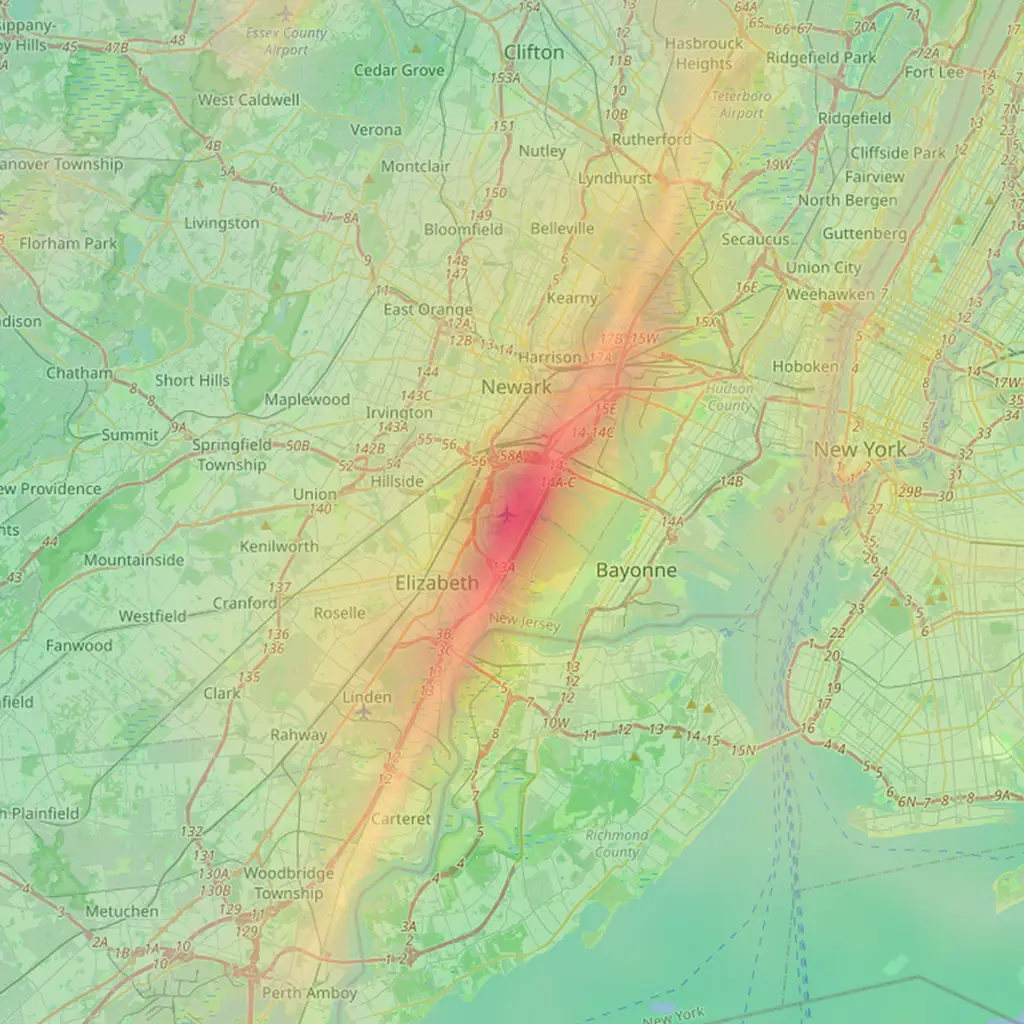
Aircraft noise around Newark in November 2026
Loudest neighborhoods near Newark: Ironbound (Newark East Ward), Elizabeth (Elizabethport / Bayway), Hillside, Linden. Quietest: Bayonne, Jersey City, Springfield Township, Lower Manhattan. Busiest around 3 PM local time averaging 1466 flights/day. Source: Flight Path Noise monitoring data, 30 days to 2026-11-23.

Does Newark Airport have a curfew?
No — Newark has no formal curfew.
EWR has no mandatory night curfew and no weekend ban. As a Port Authority airport it relies on voluntary noise-abatement measures, a per-takeoff noise ceiling and preferential runway use rather than a time-of-day ban, and it operates 24 hours. Night flights are simply more noticeable because the background noise is lower. (Temporary FAA hourly operation caps introduced in 2025–2026 are delay/capacity limits, not a noise curfew.)
Newark Liberty International Airport (EWR/KEWR) sits jammed against dense, working-class residential New Jersey — the Ironbound, Elizabeth and Hillside are almost on the airport fence — so EWR’s noise story is one of proximity rather than distance. Its two parallel runways (4L/22R and 4R/22L) run south-west to north-east and are only about 290 m apart, the fourth-tightest spacing of any major U.S. airport. That forces nearly all heavy-jet traffic into one narrow corridor over the same handful of towns. The signature controversy is the runway 22 departure: jets turn left over the Arthur Kill to keep noise over industrial New Jersey, but routinely clip the western corner of Staten Island — a cross-state complaint source running since 1990s Congressional hearings. Like JFK and LaGuardia, EWR has no mandatory curfew, relying instead on the Port Authority’s voluntary measures and a per-aircraft noise ceiling.
Which neighborhoods are quietest — and which aren’t
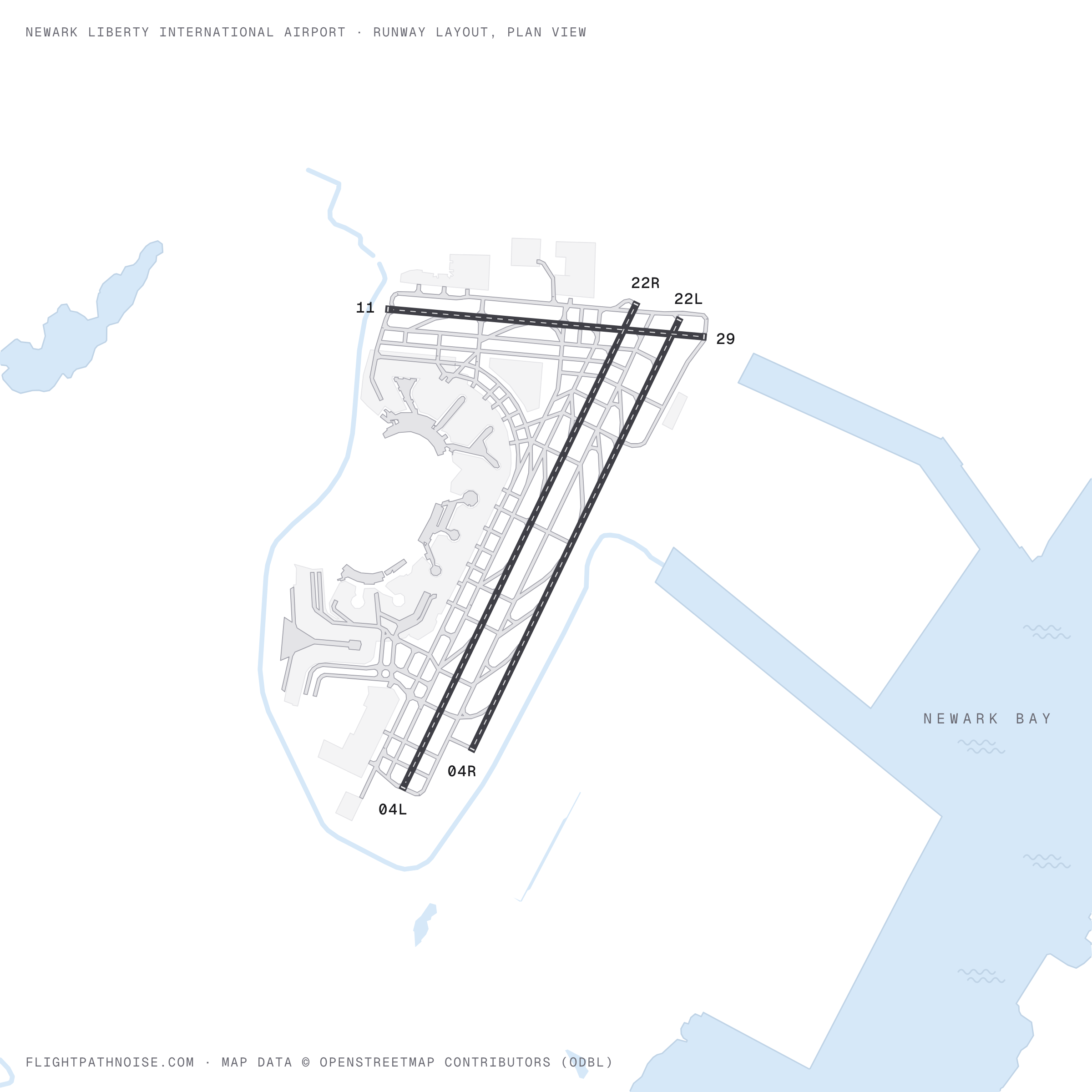
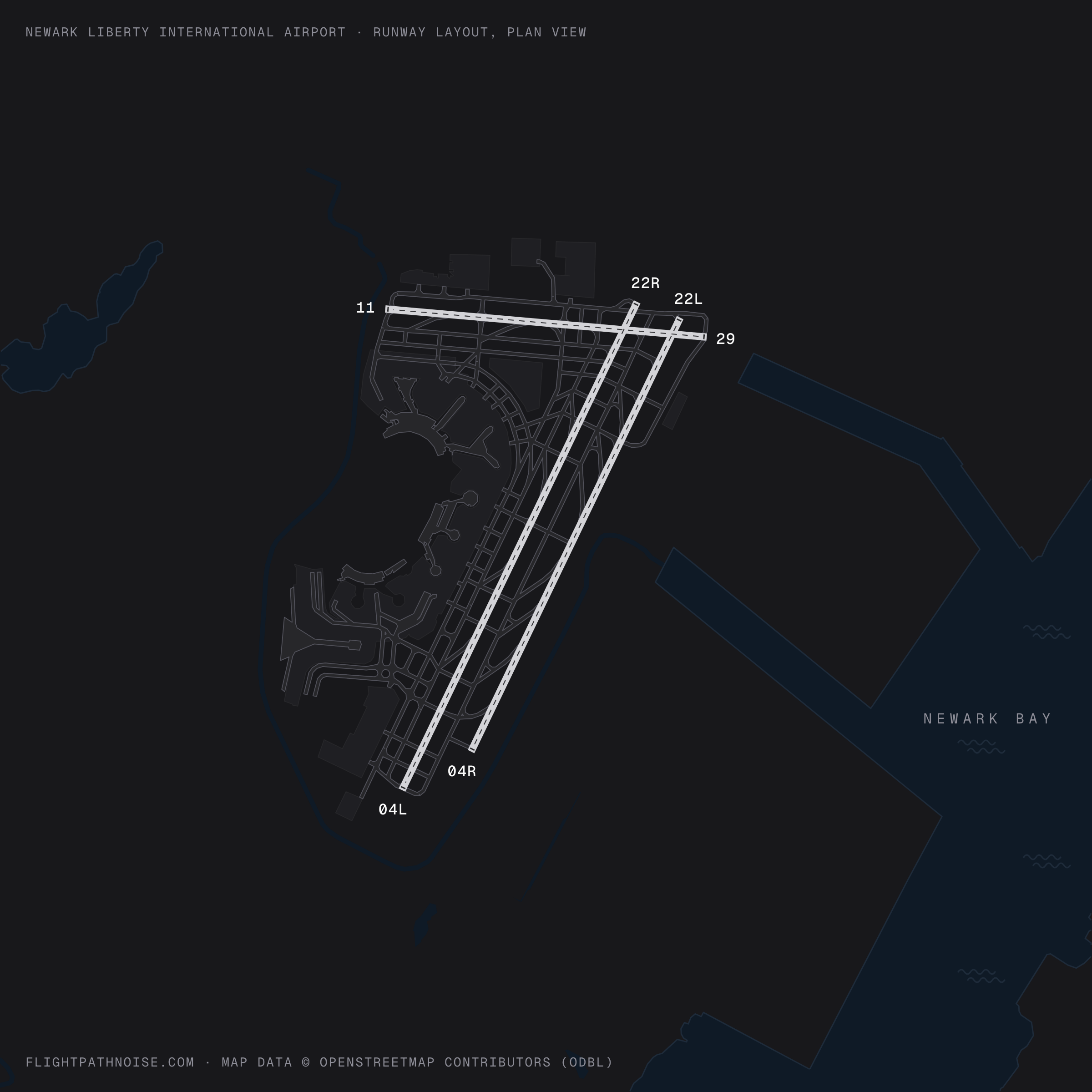
Newark Liberty runs three runways, but the two parallels do almost all the work. 4L/22R (3,353 m / 11,000 ft) is the closest runway to the terminals and the preferential departure runway; 4R/22L (3,048 m / ~9,999 ft) is the preferential arrival runway, only about 290 m away. A shorter crosswind runway, 11/29 (2,050 m / 6,725 ft), runs roughly east-west and carries a minority of lighter traffic. Because the parallels are so tightly spaced and identically aligned, exposure is essentially a question of how close you are to one of the runway ends.
If aircraft noise is a primary concern, the practical move around EWR is to get lateral to the runway 4/22 corridor rather than off either end of it — neighborhoods east of the field (Bayonne) and well to the north-east (Jersey City) catch mostly higher-altitude, intermittent traffic. The towns directly off the runway ends — the Ironbound, Elizabeth, Hillside and Linden — are the most consistently affected. If you’re weighing an apartment or house in any of those, drop a pin on the map above to see your specific street’s exposure.
| Area | Noise | Why |
|---|---|---|
| Ironbound (East Ward) | ✈︎✈︎✈︎ | Immediately off the runway ends; under 4L departures and 22L approach |
| Elizabeth (Elizabethport / Bayway) | ✈︎✈︎✈︎ | Wraps the south end; under 22R departures and 4R arrivals |
| Hillside | ✈︎✈︎✈︎ | On the extended 4/22 corridor north-west of the field |
| Linden | ✈︎✈︎✈︎ | South-west extension of 4/22; under 22R climb-out and 4R approach |
| Newark Downtown / Weequahic | ✈︎✈︎ | Lateral to the corridor; overflown on 4-config departures |
| Roselle / Roselle Park | ✈︎✈︎ | West of the corridor; fanned-out 22 departures and 4 arrivals |
| Staten Island (north shore) | ✈︎✈︎ | Runway 22 left-turn departures clip the western/north shore |
| Kearny | ✈︎✈︎ | North-east on the 4L/22L extended path, but farther out and higher |
| Union Township | ✈︎✈︎ | Off-corridor to the west; turning departures at moderate height |
| Bayonne | ✈︎ | East and lateral to the corridor; intermittent overflight |
| Jersey City | ✈︎ | North-east, well off centreline; higher-altitude traffic only |
| Springfield Township | ✈︎ | Outer edge of the radius; occasional high overflights |
| Lower Manhattan | ✈︎ | Far from runway ends; high-altitude departures only |
Flight patterns and runway use
Newark’s two parallel runways handle nearly all jet traffic in a single south-west-to-north-east corridor, and the configuration flips with the wind. With prevailing south-westerly winds, the airport runs a “22” configuration: aircraft take off on 22R and land on 22L, both into the wind. That sends departures south-west over Elizabeth, Linden and the Arthur Kill, and arrivals descending from the north-east over the Ironbound.
When winds favour the north-east, EWR switches to a “4” configuration: departures climb on 4L north-east over the Ironbound and Newark, while arrivals descend on 4R from the south-west over Elizabeth and Linden. In both configurations the runway nearest the terminals (4L/22R) is the preferential departure runway and 4R/22L is the preferential arrival runway.
The defining noise-abatement procedure is the runway 22 left-turn departure. Jets turn south and west over the Arthur Kill to concentrate noise over the industrial waterway and away from homes — but in practice many flights cross the western and north shore of Staten Island (around Mariners Harbor), which is why a New Jersey airport generates persistent complaints from a New York borough. Beyond procedural routing, the Port Authority imposes a per-takeoff noise ceiling (jet departures are expected to stay below roughly 112 PNdB, with carriers choosing thrust cutbacks, turns away from communities, or quieter aircraft to comply) and participates in voluntary “Fly Quiet”-style collaborations with airlines and controllers. The crosswind runway 11/29 absorbs lighter traffic and is used during strong crosswinds on the parallels.
The route-density layer on the map above makes the pattern obvious: a single bright band running south-west (over Elizabeth and Linden) and north-east (over the Ironbound and Kearny) from the parallel runways, with a fainter east-west smear from 11/29 and the tell-tale southward kink of the runway 22 turn toward the Arthur Kill.
When is it quietest?
Because EWR has no curfew, there is no guaranteed silent window — the airport operates 24 hours, and the quietest periods are simply the lulls between traffic banks:
- Overnight (roughly midnight – 5 AM): the lightest traffic, but not silent. Cargo and delayed flights continue, and because background noise is lower, the jets that do operate feel louder relative to the ambient quiet.
- 5 AM – 8 AM: morning departure bank builds quickly; back-to-back takeoffs once the bank is running.
- Midday (10 AM – 3 PM): sustained, moderate traffic.
- Evening (5 PM – 9 PM): arrival-heavy peak as long-haul and domestic returns stack up.
- Late evening (9 PM – midnight): tapers, but with no curfew, flights keep landing well past 11 PM.
The bigger variable for any given home is which configuration is running. A wind shift from south-westerly to north-easterly flips the whole operation — a block under quiet downwind arrivals one hour can be under low departure climb-out the next. Residents off the runway ends notice this far more than the time of day. For your specific address, drop a pin on the map above to see the hourly profile and how it changes with the wind.
How to check noise at your specific address
The map above answers the only question that really matters — “is this spot loud?” Three steps:
- Search your address or postcode in the bar at the bottom of the map.
- Drop a pin — click the location marker that appears.
- Read the noise report that opens in a panel below the map: average daily noise (Leq), peak observed dB, flights per day loud enough to hear there, and an hourly breakdown.
The Noise Heatmap layer (orange/red = louder) and the Route Density layer (purple/magenta = busier corridors) make the tight runway 4/22 corridor obvious — a single intense band over the Ironbound, Elizabeth, Hillside and Linden, with the southward hook of the runway 22 turn toward Staten Island. Most addresses lateral to that corridor fall into the green/quiet zone, while anything close to a runway end will read high. If your home reads loud and you want to log it, complaints go to the Port Authority Aircraft Noise office at aircraftnoise.panynj.gov or on 1-800-225-1071.
Frequently asked questions
- What is the Newark airport noise complaint number?
- Newark Liberty noise complaints go to the Port Authority of New York & New Jersey Aircraft Noise office. You can file online at aircraftnoise.panynj.gov or call the noise hotline on 1-800-225-1071 (the same line serves EWR, JFK and LaGuardia). The airport itself does not run a separate complaint desk — flight paths are handled by the FAA and the Port Authority.
- Is the Ironbound loud from Newark airport?
- Yes. The Ironbound (Newark's East Ward) is one of the most affected neighborhoods because it sits immediately off the runway ends — directly under the runway 4L departure climb-out and the runway 22L final approach. Because it is so close to the field, aircraft pass low and noise is sustained whenever the airport is in a 4 or 22 configuration. Drop a pin on the map above to see the count and noise level for your exact block.
- What is the EWR flight path over Elizabeth, NJ?
- Elizabeth wraps the southern end of Newark Liberty, so it sits squarely under runway 22R departures (jets climbing south-west) and runway 4R arrivals (jets descending from the south-west). Elizabethport and the Bayway area are the most exposed parts. Which one you hear depends on the wind — see the Flight patterns section below.
- Why do Newark airport departures fly over Staten Island?
- The signature EWR noise-abatement move is the runway 22 left-turn departure. Jets taking off to the south-west turn left over the Arthur Kill to concentrate noise over industrial New Jersey and the waterway, but in practice many flights clip the western and north shore of Staten Island (around Mariners Harbor). This cross-state pattern has drawn complaints since 1990s Congressional hearings and remains a recurring issue.
- Why are planes flying so low over Hillside and Linden?
- Both towns sit on the extended runway 4/22 corridor — Hillside to the north-west and Linden to the south-west — so they are under climbing departures or descending arrivals depending on the wind. Because EWR's two parallel runways are only about 290 m apart, nearly all heavy-jet traffic is funnelled into this single south-west-to-north-east corridor over the same towns, which keeps overflights low and frequent.
- Which neighborhoods near Newark airport are quietest?
- Areas lateral to the runway 4/22 corridor get the least overflight — places like Bayonne to the east and Jersey City to the north-east see mostly higher-altitude, intermittent traffic. The most affected spots are directly off the runway ends (the Ironbound, Elizabeth, Hillside and Linden). The pin-drop map above lets you check any address.
- Does this map include all aircraft over Newark?
- Yes — the commercial fleet using EWR has near-complete ADS-B coverage, so the heatmap and route-density layers reflect actual traffic. A small amount of general-aviation traffic from nearby reliever fields may not be ADS-B-equipped, but those aircraft don't operate from Newark Liberty.
Sources and further reading
- Newark Liberty International Airport — Wikipedia — Wikipedia
- Aircraft Noise — FAQs / Submit a Complaint — Port Authority of New York & New Jersey
- Newark Liberty International Airport project profile — Airport Technology
- Chart Talk: Newark (EWR) — AOPA
- Noise Exposure Map Notice for Newark Liberty International Airport — U.S. Federal Register / FAA
Data updated 2026-11-23 — live ADS-B monitoring, rolling 30-day statistics (methodology). Article text revised 2026-06-12.
Other airports we track
All 174 airports →No airports in this region yet.