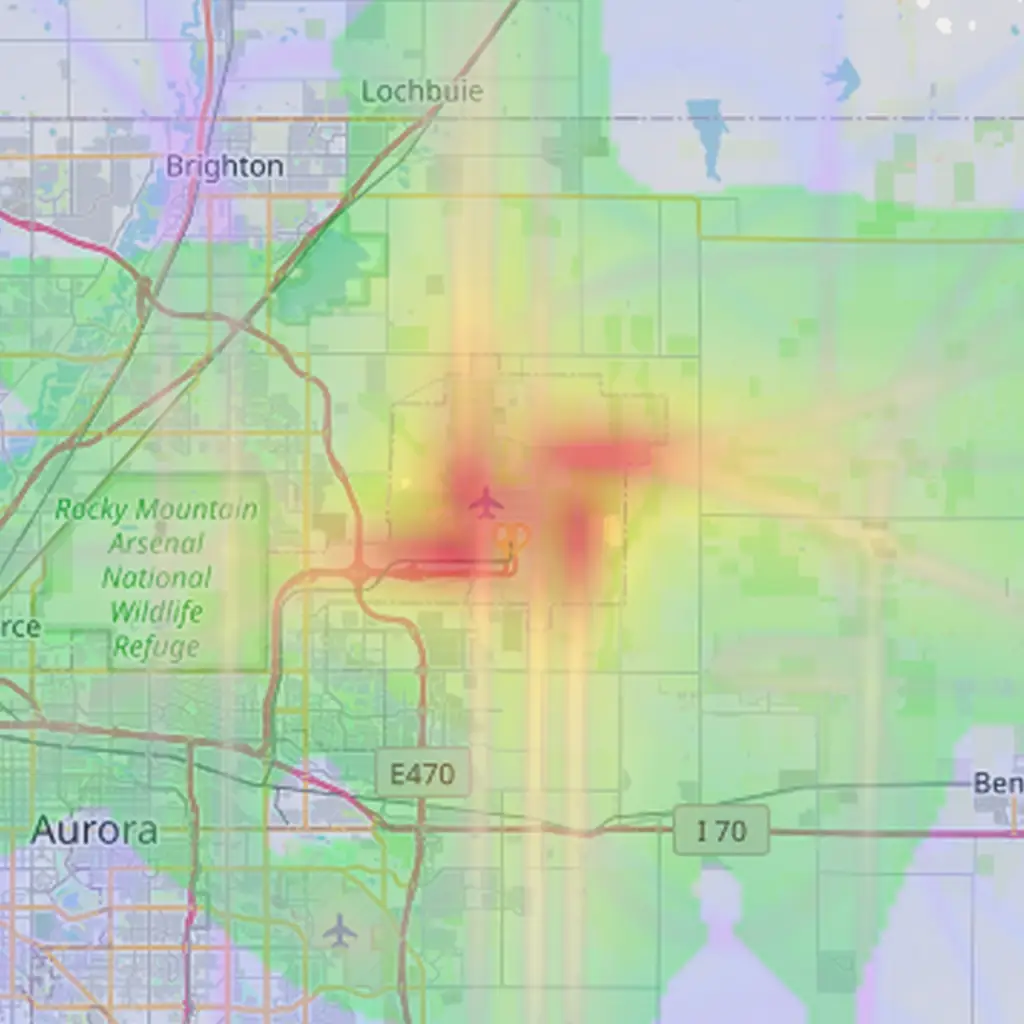
Aircraft noise around Denver in November 2026
Loudest neighborhoods near Denver: Green Valley Ranch (Denver), Montbello (Denver), Commerce City (Reunion / Buffalo Run), Brighton, North Aurora (Painted Prairie). Quietest: Northglenn, Bennett. Busiest around 11 AM local time averaging 2309 flights/day. Source: Flight Path Noise monitoring data, 30 days to 2026-11-20.

Does Denver Airport have a curfew?
No — Denver has no formal curfew.
DEN operates 24 hours a day, 365 days a year, with no mandatory curfew. For noise management, night is defined as 10 PM to 7 AM local, and during those hours a voluntary ‘Informal Runway Use Program’ (Airport Rule Part 210) applies — jets are kept on noise-abatement headings, arrivals are flown high, and the noise-sensitive east-west runways 25 and 26 are avoided. Noise-critical aircraft are barred from departing Runway 25 or 26 between 10 PM and 7 AM, but these are preferential procedures, not a flight ban — aircraft may still operate overnight.
Denver International Airport (DEN/KDEN) sits roughly 40 km north-east of downtown Denver on open high plains, deliberately sited far from dense housing — which is exactly why its noise story is unusual. Most overflight falls on Green Valley Ranch, Montbello, Commerce City and the fast-growing northern suburbs of Brighton and Thornton rather than the city core. DEN’s pinwheel of six runways is dominated by four parallel north-south strips, so the heaviest jet tracks run north (toward Brighton, Thornton and Adams County) and south (toward Aurora and Green Valley Ranch), with the two east-west runways used far less. The combination of hot-and-high elevation (1,656 m), the continent’s longest runway, and an enforceable inter-county noise agreement makes DEN’s noise profile distinct from a typical inner-city hub.
Which neighborhoods are quietest — and which aren’t
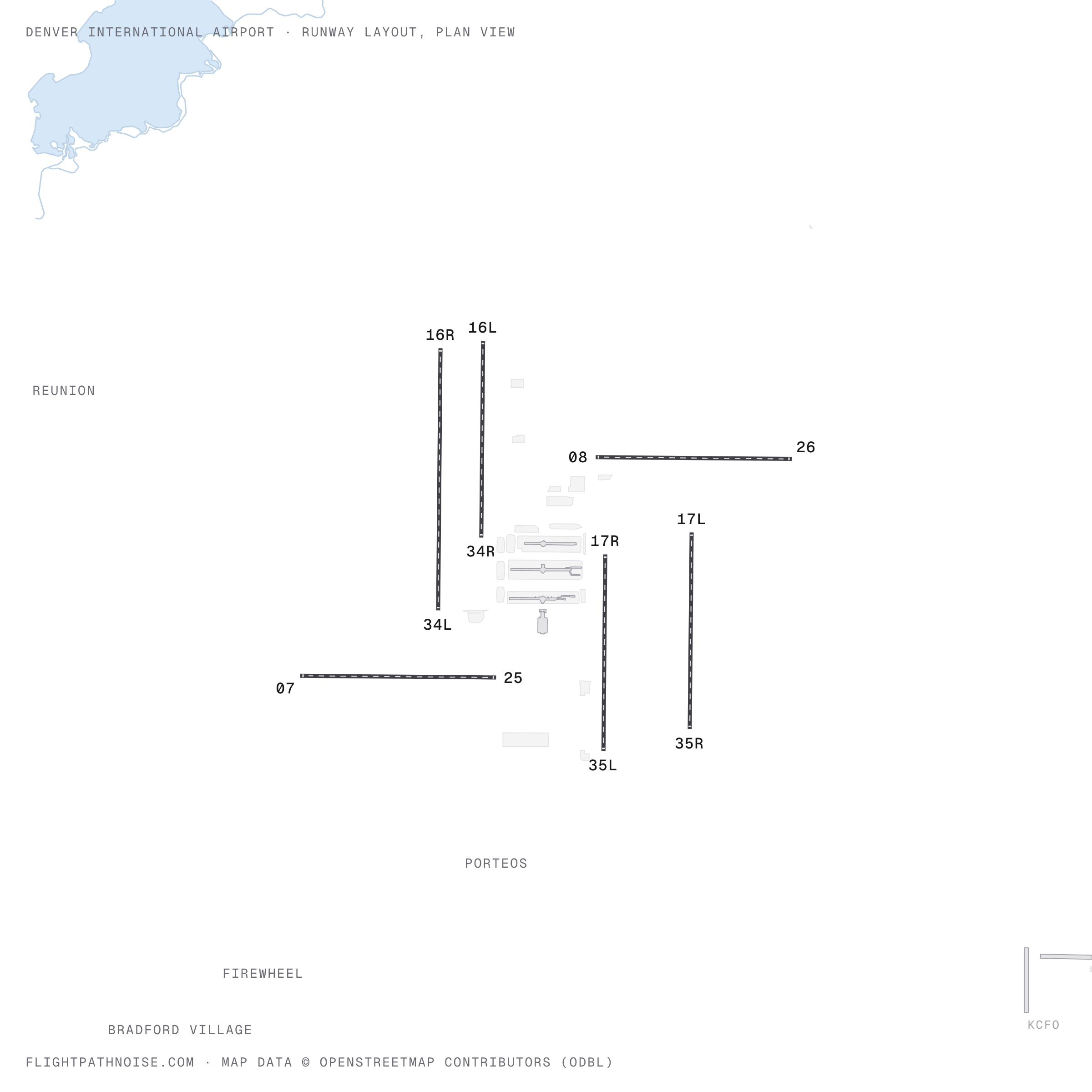
DEN runs six runways: four parallel north-south (16L/34R, 16R/34L, 17L/35R, 17R/35L) and two east-west crosswind runways (7/25 and 8/26). Runway 16R/34L is 16,000 ft (4,877 m) — the longest public-use runway in North America — while the other five are 12,000 ft (3,658 m). None of the runways intersect. The parallel north-south runways handle the bulk of traffic, so exposure is heaviest directly north and south of the field and lighter to the far east and west.
If aircraft noise is a primary concern, the practical pattern at DEN is that the north–south band through Green Valley Ranch, north Aurora, Commerce City and Brighton carries the most consistent overflight, because that is where the four parallel runways point. Communities sitting well east (Bennett, Watkins) or far west (Northglenn) catch aircraft only at higher altitude. Note that several far-west suburbs — Thornton, Northglenn and the western edge of Commerce City — sit 25 km or more from a field whose heaviest traffic runs north-south, so their exposure leans toward turning departures at altitude rather than low approach noise. If you’re looking at a specific address, drop a pin on the map above to see your street’s exposure.
| Area | Noise | Why |
|---|---|---|
| Green Valley Ranch | ✈︎✈︎✈︎ | Closest dense community; under south-flow parallel-runway and Runway 25 tracks |
| Montbello | ✈︎✈︎✈︎ | On the extended south-west corridor for parallel and west-side departures |
| Commerce City (Reunion) | ✈︎✈︎✈︎ | Subdivisions east of E-470 under north and west departure/arrival tracks |
| Brighton | ✈︎✈︎✈︎ | Under north-flow arrivals and 34L/34R departures; central to DEN noise litigation |
| North Aurora | ✈︎✈︎✈︎ | Under south-flow approaches and near west-runway climb-outs |
| Thornton | ✈︎✈︎ | Sits well west; mainly high-altitude turning departures |
| Lochbuie | ✈︎✈︎ | North of the field on the 16/34 line; moderate-altitude north-flow overflight |
| Henderson | ✈︎✈︎ | Between the field and Brighton under north-flow geometry |
| Watkins | ✈︎✈︎ | Under south and east-gate (080/155) departure routings |
| Reunion | ✈︎✈︎ | West of DEN under west-gate (245) and turning departures |
| Northglenn | ✈︎ | Far west-north-west; aircraft generally high |
| Bennett | ✈︎ | Rural south-east; high-altitude climb-out only |
Flight patterns and runway use
Prevailing winds on the Colorado Front Range come predominantly from the south and north, which is why DEN was built around four parallel north-south runways (16/34 and 17/35); the two east-west runways (7/25 and 8/26) are crosswind/secondary. In a typical north flow, arrivals come in from the north over Brighton, Thornton and Commerce City and departures climb out to the north. In south flow the pattern reverses, with arrivals over Aurora and Green Valley Ranch from the south and southbound departures.
Departures are governed by DEN’s Airport Rule Part 210 (an Informal Runway Use Program under FAA Order 8400.9). Aircraft are expected to fly FAA RNAV departure procedures where practical; otherwise they are assigned gate headings to channel climb-out away from populated areas — East Gate 080, North Gate 355, South Gate 155 and West Gate 245. The east-west runways 25 and 26 are formally noise-sensitive: Runway 25 may be used only by Stage 3 non-noise-critical jets, and noise-critical aircraft are prohibited from departing 25 or 26 at night (10 PM to 7 AM local), because those departures would climb out over residential Green Valley Ranch and Aurora.
At night, jets off 35L/35R are held on an 080 heading until 7,500 ft MSL (9,500 ft for noise-critical aircraft) to turn noise away from housing, and night arrivals join final approach high — for example outside the outer marker at around 7,000–7,100 ft MSL — to keep approaches elevated over the suburbs. Westbound noise-critical departures are routed via North or South Gate procedures rather than straight west over the neighborhoods. There is no Continuous Descent Arrival program and no mandatory curfew; the nighttime measures are preferential rather than a ban.
The route-density layer on the map above shows the cumulative pattern: bright corridors extending north (toward Brighton and Adams County) and south (toward Aurora and Green Valley Ranch) from the parallel runways, with much thinner east-west bands from the crosswind runways. DEN also runs ANOMS (its Aircraft Noise and Operations Monitoring System) with around 27 permanent and 4 portable monitors and Noise Exposure Performance Standards at 101 grid points — a legacy of its inter-county noise agreement.
When is it quietest?
DEN has no curfew, so there is no guaranteed silent window the way there is at a curfew airport. Instead, the quiet hours are shaped by traffic banks and the voluntary night program:
- Late night (10 PM – 6 AM): lightest traffic, and the Informal Runway Use Program is in effect — noise-abatement headings off the north runways, high arrivals, and the noise-sensitive east-west runways 25 and 26 avoided. Quieter, but not silent: aircraft may still operate.
- Early morning (6 AM – 8 AM): the morning departure bank builds quickly as Denver’s hub carriers push out.
- Midday (10 AM – 3 PM): sustained, moderate traffic across the parallel runways.
- Evening arrival bank (5 PM – 9 PM): one of the busiest stretches as inbound flights stack up.
The bigger variable at DEN is wind direction. A shift between north flow and south flow swaps which suburbs are under the approach versus the departure. A community that was hearing high arrivals from the north can, after a wind change, find itself under climbing departures instead. For your specific address, the hourly profile on the map above reflects the recent real pattern rather than a generic average.
How to check noise at your specific address
The map above answers “is this spot loud?” Three steps:
- Search your address or postcode in the bar at the bottom of the map.
- Drop a pin — click the location marker that appears.
- Read the noise report in the panel below the map: average daily noise (Leq), peak observed dB, flights per day loud enough to hear there, and an hourly breakdown.
The Noise Heatmap layer (orange/red = louder) and the Route Density layer (purple/magenta = busier corridors) make DEN’s north-south parallel-runway pattern obvious — two bright bands running away from the field toward Brighton in the north and Aurora and Green Valley Ranch in the south. Most addresses east or far west of that band will land in the quieter zone. If you want to log a problem rather than just check it, the Denver International Airport Noise Office takes complaints on 303-342-2360 and through the PublicVue / WebTrak flight tracker at flydenver.com.
Frequently asked questions
- Is Green Valley Ranch loud from DEN flights?
- Green Valley Ranch is the closest dense residential community to the field, about 9 km south-west, and it is the most consistently affected neighborhood. In south flow it sits directly under arrival and departure tracks of the parallel north-south runways, and it is also under any westbound departures off Runway 25. Drop a pin on the map above to see the exact overflight count for your street.
- How do I report aircraft noise at Denver International Airport?
- Contact the Denver International Airport Noise Office (City and County of Denver) on 303-342-2360, or file online through the airport's PublicVue / WebTrak noise and flight-tracking system at flydenver.com. The Noise Office logs complaints against DEN's ANOMS monitoring network of around 27 permanent monitors.
- Which Denver suburbs are quietest for aircraft noise?
- Because DEN's heaviest traffic runs north-south along four parallel runways, communities that sit well to the east or far to the west of those corridors get the least overflight. Far-west suburbs like Northglenn, and rural towns to the south-east such as Bennett, see aircraft only at high altitude. The most affected areas are Green Valley Ranch, north Aurora, Commerce City and Brighton. Use the pin-drop map above to check any address.
- Why do planes fly over Brighton at night?
- Brighton, in Adams County, sits squarely under the north-flow arrival and 34L/34R departure tracks. When DEN is in north flow, arrivals approach over Brighton and Thornton from the north and departures climb out north toward Adams County. There is no curfew, so this can happen overnight, though night departures off the north runways are flown on noise-abatement headings and arrivals are kept high to push noise away from housing.
- What was the Adams County DEN noise lawsuit about?
- Under a 1988 intergovernmental agreement, Denver agreed to noise limits as a condition of building DEN on the plains. Adams County later won a trial judgment of roughly $33.5 million for breaches of that agreement. In 2024 the Colorado Supreme Court reversed the judgment on statute-of-limitations grounds, finding the claim was filed too late. The underlying noise agreement and DEN's monitoring obligations remain in place.
- Why are Denver's runways 25 and 26 treated differently?
- The two east-west runways (7/25 and 8/26) are crosswind/secondary, and the west-facing ends 25 and 26 are formally designated noise-sensitive because departures off them climb out over residential Green Valley Ranch and Aurora. Runway 25 may be used only by Stage 3 non-noise-critical jets, and noise-critical aircraft are prohibited from departing Runway 25 or 26 between 10 PM and 7 AM.
- Does this map cover all aircraft at Denver?
- Yes — DEN's commercial fleet has near-complete ADS-B coverage, so the heatmap and route-density layers reflect actual traffic accurately. A small amount of general-aviation traffic from nearby reliever fields may not be ADS-B-equipped, but that does not operate from Denver International.
Sources and further reading
- Denver International Airport — Wikipedia — Wikipedia
- Airport Rules and Regulations Part 210 — Noise Abatement and Runway Procedures — City and County of Denver / Denver International Airport
- Noise and Airspace — Denver International Airport
- Denver International Airport noise abatement / preferential runway sheet — The Boeing Company
- City & County of Denver Prevails in Denver International Airport Noise Litigation — Kaplan Kirsch LLP
- Airplane Noise in Thornton — City of Thornton
Data updated 2026-11-20 — live ADS-B monitoring, rolling 30-day statistics (methodology). Article text revised 2026-06-12.
Other airports we track
All 174 airports →No airports in this region yet.