
Aircraft noise around Bali in October 2026
Loudest neighborhoods near Bali: Tuban (immediately north of runway), Kuta. Quietest: Canggu, Sanur, Uluwatu / Bukit, Ubud. Busiest around 4 PM local time averaging 418 flights/day. Source: Flight Path Noise monitoring data, 30 days to 2026-10-26.

Does Bali Airport have a curfew?
No — Bali has no formal curfew.
Bali’s Ngurah Rai International (DPS) operates 24 hours with no formal night curfew — scheduled international flights continue overnight, and there is no legislated ban on movements. The domestic terminal’s airside closes for a few hours in the early morning (around 2–4 AM), but that is an operational schedule, not a noise curfew. Overnight traffic is lighter than the daytime and evening peaks, though it never fully stops.
Bali’s runway sits on a thin isthmus between Kuta to the north and Jimbaran to the south, with the ocean immediately east and the narrowing Bukit peninsula to the south. That geography means most takeoffs and landings happen over the sea, not overland — so most of Bali, including the popular nomad areas, hears very little aircraft noise. The exceptions are the immediate runway-adjacent strips (Tuban and Kuta) and the south-flow approach corridor over north Jimbaran. This page combines a live ADS-B map of every flight passing DPS with notes on where the runway actually reaches.
Which neighborhoods are quietest — and which aren’t
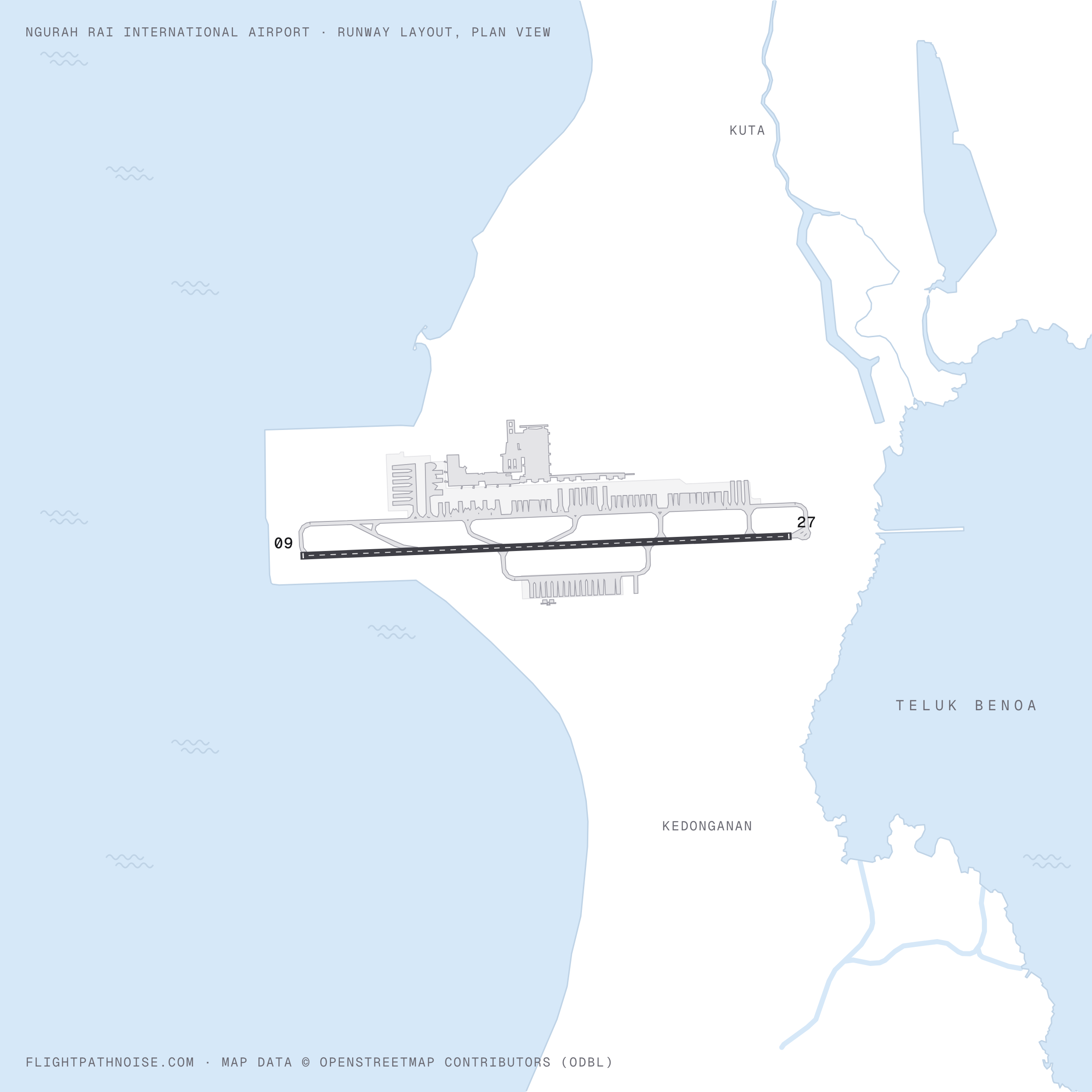
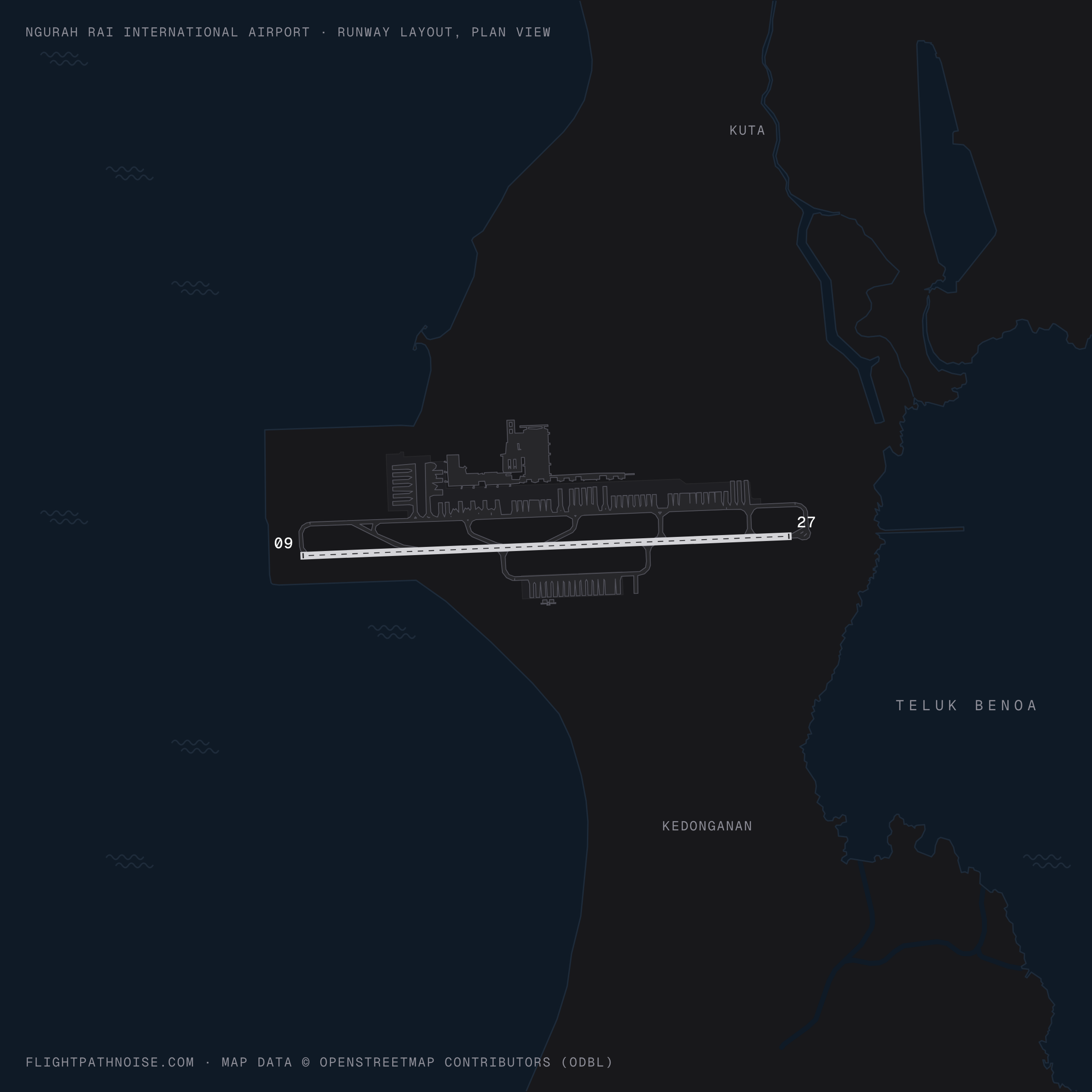
Ngurah Rai has a single east-west runway (09/27). The default configuration is east-flow: takeoffs head out over the ocean, arrivals come in from the west over Kuta and Tuban. South-flow operations send some traffic over Jimbaran. Because the runway is on an isthmus, both the east and west extents are over water — most of Bali’s land area never sits under a flight path.
If you’re choosing a Bali base and noise sensitivity matters, the practical move is anywhere except Tuban and central Kuta. Canggu, Sanur, and the broader Bukit are all comfortably quiet for aircraft. The non-aircraft soundscape (motorbikes, beach clubs, dogs) is a much bigger factor in most Bali areas than DPS.
| Area | Noise | Why |
|---|---|---|
| Tuban | ✈︎✈︎✈︎ | Wedged between the airport and Kuta — the loudest residential strip |
| Kuta | ✈︎✈︎✈︎ | Under approaches on east-flow days; also the densest tourist area |
| Jimbaran | ✈︎✈︎ | South-flow approach path; quieter on default east-flow days |
| Seminyak / Kerobokan | ✈︎✈︎ | 5–7 km north; departure corridor at climb altitude |
| Canggu | ✈︎ | ~10 km north, west of the corridor — Bali’s nomad hub is mostly clear |
| Sanur | ✈︎ | East coast; off the runway centerline |
| Uluwatu / Bukit | ✈︎ | Far south, mostly insulated by cliffs and distance |
| Ubud | ✈︎ | 25 km inland; aircraft at altitude on overflights |
Flight patterns and runway use
DPS operates a single east-west runway. Most departures climb out straight east over the Lombok Strait and bank either north (toward Java/Singapore/Hong Kong) or south-east (toward Australia). Arrivals come in from the west over Kuta and Tuban — that approach corridor is the most consistently audible feature for residents.
When monsoon winds shift, the airport flips. South-flow days send arrivals from the east (over the ocean) and departures west across Tuban and Kuta — louder for those neighborhoods but it spares the inland areas. The route-density layer above shows the cumulative picture; you’ll see the bright corridor sitting almost entirely east of the runway.
When is it quietest?
DPS scheduled traffic is heaviest mid-morning and again early evening, with continuous international traffic through the night. The 2 AM – 5 AM window is the quietest stretch — a handful of red-eye departures and arrivals rather than the daytime stream. For most of Bali (anywhere outside Tuban/Kuta), the difference between peak and quiet hours is barely audible because aircraft are over the ocean.
For your specific address, drop a pin on the map above and read the hourly breakdown. Most Canggu, Sanur, and Ubud addresses will show a near-flat hourly profile (occasional faint flyovers); Kuta and Tuban will show a clear daytime peak.
How to check noise at your specific address
The map above is the answer to “is this spot loud?” Three steps:
- Search your address or postcode in the bar at the bottom of the map.
- Drop a pin — click the location marker that appears.
- Read the noise report that opens in a panel below the map: average daily noise (Leq), peak observed dB, flights per day passing within 2 km, and an hourly breakdown.
The Noise Heatmap layer (orange/red = louder) and the Route Density layer (purple/magenta = busier flight corridors) make the runway-on-a-peninsula pattern obvious — a bright strip directly overhead and east of the airport, fading rapidly inland. Most nomad-popular addresses will land in the green/quiet zone.
Frequently asked questions
- Is Canggu loud from planes?
- No — Canggu sits ~10 km north of the airport and west of the main flight corridor. Most takeoffs and landings happen over the ocean to the east, not overland to the north-west. You'll see planes on approach, but they're typically high enough that you barely hear them over the surf and motorbike traffic.
- Which Bali area is quietest for aircraft noise?
- Ubud (deep inland), Sanur (east coast away from the corridor), and Uluwatu (south, mostly insulated by the Bukit cliffs) are all very quiet for aircraft. Canggu is also acceptable. The loudest residential areas are Tuban and Kuta, immediately north of the runway.
- Does Ngurah Rai operate at night?
- Yes, DPS runs essentially around the clock — about 320 flights per day with continuous late-night and early-morning international traffic. The big exception is Nyepi (Bali's Hindu Day of Silence) when the airport closes for 24 hours once a year.
- Are Seminyak and Kerobokan affected by aircraft noise?
- Moderately — they sit ~5–7 km north of the runway and catch the wider departure corridor as aircraft climb out. You'll hear flights, especially during peak hours, but the soundscape is dominated by ground noise (traffic, beach clubs) rather than aircraft.
- Does Bali have flight-noise restrictions?
- Bali's geography does most of the work — the runway is on a thin isthmus so the majority of takeoffs and landings route directly out over the sea. Built-up Kuta and Tuban absorb the bulk of overland noise; everywhere else benefits from the natural buffer.
- Should I avoid the Bukit if I'm noise-sensitive?
- Most of the Bukit is fine — the cliffs and distance from the runway insulate Uluwatu and surrounding villages. Areas closer to the airport on the Bukit's north edge (north Jimbaran) catch some approach noise on south-flow days. Far-Bukit (Pecatu, Bingin, Padang Padang) is consistently quiet.
- How does Bali aircraft noise compare to Bangkok or Chiang Mai?
- Per-flight, Bali's aircraft are similar to anywhere else (heavy international jets at takeoff thrust). But the runway-on-a-peninsula geometry means the *area* of audible noise is small — Canggu and Ubud are essentially out of earshot, while comparable distances from Bangkok or Chiang Mai would still catch the corridor.
Sources and further reading
- Ngurah Rai International Airport overview — Wikipedia
- Nyepi annual airport closure — Bali Airport (official)
- Bali neighborhoods for digital nomads — A Way Abroad
- Digital nomad guide to Bali (2026) — SearchSpot
Data updated 2026-10-26 — live ADS-B monitoring, rolling 30-day statistics (methodology). Article text revised 2026-04-29.
Other airports we track
All 173 airports →No airports in this region yet.