
Aircraft noise around Paris Orly in November 2026
Loudest neighborhoods near Paris Orly: Orly, Paray-Vieille-Poste, Athis-Mons, Villeneuve-le-Roi, Ablon-sur-Seine. Quietest: Massy. Busiest around 4 PM local time averaging 585 flights/day. Source: Flight Path Noise monitoring data, 30 days to 2026-11-23.

Does Paris Orly Airport have a curfew?
Yes — a mandatory night curfew, 11:30 PM – 6 AM.
Orly has a mandatory full night curfew from 23:30 to 06:00, in force since a ministerial decision of 4 April 1968. No scheduled flights take off or land in that window — exemptions are limited to safety, security and public-order cases. From 2025 a partial curfew also applies from 22:00, banning the noisiest aircraft so only the quietest types may operate in the late evening, and the curfew reference point has shifted from takeoff time to pushback (stand-departure) time of 23:15, making the rule effectively stricter.
Paris-Orly (ORY/LFPO) is the rare major European hub whose growth is legally frozen. A ministerial decision of 1968 imposed a hard overnight curfew from 23:30 to 06:00, and a 1994 order capped the airport at 250,000 aircraft movements per year — limits that make Orly the textbook contrast to curfew-free Charles de Gaulle. The single defining noise fact is that curfew: scheduled jets simply do not take off or land overnight, a protection residents of Athis-Mons, Villeneuve-le-Roi and Savigny-sur-Orge have relied on for over fifty years. Hemmed in by dense suburbs barely 13 km south of central Paris, Orly cannot fan its tracks out the way a rural airport can, so the same communes sit under departures or arrivals depending only on the wind. New 2025 measures tighten the screw further — a 22:00 ban on the noisiest aircraft and a shift of the curfew reference to pushback time (23:15) rather than takeoff.
Which neighborhoods are quietest — and which aren’t
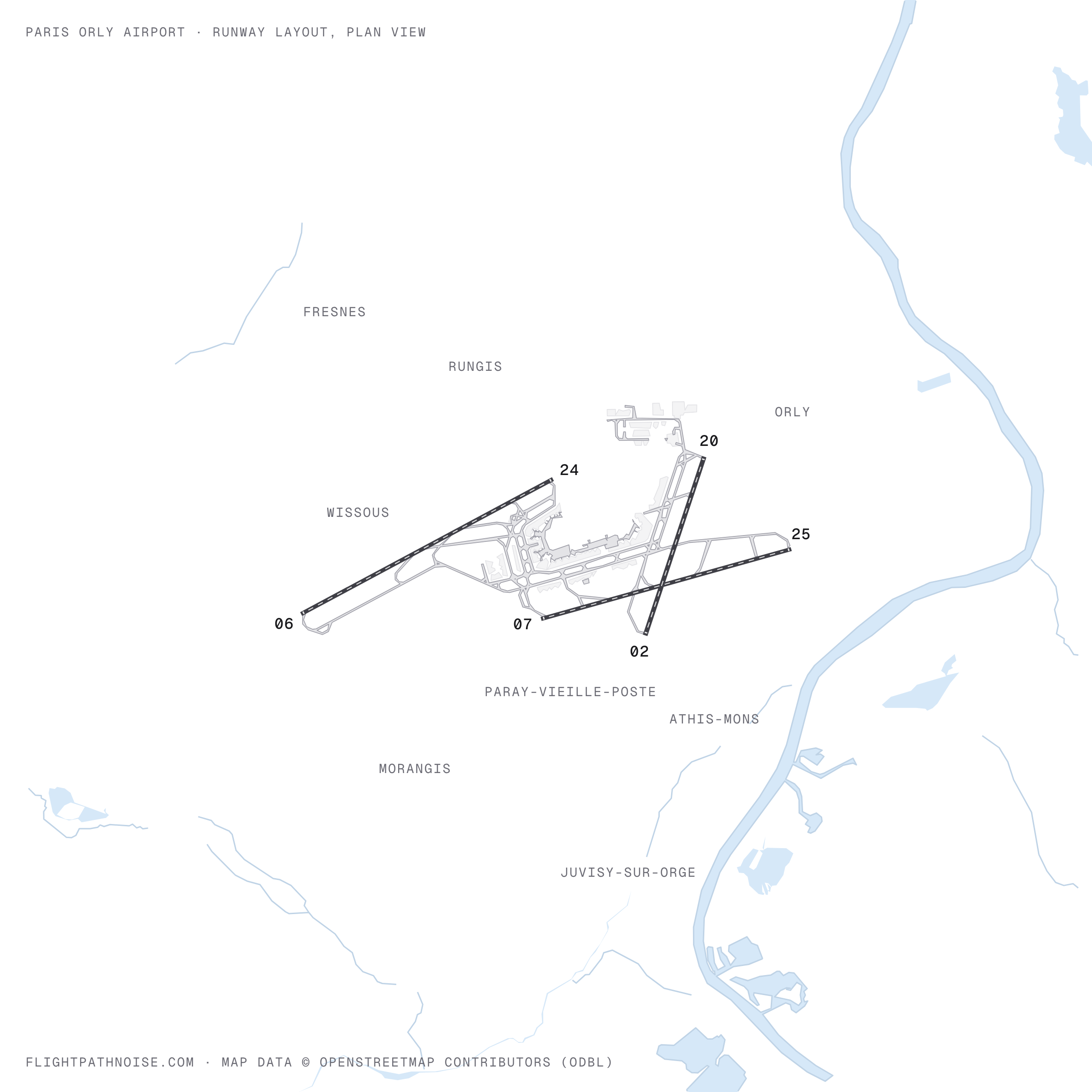
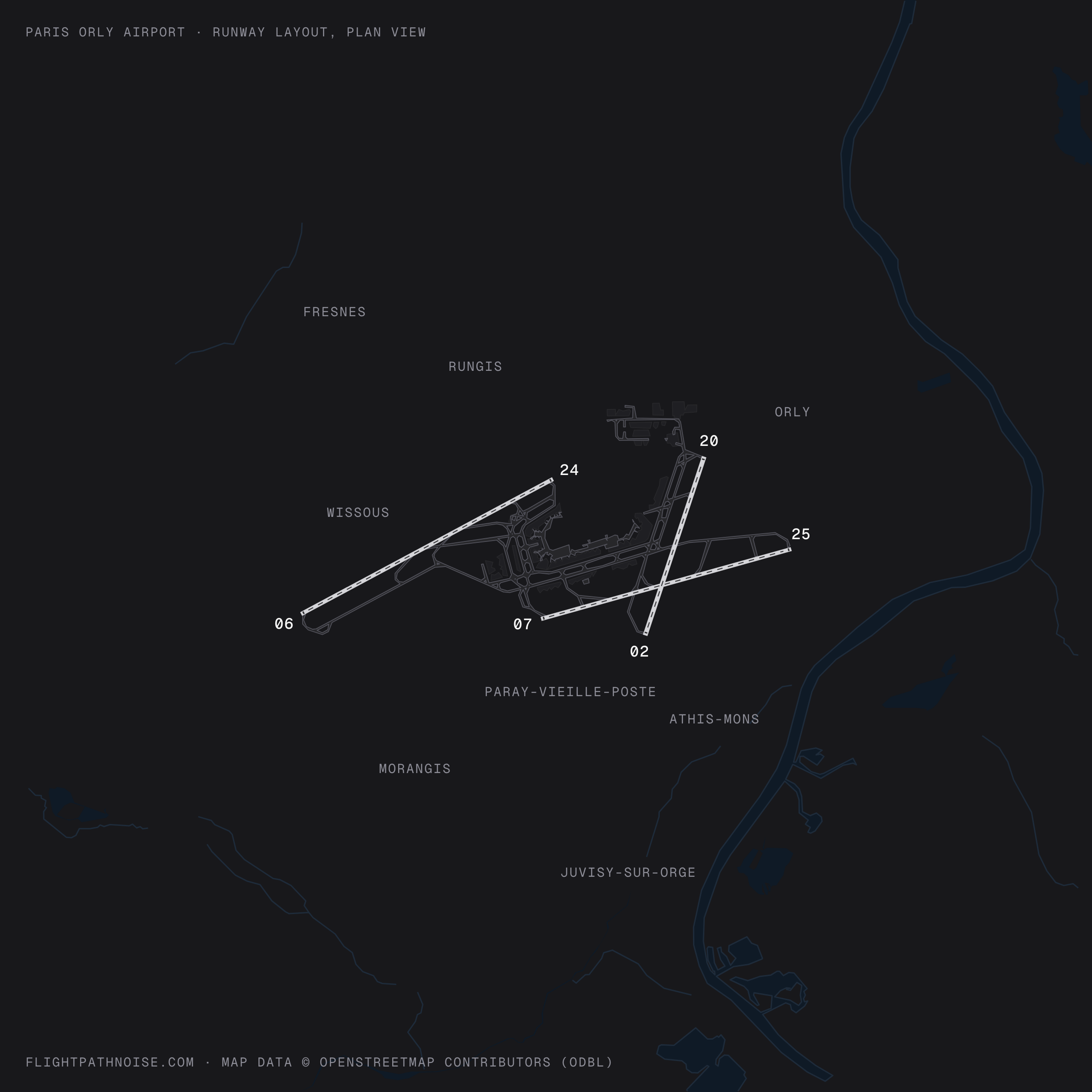
Orly has three runways: the primary 06/24 (3,650 m), the crossing 07/25 (3,320 m, renamed from 08/26 in 2019), and 02/20 (2,400 m), which is reserved for exceptional use and crosses 07/25 at its midpoint, so the two cannot run together. Almost all jet traffic uses 06/24 and 07/25.
The communes that ring the field — Orly, Paray-Vieille-Poste, Athis-Mons and Villeneuve-le-Roi — are the most exposed because they sit at the runway thresholds and are overflown at low altitude in both configurations, regardless of wind. Further out, exposure depends on the day’s configuration: the south-western Essonne communes catch departures, while the eastern Val-de-Marne / Seine-et-Marne communes catch arrivals.
If aircraft noise is the priority, the practical move around Orly is to get off the runway 06/24 axis and a few kilometres clear of the field — the threshold communes are unavoidable in both wind directions, while addresses to the side of the main corridors only catch one configuration and at greater altitude. If you are weighing a specific street in Athis-Mons, Wissous or Villeneuve-le-Roi, drop a pin on the map above to see its exposure.
| Area | Noise | Why |
|---|---|---|
| Orly | ✈︎✈︎✈︎ | At the northern edge of the runways, under thresholds in both configs |
| Paray-Vieille-Poste | ✈︎✈︎✈︎ | Wraps the western boundary; under takeoffs and approaches very low |
| Athis-Mons | ✈︎✈︎✈︎ | Adjoins the southern edge of the field; long-standing complaint hotspot |
| Villeneuve-le-Roi | ✈︎✈︎✈︎ | Just east on the 06/24 axis; low departures and arrivals |
| Ablon-sur-Seine | ✈︎✈︎✈︎ | On the north-east extended centreline of 06/24 |
| Wissous | ✈︎✈︎✈︎ | Under runway-24 departures (west) and runway-06 approach (east) |
| Villeneuve-Saint-Georges | ✈︎✈︎ | Under runway-25 arrivals from the east (west config) |
| Morangis | ✈︎✈︎ | On the runway-24 south-westbound departure route |
| Juvisy-sur-Orge | ✈︎✈︎ | Close on the south-western side; departure and arrival tracks |
| Chilly-Mazarin | ✈︎✈︎ | Under runway-24 departure routings (west config) |
| Antony | ✈︎✈︎ | Runway-24 departures (west) and runway-06 approach side (east) |
| Savigny-sur-Orge | ✈︎✈︎ | On south-westerly departure tracks; varies with route |
| Yerres | ✈︎✈︎ | Higher-altitude runway-25 arrivals from the east |
| Massy | ✈︎ | Outer edge of departure / approach corridors at altitude |
Flight patterns and runway use
Île-de-France winds are predominantly westerly, so Orly spends somewhat more time west-facing than east-facing — independent figures vary, but the configuration is west-favouring because aircraft take off into the prevailing westerly wind.
In west-facing configuration, departures roll off runway 24, climbing out to the south-west over Wissous, Antony, Morangis and Chilly-Mazarin on the standard departure routes, while arrivals land on runway 25, descending from the east over the Essonne / Seine-et-Marne side (Villeneuve-Saint-Georges, Yerres and around).
In east-facing configuration, the flow reverses: departures use runway 07 toward the east, and arrivals land on runway 06, approaching from the west over the Saclay plateau and the Bièvre valley (Wissous, Massy, Antony).
Crucially, the communes immediately at the field — Orly, Paray-Vieille-Poste, Villeneuve-le-Roi, Athis-Mons — sit under traffic in either configuration, because they are at the runway thresholds. The dominant noise-control levers at Orly are regulatory rather than procedural: the binding 250,000-movements cap and the overnight curfew do more to limit exposure than route design ever could. These are supplemented by a Plan d’Exposition au Bruit (PEB), a Plan de Gêne Sonore (PGS) for insulation aid, noise-monitoring stations and noise-related landing charges. The route-density layer on the map above shows the result: bright corridors to the south-west (departures) and east (arrivals) in the prevailing west configuration, with a tight knot of overflight right around the field that never moves.
When is it quietest?
Orly’s curfew makes the daily noise profile unusually clean-edged:
- Curfew (23:30 – 06:00): silent. No scheduled takeoffs or landings, exemptions only for safety, security or public order. This is the guaranteed quiet window and the airport’s defining feature.
- 22:00 – 23:30: from 2025, only the quietest aircraft types may operate, so the late evening is markedly calmer than at an unrestricted airport.
- 06:00 – 09:00: the morning departure bank ramps up quickly as the airport works against the daily movement cap.
- Midday (10:00 – 16:00): sustained, moderate traffic.
- Evening (17:00 – 22:00): a second peak of arrivals and departures, tapering as flights race to be on the stand before the 23:15 pushback cut-off.
A wind shift that flips the configuration matters too: a change from west-facing to east-facing moves the departure noise from the Essonne communes (Wissous, Morangis) to the eastern side, and swaps which towns are under arrivals. The threshold communes feel the change least — they are overflown either way.
How to check noise at your specific address
The map above answers the question “is this spot loud?” Three steps:
- Search your address or postcode (commune or street) in the bar at the bottom of the map.
- Drop a pin — click the location marker that appears.
- Read the noise report in the panel below the map: average daily noise (Leq), peak observed dB, flights per day loud enough to hear there, and an hourly breakdown.
The Noise Heatmap layer (orange/red = louder) and the Route Density layer (purple/magenta = busier corridors) make the 06/24-axis pattern obvious — the tight ring around Orly, Paray-Vieille-Poste, Athis-Mons and Villeneuve-le-Roi, plus the south-west departure and eastern arrival corridors. For an official view, the Plan d’Exposition au Bruit (PEB) and Plan de Gêne Sonore (PGS) maps show the regulatory noise zones, and the Maison de l’Environnement et des Territoires de Paris-Orly (Groupe ADP, +33 1 49 75 90 70) handles overflight enquiries, complaints and questions about insulation eligibility for your address.
Frequently asked questions
- Is Orly Airport noisy to live near?
- It depends heavily on which commune. Towns at the runway thresholds — Orly, Paray-Vieille-Poste, Athis-Mons and Villeneuve-le-Roi — are heavily overflown at low altitude in both wind configurations and are the most affected. Communes a few kilometres out (Wissous, Morangis, Villeneuve-Saint-Georges) sit under departure climb-outs or arrival approaches only in one configuration. The one guarantee everywhere is the 23:30–06:00 curfew, which protects every neighbourhood overnight. Drop a pin on the map above to see the exposure for your exact address.
- How is Orly different from Charles de Gaulle for noise?
- Orly is the curfew-bound southern Paris airport: a mandatory 23:30–06:00 overnight ban and a legal cap of 250,000 aircraft movements per year. Charles de Gaulle (CDG/LFPG), to the north-east, has no equivalent night curfew and is far larger. If you are comparing where to live, Orly's curfew gives residents a guaranteed quiet overnight window that CDG does not.
- Why do planes fly over Athis-Mons and Villeneuve-le-Roi so much?
- Both communes sit right at the edge of the field on the runway 06/24 axis — Athis-Mons on the southern boundary, Villeneuve-le-Roi just to the east. Because they are so close to the runways, they are overflown by low departures and arrivals regardless of which way the wind is blowing, since the airport cannot shift its tracks away from suburbs only 13 km from central Paris.
- What is the difference between Orly's west-facing and east-facing configurations?
- Orly switches configuration with the wind. In west-facing configuration (the more common one, because Île-de-France winds are predominantly westerly) departures use runway 24, climbing to the south-west over Wissous, Antony, Morangis and Chilly-Mazarin, while arrivals land on runway 25 from the east over Villeneuve-Saint-Georges and Yerres. In east-facing configuration it flips: departures use runway 07 toward the east, and arrivals land on runway 06 from the west over the Saclay plateau and the Wissous/Massy/Antony side.
- Can I get help soundproofing my home near Orly?
- Yes. Orly has a Plan de Gêne Sonore (PGS) that defines the zone where residents can apply for sound-insulation aid, and a Plan d'Exposition au Bruit (PEB) that constrains new construction near the airport. Eligibility depends on your address falling inside the mapped zones. The Maison de l'Environnement et des Territoires de Paris-Orly (Groupe ADP) can point you to the current schemes and confirm whether your home qualifies.
- How do I report aircraft noise from Orly?
- Overflight enquiries and noise complaints for Orly go to the Maison de l'Environnement et des Territoires de Paris-Orly, run by Groupe ADP, via entrevoisins.groupeadp.fr or by phone on +33 1 49 75 90 70. The same service can explain the trajectories over your commune and the airport's noise-monitoring stations.
- Does this map cover all flights at Orly?
- The heatmap and route-density layers are built from ADS-B tracking, which covers the commercial jet fleet operating at Orly very well. A small amount of light general-aviation traffic may not be ADS-B-equipped, but the scheduled airline movements that drive Orly's noise footprint are captured accurately. The curfew also means there is simply no scheduled traffic to track between 23:30 and 06:00.
Sources and further reading
- Aéroport de Paris-Orly — runways, configurations, curfew and movement cap — Wikipedia
- LFPO / Paris-Orly / ORY — official airport noise factsheet — Ministère de la Transition écologique (France)
- Signature du nouvel arrêté de restriction de l'aéroport d'Orly — Ministère de la Transition écologique (France)
- France Imposes Stricter Night Curfew To Curb Paris Orly Airport Noise — Aviation Week Network
- Paris Orly Airport (ORY/LFPO) slot coordination — 250,000 movement cap and curfew — COHOR (French airport slot coordinator)
- Maison de l'Environnement et des Territoires de Paris-Orly — overflight enquiries — Groupe ADP
Data updated 2026-11-23 — live ADS-B monitoring, rolling 30-day statistics (methodology). Article text revised 2026-06-12.
Other airports we track
All 174 airports →No airports in this region yet.