
Aircraft noise around Paris CDG in November 2026
Loudest neighborhoods near Paris CDG: Roissy-en-France, Le Mesnil-Amelot, Mauregard & Le Thillay, Goussainville, Gonesse. Quietest: Aulnay-sous-Bois, Dammartin-en-Goële. Busiest around 11 AM local time averaging 1334 flights/day. Source: Flight Path Noise monitoring data, 30 days to 2026-11-22.

Does Paris CDG Airport have a curfew?
No — Paris CDG has no formal curfew.
and that is the heart of the complaint. Unlike Paris Orly, which has a strict night curfew from 11:30 PM to 6 AM and a hard cap on movements, Charles de Gaulle operates around the clock as a major passenger and cargo hub. There are restrictions — the noisiest older aircraft are banned at night and there is a limit on the noisiest night slots — but flights continue through the night, which is why residents and the national nuisance authority push for tighter rules and better enforcement.
Charles de Gaulle is France’s busiest airport and one of Europe’s largest hubs, sitting about 23 km north-east of central Paris in the plain of Roissy. Its defining feature for the people who live beneath it is simple — it never closes. Where Paris Orly, on the south side of the city, has a strict overnight curfew, Charles de Gaulle runs 24 hours a day as a major passenger and air-cargo hub, and that night-time operation has made it the focus of decades of campaigning by the towns to its north and west and by France’s national airport-nuisance authority.
Which neighborhoods are quietest — and which aren’t
CDG sits in open farmland, but it is ringed by communes that take the full force of its operations. The villages immediately around the field — Roissy-en-France to the west, Le Mesnil-Amelot to the east, Mauregard and Le Thillay in between — are under low movements whichever way the airport is running. To the west, along the corridor toward Paris, Goussainville and Gonesse have been among the most vocal communities; Goussainville’s old town was largely abandoned under the flight path. To the south, Tremblay-en-France, Villepinte and Mitry-Mory sit beneath the southern runway pair.
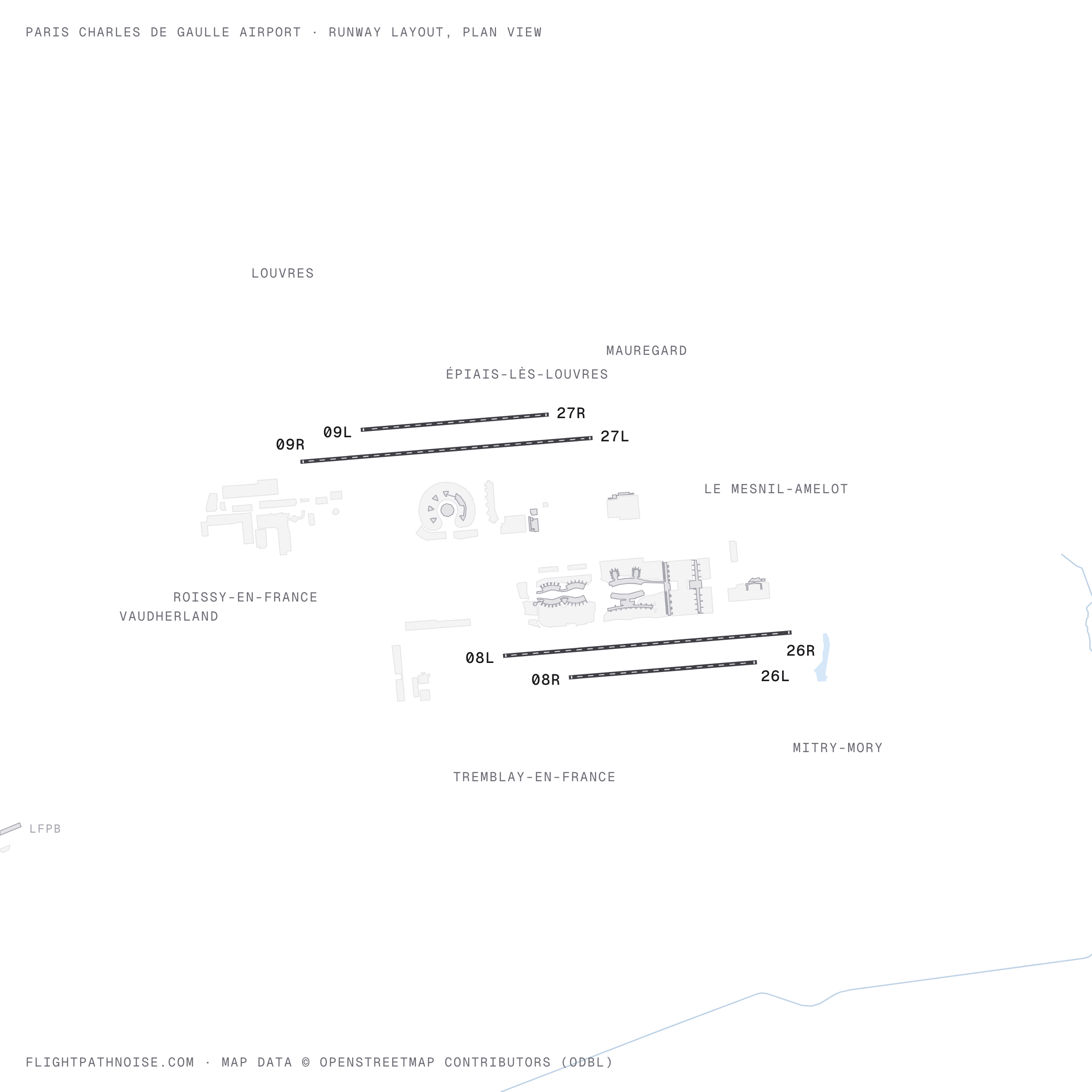
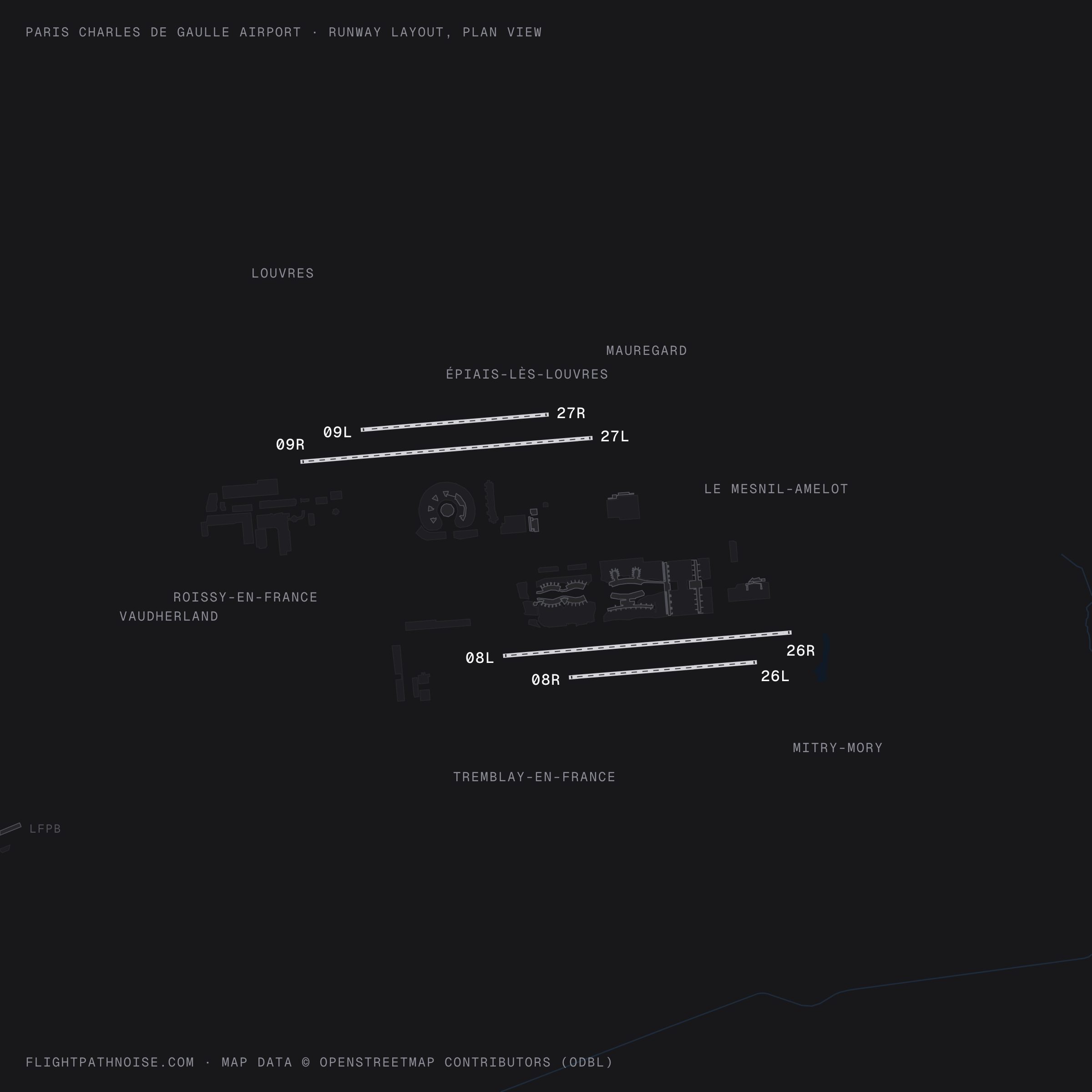
Because the airport’s four runways are arranged in two widely-spaced pairs, the noise footprint is broad — spread across communes both north and south of the field rather than concentrated on a single line. Further from the airport, towns like Sevran, Aulnay-sous-Bois and Dammartin-en-Goële hear higher-altitude traffic that is audible but less intense.
| Area | Exposure | Why |
|---|---|---|
| Roissy-en-France, Le Mesnil-Amelot, Mauregard | ✈︎✈︎✈︎ | Villages ringing the runways, low movements both directions |
| Goussainville, Gonesse | ✈︎✈︎✈︎ | Under the western corridor toward Paris |
| Tremblay-en-France, Villepinte, Mitry-Mory | ✈︎✈︎ | Beneath the southern runway pair |
| Louvres, Fosses, Sevran | ✈︎✈︎ | Approach and departure corridors further out |
| Aulnay-sous-Bois, Dammartin | ✈︎ | Higher-altitude or edge-of-area traffic |
Flight patterns and runway use
Charles de Gaulle has four parallel runways in two widely-spaced pairs, all oriented roughly east–west. The airport switches between westerly and easterly operations with the wind, which determines whether a given commune sits under departures or arrivals on a particular day. The wide spacing of the runway pairs — one set to the north of the terminals, one to the south — means the noise is spread across a broad band of communities rather than a single corridor.
The recurring controversy is the night. A 2011 government order bans the noisiest aircraft from operating at night, and there are limits on the noisiest night slots, but CDG has no blanket curfew like Orly’s. ACNUSA, the independent national authority, has repeatedly called for tighter enforcement and more legal action against carriers that breach the night rules, warning about the growth of night flights. A planned fourth terminal that would have significantly expanded the airport was cancelled in 2021, but the debate over capacity and overnight operations continues.
When is it quietest?
There is no period when flights stop entirely — that is precisely the grievance. Movements do thin out in the small hours relative to the daytime peaks, but because there is no full curfew, overnight quiet is relative and depends heavily on whether your address lies under a runway that is active that night. The hourly breakdown in the pin-drop report is the best way to see how the overnight pattern actually falls on your location.
How to check noise at your specific address
The map at the top of this page shows the overall noise and flight-density picture, but the pin drop is the most useful tool. Drop a pin on your home and the report tells you how many aircraft pass nearby, how loud they typically are, and how that activity splits across the hours of the day. Around Charles de Gaulle, where 24-hour operations and the wide runway spacing make exposure vary sharply from one commune to the next, checking your exact address matters more than the town name alone.
Frequently asked questions
- Why is there so much night noise at CDG when Orly is quiet?
- The two Paris airports are treated differently. Orly, closer to the city, has a legislated overnight curfew. Charles de Gaulle, further out to the north-east and central to France's air-cargo network, was left with lighter night restrictions, so freight and late passenger flights keep operating overnight. The pin-drop tool above shows the real overnight pattern for any address.
- Which towns are worst affected by CDG aircraft noise?
- The communes ringing the airport — Roissy-en-France, Le Mesnil-Amelot, Mauregard, Goussainville and Tremblay-en-France — get the most, sitting under low movements in both runway directions. Goussainville and Gonesse to the west, under the corridor toward Paris, have been among the most vocal. Further out, towns like Sevran and Aulnay hear higher-altitude traffic.
- Which way do the runways at CDG operate?
- Charles de Gaulle has four parallel runways in two widely-spaced pairs, all oriented roughly east–west. Like most airports it switches between "westerly" and "easterly" operations with the wind, which changes whether a given town sits under departures or arrivals on a given day. The wide spacing of the pairs means the noise footprint is broad, covering communes to both the north and south of the airport.
- What is being done about Charles de Gaulle noise?
- France's independent airport-nuisance authority, ACNUSA, monitors noise and has pressed for stronger enforcement and more legal action against carriers that breach the night rules. Aéroports de Paris publishes noise-exposure plans and runs sound-insulation assistance for nearby homes. A long-planned fourth terminal that would have expanded CDG was cancelled in 2021, but debate over capacity and night flights continues.
- How do I make an aircraft noise complaint about CDG?
- Complaints can be made to Aéroports de Paris (the airport operator) and to ACNUSA, the national authority responsible for airport noise. Logging complaints contributes to the official record that shapes France's night-flight rules and noise-exposure plans around the airport.
- When is it quietest near CDG?
- There is no period when flights stop entirely, but movements thin out in the small hours compared with the daytime peaks. Because CDG has no full curfew, "quiet" overnight is relative — and depends heavily on whether your address sits under an active runway that night. The hourly breakdown in the pin-drop report shows the pattern for your location.
- How do I check the noise at my specific address?
- Use the pin-drop tool at the top of this page. Drop a pin on your home and it reports how many aircraft pass nearby, how loud they typically are, and how that activity splits across the hours of the day — useful around CDG, where 24-hour operations and the wide runway spacing mean exposure varies a lot street to street.
Sources and further reading
- Charles de Gaulle Airport — Wikipedia
- ACNUSA — French airport noise authority — ACNUSA
- French Airport Nuisance Authority Warns of CDG Night Flights' Growth — Aviation Week
- Paris Charles de Gaulle Airport (CDG/LFPG) — COHOR
- Aéroports de Paris — environment and noise — Groupe ADP
Data updated 2026-11-22 — live ADS-B monitoring, rolling 30-day statistics (methodology). Article text revised 2026-06-12.
Other airports we track
All 174 airports →No airports in this region yet.