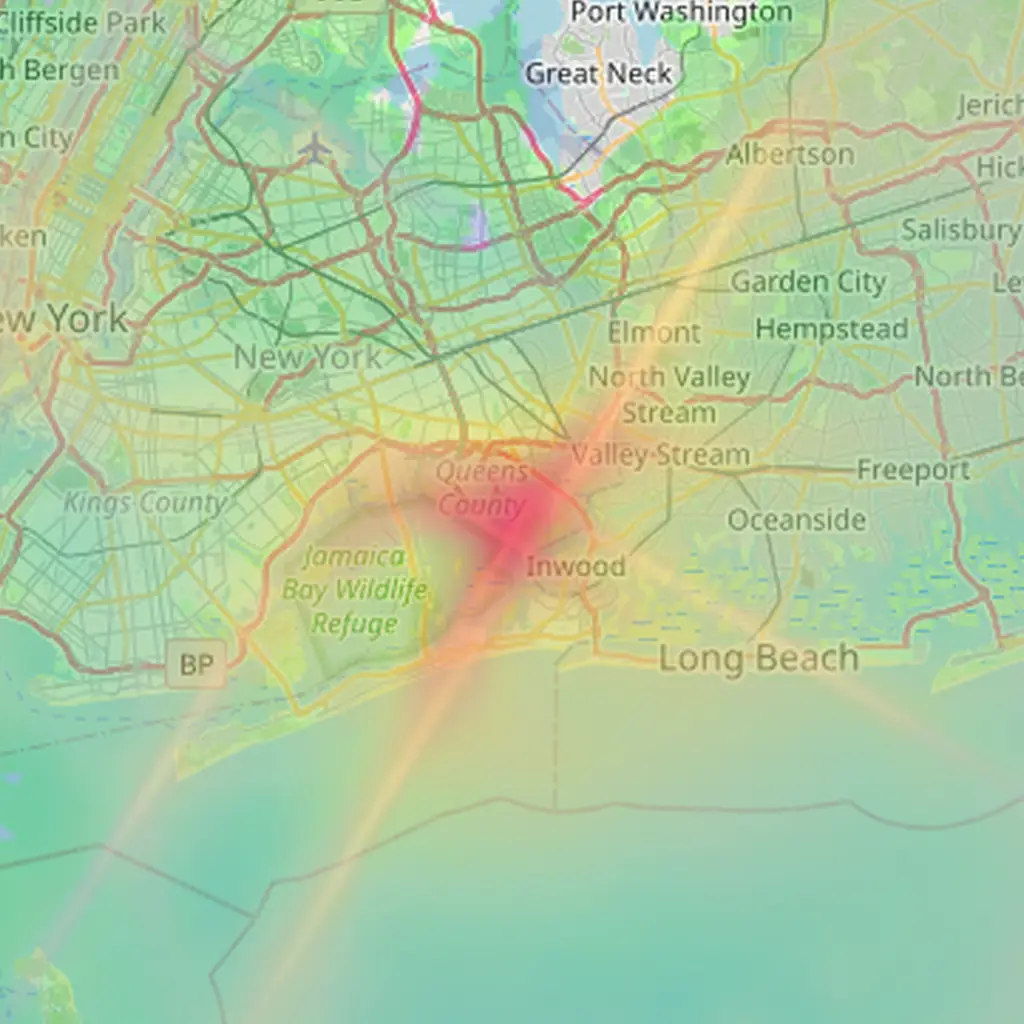
Aircraft noise around New York JFK in November 2026
Loudest neighborhoods near New York JFK: Howard Beach, Springfield Gardens, Rosedale, Inwood, Cedarhurst (Five Towns). Quietest: New Hyde Park, Belle Harbor, Atlantic Beach. Busiest around 5 PM local time averaging 1274 flights/day. Source: Flight Path Noise monitoring data, 30 days to 2026-11-23.

Does New York JFK Airport have a curfew?
No — New York JFK has no formal curfew.
JFK runs 24 hours a day and has no mandatory curfew — it routinely takes overnight diversions that miss LaGuardia’s curfew. The only nighttime measures are voluntary noise-abatement procedures, like turning 22L/22R departures to heading 240 over water at night. There was once an informal understanding to avoid 22L arrivals roughly 11 PM–7 AM, but it is not enforced, and overnight 22L arrivals have increased. That is why the most bitter complaints come from south Nassau residents woken by 4:30 AM arrivals.
John F. Kennedy International Airport (JFK/KJFK) sits on the Jamaica Bay shoreline in southern Queens, and its noise story is defined by that bay and the long approach corridor over south Nassau County. In busy periods roughly half of all arrivals land on runways 22L/22R, sending a near-continuous stream of jets low over a 25 km line of south-shore Long Island towns — Floral Park, Elmont, Valley Stream and the Five Towns — before they cross the Queens shoreline at Inwood and Far Rockaway. Unlike LaGuardia (the larger of the two city airports for noise complaints does not own that distinction by accident), JFK has no curfew and runs 24 hours, so the most bitter complaints are about overnight 22L arrivals waking residents at 4:30 AM. Departures, by contrast, are deliberately steered over water: 13-direction takeoffs climb out over Jamaica Bay, and nighttime 22L/22R measures turn jets to heading 240 to keep them off the residential shoreline.
Which neighborhoods are quietest — and which aren’t
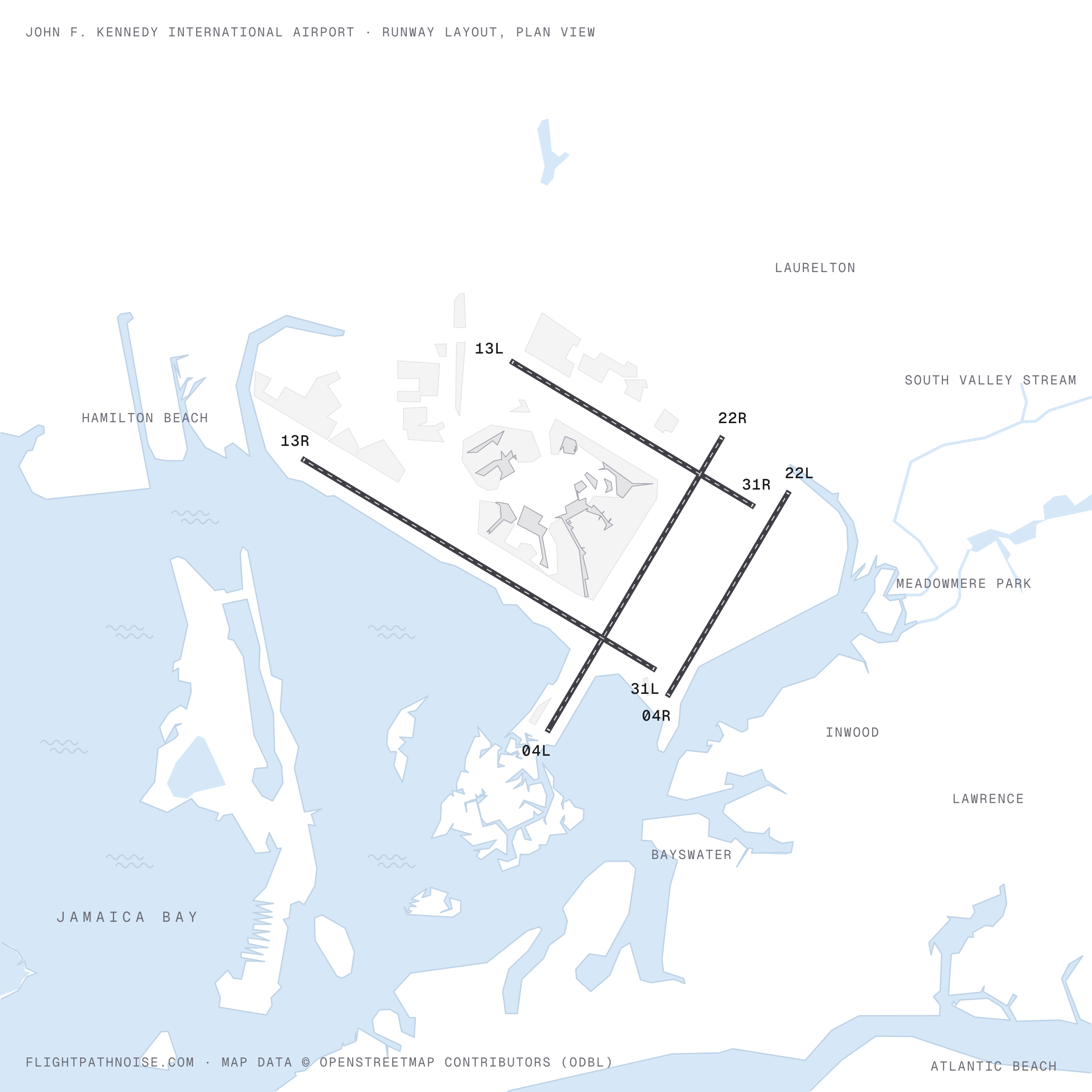
JFK has two perpendicular pairs of parallel runways. The 04/22 pair runs south-west/north-east (04L/22R, 12,079 ft; 04R/22L, 8,400 ft), and the 13/31 pair runs south-east/north-west (13L/31R, 10,000 ft; 13R/31L, 14,511 ft — the airport’s longest). With prevailing south-westerly winds the 22s carry most of the arrivals, which fixes a long approach corridor over south-east Queens and south Nassau.
If aircraft noise is the deciding factor, the practical move around JFK is to stay off the 22 approach centerline and away from the close-in shoreline. The hardest-hit band runs from Springfield Gardens and Rosedale in Queens out through Inwood, Cedarhurst and Valley Stream in Nassau — these are the towns directly under low arrivals every time the 22s are in use. Further out (New Hyde Park) or off to the side on the Rockaway beaches (Belle Harbor, Atlantic Beach), aircraft are higher or the noise is mostly intermittent over-water departure noise. If you’re house-hunting in south Nassau or the Five Towns, drop a pin on the map above to see your specific street’s exposure.
| Area | Noise | Why |
|---|---|---|
| Springfield Gardens | ✈︎✈︎✈︎ | Directly north under 04 departures and 22 arrivals; has a noise monitor |
| Rosedale | ✈︎✈︎✈︎ | On the 22L/22R final-approach line at the Queens-Nassau border |
| Inwood | ✈︎✈︎✈︎ | First Nassau town under the 22 approach as jets cross the shoreline |
| Cedarhurst (Five Towns) | ✈︎✈︎✈︎ | Directly under the 22L/22R corridor; complaint-heavy, has a monitor |
| Valley Stream | ✈︎✈︎✈︎ | On the extended 22 centerline; named in overnight complaints |
| Howard Beach | ✈︎✈︎✈︎ | Just west of the field; 31L arrivals, over-water departures, ground noise |
| South Ozone Park | ✈︎✈︎ | 04 departures plus taxi and ground noise |
| Far Rockaway | ✈︎✈︎ | Shoreline under 31R/31L approaches; intermittent |
| Elmont | ✈︎✈︎ | Higher-altitude 22 approach further out |
| Floral Park | ✈︎✈︎ | Long 22 corridor; monitor confirms elevated overnight decibels |
| Arverne | ✈︎✈︎ | Rockaway peninsula under southern tracks; two monitors |
| New Hyde Park | ✈︎ | Far end of the 22 corridor; aircraft are high |
| Belle Harbor | ✈︎ | Off the main corridor; mostly over-water departure noise |
| Atlantic Beach | ✈︎ | South-shore beach off the approach line; occasional only |
Flight patterns and runway use
JFK’s runway selection is officially based on wind, weather, traffic volume, safety, efficiency and noise — but the geography does most of the work. The two pairs of runways form a cross on the Jamaica Bay shoreline, and the prevailing south-westerly wind tips the balance heavily toward arrivals on the 22s. Runways 22L/22R take close to half of all arrivals in busy periods and as much as ~76% in some months, which is why the approach corridor over south Nassau and south-east Queens is the defining feature of JFK’s noise footprint. Aircraft on that approach pass over Floral Park around 5.6 miles out and continue down over Valley Stream, Cedarhurst, Inwood and Rosedale before crossing the shoreline.
Departures are routed over water wherever possible. 13-direction takeoffs climb out south-east over Jamaica Bay, and 04 departures head north-east over Springfield Gardens and the close-in Queens neighborhoods. The 14,511 ft 13R is used by heavy long-haul departures routing over the bay. At night, voluntary noise-abatement procedures kick in: 22L/22R departures are turned to heading 240 to send jets over water away from homes, and 31L departures are asked to turn south over the bay rather than climb out over the close-in residential shoreline. NADP-2 is the standard departure profile unless otherwise specified.
The FAA approved JFK’s 14 CFR Part 150 Noise Compatibility Program in March 2023, with 22 measures including 7 noise-abatement measures. The route-density layer on the map above makes the pattern obvious: a long, bright arrival corridor stretching north-east toward Nassau, an over-water departure fan to the south and south-east across Jamaica Bay, and a secondary north-east departure band over Springfield Gardens.
When is it quietest?
JFK’s lack of a curfew is the single most important fact for residents under the 22 approach. There is no guaranteed quiet window:
- Overnight (11 PM – 6 AM): this is the contested period. JFK takes overnight diversions that miss LaGuardia’s curfew, and overnight 22L arrivals have increased — these are the 4:30 AM arrivals that generate the bulk of south-Nassau complaints. The only protection is voluntary, and only on the departure side.
- 6 AM – 9 AM: morning departure bank builds; heavy over-water and north-east departures.
- Midday (10 AM – 3 PM): sustained arrivals and departures.
- Evening arrival bank (5 PM – 9 PM): peak. International long-haul arrivals stacked from Europe and beyond, concentrated on the 22s when the wind favours them — the busiest overflight period for the south Nassau and Five Towns corridor.
The other variable is wind direction. When winds swing away from the south-west, the operation can shift to the 13/31 pair and push more noise over the Rockaways and Howard Beach instead of south Nassau. A pin drop on the map above shows the hourly profile for your address so you can see whether your street’s worst period is the evening arrival bank or the overnight arrivals.
How to check noise at your specific address
The map above answers “is this spot loud?” Three steps:
- Search your address or postcode in the bar at the bottom of the map.
- Drop a pin — click the location marker that appears.
- Read the noise report in the panel below the map: average daily noise (Leq), peak observed dB, flights per day loud enough to hear there, and an hourly breakdown.
The Noise Heatmap layer (orange/red = louder) and the Route Density layer (purple/magenta = busier corridors) make the 22 approach corridor stand out as a long band running north-east from the shoreline into Nassau. Addresses on that centerline — Rosedale, Inwood, Cedarhurst, Valley Stream — will read high, especially overnight, while Rockaway-beach and outer-Nassau addresses generally land in the quieter range.
If you want to formally log noise, contact the Port Authority of New York & New Jersey Noise Management Office through its PlaneNoise system: call 1-800-225-1071 or submit online at aircraftnoise.panynj.gov. Logged complaints and the Port Authority’s fixed noise monitors — in Springfield Gardens, South Ozone Park, Inwood, Cedarhurst, Valley Stream, Floral Park, Arverne and Belle Harbor — feed the data behind JFK’s Part 150 program.
Frequently asked questions
- Why are planes so low over Nassau County and the Five Towns?
- With prevailing south-westerly winds, JFK favours runways 22L and 22R for arrivals — close to half of all arrivals in busy periods, and as much as ~76% in some months. That sends a near-continuous stream of jets down a long approach corridor over south Nassau (Floral Park, Elmont, Valley Stream) and across the Five Towns and Queens shoreline (Inwood, Cedarhurst, Rosedale, Far Rockaway). A 2019 agreement holds 22L/22R arrivals at or above 3,000 ft within 15 miles, but the corridor is fixed, so the same towns get the traffic every time the 22s are in use.
- What is the JFK runway 22L 'runway of last resort'?
- Runway 22L (the 04R/22L pair, 8,400 ft) is the most contested at JFK. Its overnight arrivals pass low over Floral Park, Elmont, New Hyde Park and Valley Stream, generating the bulk of Nassau County noise complaints. Residents call it the 'runway of last resort' because it tends to be used when the busier 22R cannot absorb all the arrivals — and arrival volume on the 22L/22R pair reached roughly 76% of monthly arrivals in some peak months.
- Why is Cedarhurst and the Five Towns so affected by JFK noise?
- Cedarhurst and the surrounding Five Towns sit directly under the 22L/22R approach corridor as jets cross the shoreline toward JFK. Cedarhurst is one of the most complaint-heavy communities in the area and hosts a Port Authority noise monitor. Inwood, the first Nassau town under the approach, also has a monitor. Drop a pin on the map above to see how many flights pass over your specific street and how loud they are.
- Is Howard Beach loud from JFK?
- Howard Beach sits on the same mainland-Queens shoreline just west of the field, so it gets a mix of 31L arrivals, close-in 13-direction over-water departures and ground noise from taxiing aircraft. It is exposed but the character is different from the south-Nassau corridor — more departure and ground noise than the steady low-arrival stream that the Five Towns and Rosedale get.
- How are JFK departures routed to reduce noise?
- Departures are steered over water wherever possible. 13-direction takeoffs climb out south-east over Jamaica Bay, and 04 departures head north-east. At night, 22L/22R departures are turned to heading 240 to send jets over water away from homes, and 31L departures are asked to turn south over the bay rather than over the close-in residential shoreline. NADP-2 is the standard departure profile. The FAA approved JFK's Part 150 Noise Compatibility Program in March 2023, with 22 measures including 7 noise-abatement measures.
- What is the JFK noise complaint phone number?
- Aircraft noise at JFK is handled by the Port Authority of New York & New Jersey's Noise Management Office through its PlaneNoise system. You can call 1-800-225-1071 or submit a complaint online at aircraftnoise.panynj.gov. The Port Authority also runs WebTrak and a network of fixed noise monitors across Queens and south Nassau (including Springfield Gardens, Inwood, Cedarhurst, Valley Stream and Floral Park).
- Which JFK neighborhoods are quietest for aircraft noise?
- The quietest spots are off the 22 approach centerline and away from the close-in shoreline — outer-corridor towns like New Hyde Park, and western/eastern Rockaway beaches such as Belle Harbor and Atlantic Beach, where most of what you hear is intermittent over-water departure noise rather than a steady arrival stream. The hardest-hit areas are the 22 approach corridor (Rosedale, Inwood, Cedarhurst, Valley Stream) and north-of-field Springfield Gardens. Use the pin-drop tool above to check any address.
Sources and further reading
- Aircraft Noise — Submit a Noise Complaint / WebTrak — Port Authority of New York & New Jersey
- JFK Noise Monitor Locations — Port Authority of New York & New Jersey
- Approval of John F. Kennedy International Airport (JFK) Noise Compatibility Program — FAA / Federal Register
- John F. Kennedy International Airport — Wikipedia — Wikipedia
- Long Island residents say noise from JFK overnight arrivals on the rise — CBS News New York
- New York, New York John F. Kennedy International (AIP AD 2.0) — Federal Aviation Administration
Data updated 2026-11-23 — live ADS-B monitoring, rolling 30-day statistics (methodology). Article text revised 2026-06-12.
Other airports we track
All 174 airports →No airports in this region yet.