
Aircraft noise around Chiang Mai in October 2026
Loudest neighborhoods near Chiang Mai: Nimman (Nimmanhaemin). Quietest: Chang Phuak (Chang Pueak), Old City (inside the moat), Mae Rim. Busiest around 9 PM local time averaging 164 flights/day. Source: Flight Path Noise monitoring data, 30 days to 2026-10-27.

Does Chiang Mai Airport have a curfew?
No — Chiang Mai has no formal curfew.
CNX has been licensed for 24-hour operation since 2014. In practice scheduled traffic clusters between 6 AM and midnight, with a quieter overnight window that still sees occasional cargo and repositioning flights. Residents have raised concerns about late-night noise; the heatmap and pin-drop tool above show actual observed activity rather than the published schedule.
If you’re considering a move to Chiang Mai — for a year of nomad life, a long-term lease, or a property purchase — aircraft noise is one of the variables you can’t easily check from a listing photo. This page combines a live ADS-B map of every flight passing CNX with neighborhood- specific notes so you can decide where the noise is worth tolerating and where it isn’t. Scroll back up at any point to drop a pin on the exact address you’re considering.
Which neighborhoods are quietest — and which aren’t
Chiang Mai’s runway runs north–south, and the city centre sits just north of the airport. That geometry creates a clear noise gradient across the popular residential and nomad areas:
If you’re noise-sensitive and you want the nomad scene anyway, the practical move is Santitham or Chang Phuak — both are walkable to Nimman’s coworking spaces and cafés but step out of the worst of the overhead noise. East of the Ping River and west of Doi Suthep are near-silent for aircraft.
| Area | Noise | Why |
|---|---|---|
| Nimman / Nimmanhaemin | ✈︎✈︎✈︎ | Sits directly under the northern departure path. Most takeoffs cross overhead. |
| Santitham | ✈︎✈︎ | North of Nimman and slightly east of the takeoff line. Quieter than Nimman, still in the corridor. |
| Chang Phuak (Chang Pueak) | ✈︎ | Off the main flight path. The quietest of the three central nomad-friendly areas. |
| Old City (inside the moat) | ✈︎ | Most flights track west of the moat. Central Old City stays relatively quiet. |
| Hang Dong / Mae Hia | ✈︎✈︎ | South of the airport, under the arrival path on north-flow days. |
| Mae Rim, Doi Saket, San Sai | ✈︎ | Far enough out that aircraft are at altitude. Minimal exposure. |
Flight patterns and runway use
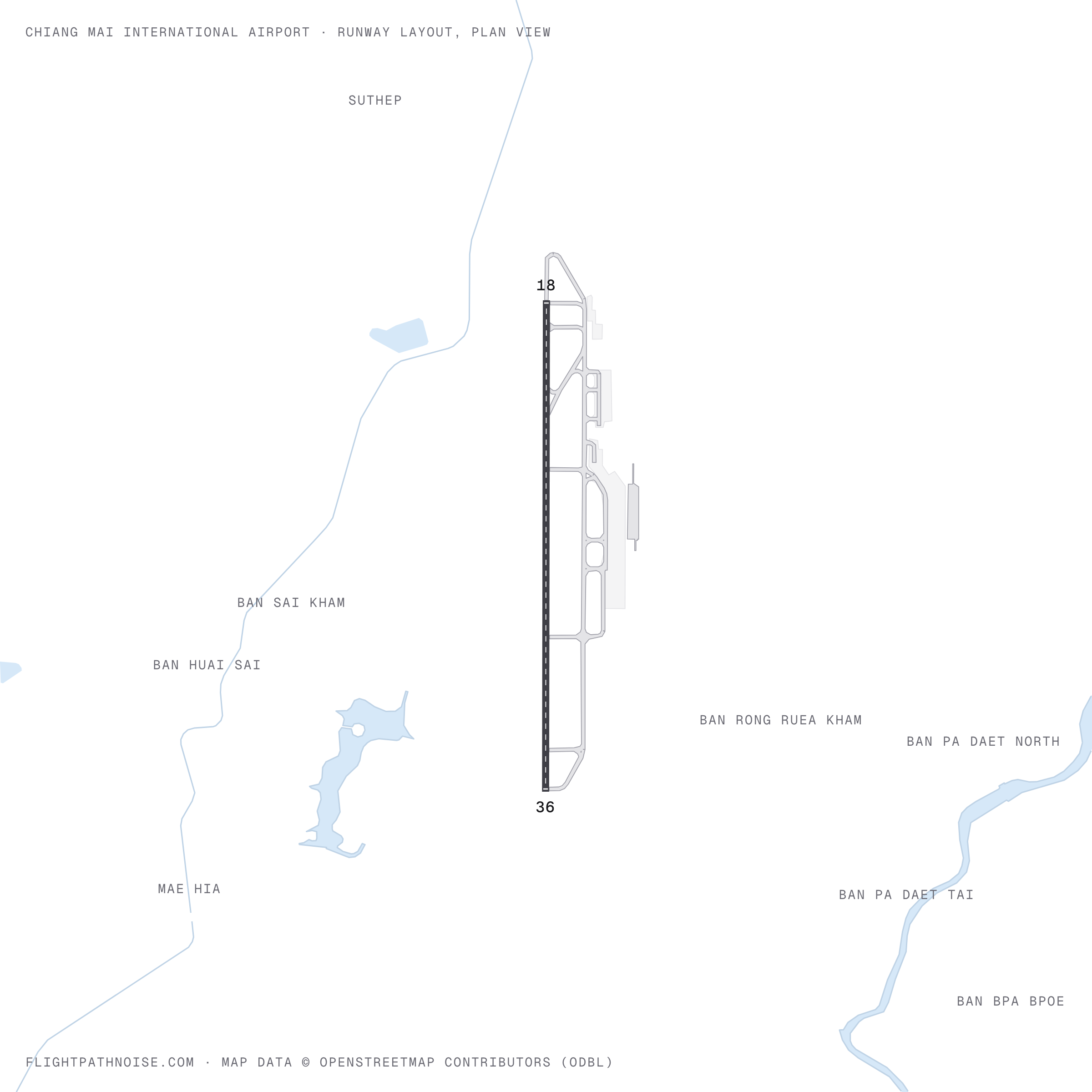
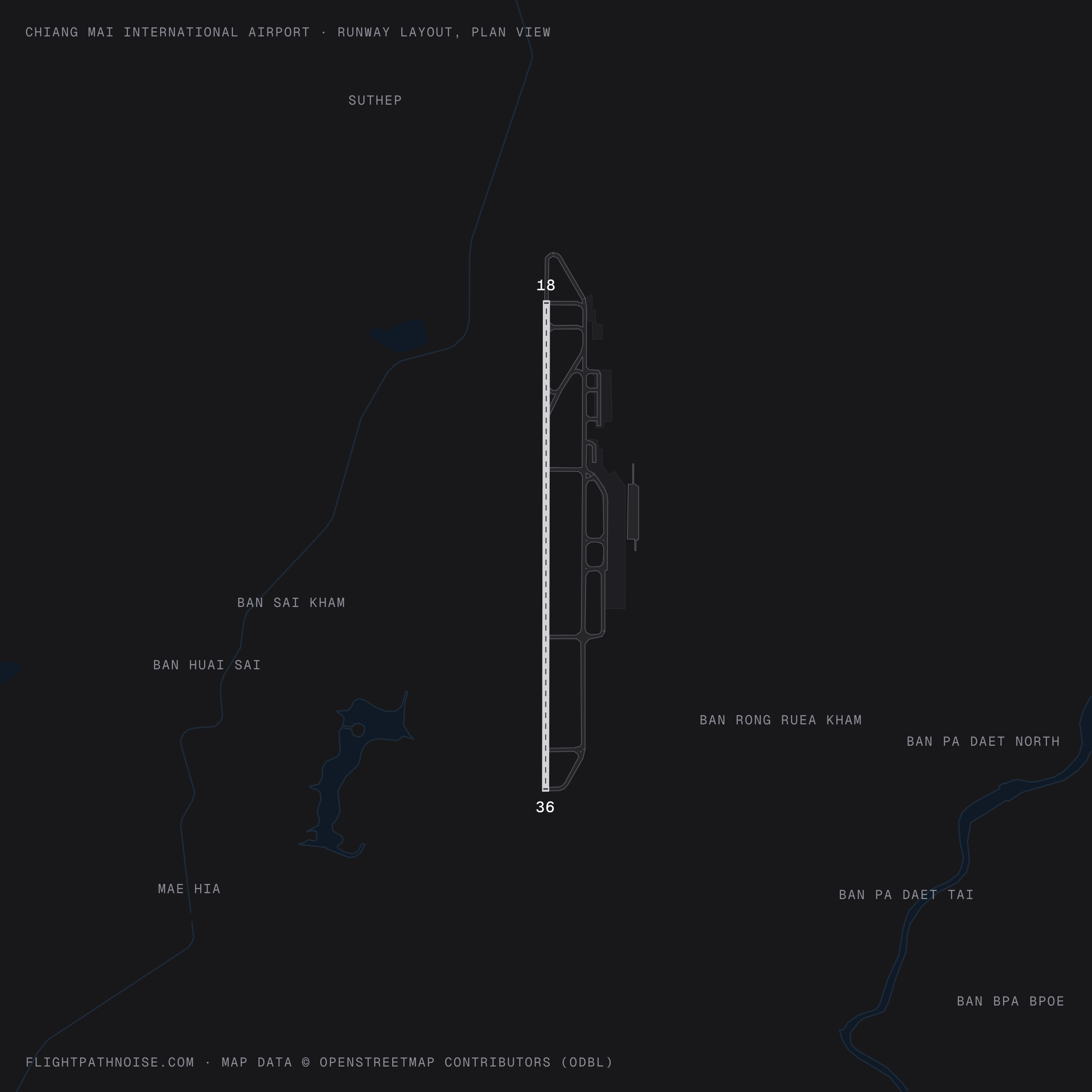
CNX has a single runway (18/36) that runs almost true north–south. Aircraft typically depart to the north (Runway 36), turning right shortly after liftoff and tracking roughly along the Super Highway as they climb out. This is why Nimman and the western edge of Santitham get most of the takeoff noise — they sit directly under that climb profile.
Approaches usually come from the south (also Runway 36), passing over Hang Dong and Mae Hia before touchdown. When wind is from the south, the airport flips: traffic departs south over Hang Dong and approaches from the north over Mae Rim and Nimman. The route-density layer above shows the cumulative picture of how often each path is used at the moment, weighted by recent observations.
When is it quietest?
CNX scheduled traffic clusters between roughly 7 AM and 11 PM, with the busiest hour usually around midday. The 1 AM – 5 AM stretch is genuinely quiet — only a handful of overnight cargo or repositioning flights — but the airport has been licensed for 24-hour operation since 2014, so an occasional late flight is part of life under the flight path.
For a specific address, the noise report (drop a pin above) breaks the last 30 days of data down by hour of local time, so you can see how quiet a quiet hour really is at your spot. If you keep traditional sleeping hours and live well off the runway centerline, you’ll mostly sleep through CNX. If you live in central Nimman, expect at least a few audible overflights between 6 and 7 AM.
How to check noise at your specific address
The map above is the answer to “is this spot loud?” Three quick steps:
- Search your address or postcode in the bar at the bottom of the map.
- Drop a pin — click the location marker that appears.
- Read the noise report that opens in a panel below the map: average daily noise (Leq), peak observed dB, flights per day passing within 2 km, and an hourly breakdown so you can see when those flights happen.
The Noise Heatmap layer (orange/red = louder) and the Route Density layer (purple/magenta = busier flight corridors) give you the city-wide context. Toggle them in the Layers panel beside the map. The Live Aircraft layer shows what’s currently overhead in real time — useful for verifying that what you see on the heatmap matches what you experience on the ground.
Frequently asked questions
- How often do planes fly over Nimman?
- Nimman sits directly under the northern departure path, so most takeoffs from CNX cross overhead. On a typical day that's 60–80 flights, concentrated between 7 AM and 11 PM. Use the pin-drop tool above to see the count for your specific address and time window.
- Which Chiang Mai neighborhoods are quietest for digital nomads?
- Chang Phuak (north of the gate) and the central Old City both sit off the main flight path. Among the three popular nomad areas — Nimman, Santitham, and Chang Phuak — Chang Phuak is by far the quietest from aircraft.
- When are flights quietest at CNX?
- The 1 AM – 5 AM window is the quietest stretch — far fewer flights than peak midday hours. Use the pin-drop noise report's hourly breakdown to see how that translates to your address.
- Should I avoid Nimman if I work from home?
- If you take video calls or are sensitive to noise, yes — most nomads who work from home say Nimman gets disruptive on busy departure days. Santitham is a moderate compromise; Chang Phuak or the central Old City are far quieter.
- Does aircraft noise affect property prices in Chiang Mai?
- Research on aircraft noise consistently shows a 0.5–1.0% house-price reduction per decibel of average daily noise. Properties directly under the CNX departure path (Nimman especially) trade at a measurable discount versus comparable properties a few blocks east or in Chang Phuak.
- How does Chiang Mai's noise compare to Bangkok?
- CNX has roughly a tenth of Bangkok Suvarnabhumi's traffic, so the average exposure is much lower. But CNX's runway sits much closer to the city centre, so for residents directly under the flight path the per-event noise can feel comparable. Compare the heatmap to Bangkok's via the airport directory.
Sources and further reading
- CNX 24-hour operating hours coverage — Bangkok Post
- Assessment of Air Traffic Noise level — Chiang Mai International Airport — Research study (2024)
- Chiang Mai International Airport overview — Wikipedia
- VTCC ATC procedures (runway use, approach paths) — IVAO Documentation
Data updated 2026-10-27 — live ADS-B monitoring, rolling 30-day statistics (methodology). Article text revised 2026-04-29.
Other airports we track
All 173 airports →No airports in this region yet.