
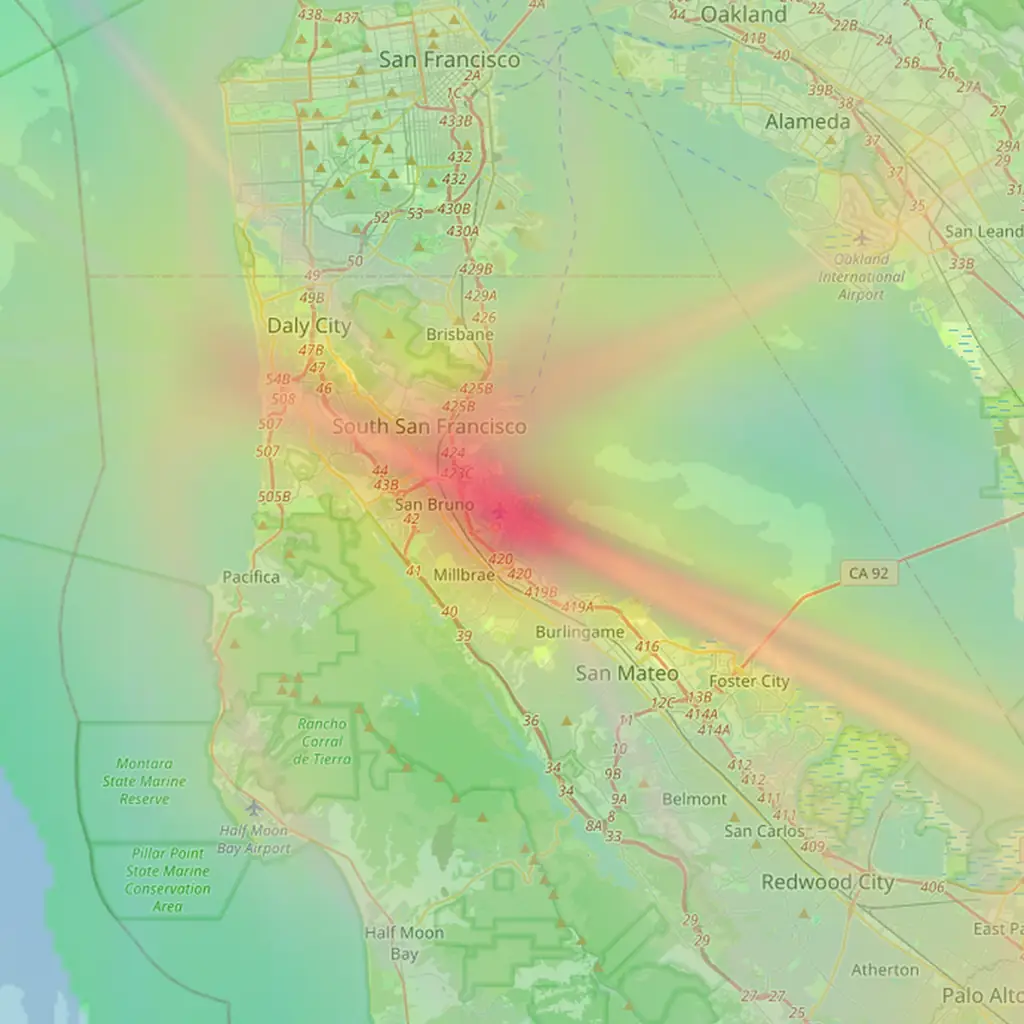
San Francisco Flight Path Noise Map – San Francisco International Airport (SFO)
Aircraft noise around San Francisco in October 2026
Loudest neighborhoods near San Francisco: San Bruno (Crestmoor / Rollingwood area), South San Francisco (Westborough), Millbrae, Brisbane. Quietest: Colma, Belmont, Half Moon Bay, Redwood City. Busiest around 2 PM local time averaging 1594 flights/day. Source: Flight Path Noise monitoring data, 30 days to 2026-10-08.
Does San Francisco Airport have a curfew?
No — San Francisco has no formal curfew.
SFO has no mandatory curfew or night flight ban. Noise control overnight is voluntary, run through the Jon C. Long Fly Quiet Program and the SFO/Community Roundtable. Between roughly 1 AM and 6 AM the airport asks airlines to depart east from Runways 10L/10R out over the Bay, and to fly Shoreline or Gap departure turns away from homes west of the field. Compliance is scored and awarded annually rather than enforced — there are no fines.
San Francisco International Airport (SFO/KSFO) has a noise story defined less by a curfew and more by a tech-and-data-fuelled residents’ revolt. When the FAA rolled out its satellite-based NextGen flight paths in 2015, the broad arrival and departure swaths over the Peninsula were squeezed into narrow “superhighways in the sky,” concentrating jet noise over a handful of neighborhoods and detonating complaint volumes — from a few hundred a month by dozens of people into hundreds of thousands a year from thousands of residents. Geometry makes SFO unusual: with two intersecting pairs of closely-spaced parallel runways on a narrow bayfront shelf, the airport leans on the prevailing west-northwesterly San Bruno Gap wind to run its West Plan roughly 81% of the time — arrivals in low over the water, departures climbing out to the north. There is no mandatory curfew; instead SFO relies on a voluntary Fly Quiet program to keep jets off the dense residential blocks immediately west of the field. The result is a long-running, well-organized community-roundtable fight that is as much about flight-path politics as raw decibels.
Which neighborhoods are quietest — and which aren’t
SFO has four runways arranged as two intersecting, closely-spaced parallel pairs: the 1/19 pair (1L/19R at 2,332 m and 1R/19L at 2,637 m) and the longer 10/28 pair (10L/28R at 3,618 m, the longest, and 10R/28L at 3,469 m). Under the dominant West Plan, the 1s handle domestic departures northbound and the 28s handle arrivals and overseas departures from the east. That fixed geometry — squeezed onto a narrow shelf between the Bay and the Peninsula hills — is what makes some communities consistently loud and others nearly clear.
| Area | Aircraft noise | Why |
|---|---|---|
| San Bruno (Crestmoor/Rollingwood) | ✈︎✈︎✈︎ | Off the west end of 28/10; under 28 straight-out and Shoreline departures |
| South San Francisco (Westborough) | ✈︎✈︎✈︎ | Within the FAA 65 dB contour; under departure and turn paths |
| Millbrae | ✈︎✈︎✈︎ | Directly beneath the West Plan 28 arrival final approach |
| Brisbane | ✈︎✈︎✈︎ | Under northbound 1L/1R departure climb-outs |
| Hillsborough | ✈︎✈︎ | Off the south end under West Plan arrival corridors |
| Burlingame | ✈︎✈︎ | Bay shore on the 28 arrival approach side |
| Pacifica | ✈︎✈︎ | Over the hills under 28 departures and turns |
| Daly City | ✈︎✈︎ | Wind- and route-dependent departure overflight |
| Foster City | ✈︎✈︎ | Across the bay on the 28 arrival path |
| San Mateo | ✈︎✈︎ | Under arrival corridors feeding the 28 finals |
| Colma | ✈︎ | Off the primary corridors; mostly non-residential land |
| Belmont | ✈︎ | Down-Peninsula; intermittent high-altitude arrivals |
| Half Moon Bay | ✈︎ | Coastal, beyond the hills and largely off-corridor |
| Redwood City | ✈︎ | Higher-altitude arrival flows merging toward SFO |
If aircraft noise is your primary concern, the pattern around SFO is strongly east-west and runway-driven rather than a simple distance ring. The communities packed in tight off the west ends of the runways — San Bruno, South San Francisco’s Westborough, Millbrae — and the departure-corridor cities to the north (Brisbane) are the most consistently affected. Down-Peninsula cities like Belmont and Redwood City, and the coastal towns beyond the hills like Half Moon Bay, catch traffic at much higher altitude and far less often. Because so much of SFO’s exposure is about which narrow NextGen track you happen to sit under, two homes a few blocks apart can differ sharply — drop a pin on the map above to see your specific street.
Flight patterns and runway use
SFO’s runway use is dictated by wind, and the prevailing wind here is unusually consistent. West-northwesterly air funnels through the San Bruno Gap in the coastal hills, which lets the airport run its West Plan about 81% of the time. Under the West Plan, domestic departures use Runways 1L/1R, climbing out northbound over Brisbane and away from the homes immediately west of the field, while arrivals and overseas/heavy departures use Runways 28L/28R — descending in low over the Bay and the bay-shore communities from the east. That split is why Millbrae and Burlingame hear arrivals while Brisbane hears departures.
During rainstorms — roughly 4% of the time — winds back around to the south-southeast and the airport switches to the Southeast Plan, departing on Runways 10 and arriving on Runways 19. It’s infrequent, but it briefly reverses who hears what.
Overnight, SFO’s voluntary noise-abatement procedures kick in. The preferred move is to depart east from Runways 10L/10R out over the Bay between roughly 1 AM and 6 AM. If a westbound 28 departure is unavoidable, pilots are asked to fly the Shoreline Departure or the Gap (Quiet) Departure, both of which turn right immediately after takeoff to avoid the dense neighborhoods directly west of the field. The straight-out 28 departure overflies populated communities — San Bruno worst of all — and is the least-desirable procedure, discouraged at all hours.
The route-density layer on the map above shows the cumulative result of the 2015 NextGen redesign: bright, narrow corridors rather than the diffuse smears of the pre-2015 era. SFO has since tested enhanced and precision navigation to slightly disperse or shift specific tracks (for example over Brisbane), but the concentrated-corridor character is still the root of the modern complaint surge.
When is it quietest?
SFO has no curfew, so there is no guaranteed silent window the way Sydney or London Heathrow residents get. What you have instead is a voluntary overnight lull and the natural ebb of the schedule:
- 1 AM – 6 AM: lightest traffic, and what little flies is asked to depart east over the Bay on Runways 10L/10R under the Fly Quiet preferential-runway program. Quiet for west-side communities, but not silent and not enforced.
- 6 AM – 9 AM: morning departure bank builds; domestic 1L/1R climb-outs ramp up over Brisbane and the north.
- Midday: sustained arrivals on the 28s over Millbrae, Burlingame and the bay shore.
- Late afternoon – evening: heavy international and domestic arrival banks stack onto the 28 finals; this is often the most relentless stretch for the bay-shore arrival corridor.
- Late evening: tapers, but with no hard curfew, late and delayed flights can still arrive well past midnight.
The other variable is wind. The West Plan holds most of the time, but a rare rainstorm flipping the airport to the Southeast Plan will suddenly move the noise — arrivals shifting to Runway 19 over the south, departures to Runway 10 over the Bay. For the hour-by-hour profile at your address, drop a pin on the map above.
How to check noise at your specific address
Because SFO’s exposure is so track-dependent, a citywide generalization won’t tell you whether your block is loud. The map above will. Three steps:
- Search your address or postcode in the bar at the bottom of the map.
- Drop a pin — click the location marker that appears.
- Read the noise report in the sidebar: average daily noise (Leq), peak observed dB, flights per day passing within 2 km, and an hourly breakdown.
The Noise Heatmap layer (orange/red = louder) and the Route Density layer (purple/magenta = busier corridors) make the West Plan pattern obvious — the northbound 1L/1R departure corridor over Brisbane and the inbound 28 arrival corridor over the bay shore. Addresses outside the tight ring of high-exposure west-side and north-side communities (San Bruno, Westborough, Millbrae, Brisbane) generally land in the quieter zone.
If you want to act on what you find, file with the SFO Aircraft Noise Abatement Office at flysfo.com/about/community-noise/report-aircraft-noise, by phone on +1-650-821-4736, or by email to sfo.noise@flysfo.com. Logged complaints feed the SFO/Community Roundtable, which tracks them by neighborhood — the same data-driven pressure that put SFO’s NextGen flight paths on the map in the first place.
Frequently asked questions
- Why are planes suddenly so loud over the Peninsula?
- The usual answer is NextGen. When the FAA rolled out satellite-based flight paths in 2015, the broad arrival and departure swaths over the Peninsula were squeezed into narrow, repeatable corridors — the same tracks flown over the same neighborhoods, hundreds of times a day. Total noise didn't necessarily rise, but its concentration did, and complaint volumes jumped from a few hundred a month to hundreds of thousands a year. Drop a pin on the map above to see whether your address sits under one of those concentrated tracks.
- Is San Bruno loud from SFO planes?
- Yes — San Bruno (especially the Crestmoor and Rollingwood areas) is among the most overflown communities around SFO. It sits just off the west end of the 28/10 runways, directly under 28 straight-out and Shoreline departure tracks. A straight-out departure on Runway 28 is the least-desirable, most-overhead procedure and is discouraged at all hours, but it still happens. Use the pin-drop tool above to see the flight count for your specific street.
- Is Millbrae affected by SFO arrival noise?
- Yes. Millbrae sits immediately south of the airport, directly beneath the West Plan Runway 28 arrival final approach as aircraft descend in low over the bay shore. Because the West Plan runs about 81% of the time, that arrival stream is the dominant noise source for Millbrae most days.
- Why is Brisbane noisy when it's north of the airport?
- Brisbane sits under the northbound climb-out from Runways 1L/1R, which are the primary domestic departure runways under the West Plan. So Brisbane's noise comes from departures clawing for altitude rather than arrivals. It has been a focus of SFO's precision-navigation tests aimed at shifting or dispersing those departure tracks.
- Which runways does SFO use most, and why does it matter for noise?
- SFO has four runways in two intersecting closely-spaced pairs. The prevailing west-northwesterly wind funnels through the San Bruno Gap and supports the West Plan about 81% of the time — domestic departures climb out north on 1L/1R, while arrivals and overseas departures use 28L/28R, descending in low over the Bay. In rainstorms (~4%) winds shift and the airport flips to the Southeast Plan, departing on 10 and arriving on 19. Your noise exposure depends heavily on which plan is running.
- How do I report SFO aircraft noise?
- Contact the SFO Aircraft Noise Abatement Office. File online at flysfo.com/about/community-noise/report-aircraft-noise, call +1-650-821-4736 (alternate 1-877-206-8290), or email sfo.noise@flysfo.com. Complaints feed into the SFO Airport/Community Roundtable, which tracks them by neighborhood and uses them to push for flight-path changes.
- Does coverage on this map include all aircraft?
- Yes — SFO's commercial fleet has near-complete ADS-B coverage, so the heatmap and route-density layers reflect actual traffic accurately. The main gaps are a small amount of general-aviation traffic from nearby reliever fields, which doesn't operate from SFO.
Sources and further reading
- San Francisco International Airport — Wikipedia — Wikipedia
- Fly Quiet Program — preferential runways, Shoreline/Gap departures — SFO Airport/Community Roundtable
- Report Aircraft Noise / Noise Abatement Office contact — San Francisco International Airport (flySFO)
- SFO Noise Complaints Skyrocket After Flight Paths Changed — CBS News San Francisco
- New SFO flight paths causing record airplane noise complaints — Peninsula Press
- SFO tests system to reduce flight noise in nearby neighborhoods — ABC7 News
Data updated 2026-10-08 — live ADS-B monitoring, rolling 30-day statistics (methodology). Article text revised 2026-06-12.
Other airports we track
Adelaide, Australia
Adelaide Airport ADL
Alicante, Spain
Alicante-Elche Miguel Hernández Airport ALC
Amsterdam, Netherlands
Amsterdam Schiphol Airport AMS
Archerfield, Australia
Archerfield Airport YBAF
Athens, Greece
Athens International Airport Eleftherios Venizelos ATH
Atlanta, USA
Hartsfield-Jackson Atlanta International Airport ATL
Auckland, New Zealand
Auckland Airport AKL
Austin, USA
Austin–Bergstrom International Airport AUS
Bali, Indonesia
Ngurah Rai International Airport DPS
Ballina, Australia
Ballina Byron Gateway Airport BNK
Baltimore, USA
Baltimore/Washington International Thurgood Marshall Airport BWI
Bangalore, India
Kempegowda International Airport BLR
Bangkok, Thailand
Suvarnabhumi Airport BKK
Bankstown, Australia
Bankstown Airport YSBK
Barcelona, Spain
Barcelona–El Prat Airport BCN
Basel, France
EuroAirport Basel Mulhouse Freiburg BSL
Beirut, Lebanon
Beirut–Rafic Hariri International Airport BEY
Belfast City, UK
George Best Belfast City Airport BHD
Berlin, Germany
Berlin Brandenburg Airport BER
Bilbao, Spain
Bilbao Airport BIO
Billy Bishop, Canada
Billy Bishop Toronto City Airport YTZ
Birmingham, UK
Birmingham Airport BHX
Bogotá, Colombia
El Dorado International Airport BOG
Boston, USA
Boston Logan International Airport BOS
Brisbane, Australia
Brisbane Airport BNE
Bristol, UK
Bristol Airport BRS
Brussels, Belgium
Brussels Airport BRU
Brussels Charleroi, Belgium
Brussels South Charleroi Airport CRL
Budapest, Hungary
Budapest Ferenc Liszt International Airport BUD
Buenos Aires, Argentina
Aeroparque Jorge Newbery AEP
Canberra, Australia
Canberra Airport CBR
Cape Town, South Africa
Cape Town International Airport CPT
Cartagena, Colombia
Rafael Núñez International Airport CTG
Charlotte, USA
Charlotte Douglas International Airport CLT
Chiang Mai, Thailand
Chiang Mai International Airport CNX
Chicago, USA
Chicago Midway International Airport MDW
Chicago O'Hare, USA
Chicago O'Hare International Airport ORD
Christchurch, New Zealand
Christchurch International Airport CHC
Cologne, Germany
Cologne Bonn Airport CGN
Copenhagen, Denmark
Copenhagen Airport CPH
Cusco, Peru
Alejandro Velasco Astete International Airport CUZ
Da Nang, Vietnam
Da Nang International Airport DAD
Dallas, USA
Dallas Love Field DAL
Delhi, India
Indira Gandhi International Airport DEL
Denver, USA
Denver International Airport DEN
Detroit, USA
Detroit Metropolitan Wayne County Airport DTW
DFW, USA
Dallas/Fort Worth International Airport DFW
Doha, Qatar
Hamad International Airport DOH
Don Mueang, Thailand
Don Mueang International Airport DMK
Dubai, UAE
Dubai International Airport DXB
Dublin, Ireland
Dublin Airport DUB
Düsseldorf, Germany
Düsseldorf Airport DUS
Edinburgh, UK
Edinburgh Airport EDI
Eindhoven, Netherlands
Eindhoven Airport EIN
Faro, Portugal
Faro Airport FAO
Florence, Italy
Florence Peretola Airport FLR
Fort Lauderdale, USA
Fort Lauderdale-Hollywood International Airport FLL
Frankfurt, Germany
Frankfurt Airport FRA
Funchal, Portugal
Madeira Cristiano Ronaldo Airport FNC
Gatwick, UK
London Gatwick Airport LGW
Geneva, Switzerland
Geneva International Airport GVA
Glasgow, UK
Glasgow Airport GLA
Gold Coast, Australia
Gold Coast Airport OOL
Hamburg, Germany
Hamburg Airport HAM
Hanoi, Vietnam
Noi Bai International Airport HAN
Heathrow, UK
London Heathrow Airport LHR
Helsinki, Finland
Helsinki-Vantaa Airport HEL
Ho Chi Minh City, Vietnam
Tan Son Nhat International Airport SGN
Hobart, Australia
Hobart Airport HBA
Hong Kong, Hong Kong
Hong Kong International Airport HKG
Honolulu, USA
Daniel K. Inouye International Airport HNL
Houston, USA
William P. Hobby Airport HOU
Houston IAH, USA
George Bush Intercontinental Airport IAH
Ibiza, Spain
Ibiza Airport IBZ
Jandakot, Australia
Jandakot Airport YPJT
John Wayne, USA
John Wayne Airport SNA
Kathmandu, Nepal
Tribhuvan International Airport KTM
Keflavík, Iceland
Keflavík International Airport KEF
Kraków, Poland
Kraków John Paul II International Airport KRK
Las Vegas, USA
Harry Reid International Airport LAS
LAX, USA
Los Angeles International Airport LAX
Leeds Bradford, UK
Leeds Bradford Airport LBA
Lima, Peru
Jorge Chávez International Airport LIM
Lisbon, Portugal
Humberto Delgado Airport LIS
London City, UK
London City Airport LCY
Long Beach, USA
Long Beach Airport LGB
Los Angeles, USA
Hollywood Burbank Airport BUR
Louisville, USA
Louisville Muhammad Ali International Airport SDF
Luton, UK
London Luton Airport LTN
Lyon, France
Lyon-Saint Exupéry Airport LYS
Madrid, Spain
Adolfo Suárez Madrid–Barajas Airport MAD
Manchester, UK
Manchester Airport MAN
Manila, Philippines
Ninoy Aquino International Airport MNL
Marrakech, Morocco
Marrakech Menara Airport RAK
Marseille, France
Marseille Provence Airport MRS
Medellín, Colombia
Olaya Herrera Airport EOH
Melbourne, Australia
Melbourne Airport MEL
Memphis, USA
Memphis International Airport MEM
Mexico City, Mexico
Benito Juárez International Airport MEX
Miami, USA
Miami International Airport MIA
Milan, Italy
Milan Linate Airport LIN
Milan Bergamo, Italy
Milan Bergamo Airport BGY
Milan Malpensa, Italy
Milan Malpensa Airport MXP
Minneapolis, USA
Minneapolis–Saint Paul International Airport MSP
Moorabbin, Australia
Moorabbin Airport YMMB
Mumbai, India
Chhatrapati Shivaji Maharaj International Airport BOM
Munich, Germany
Munich Airport MUC
Málaga, Spain
Málaga–Costa del Sol Airport AGP
Naples, Italy
Naples Capodichino Airport NAP
Nashville, USA
Nashville International Airport BNA
New York, USA
LaGuardia Airport LGA
New York JFK, USA
John F. Kennedy International Airport JFK
Newark, USA
Newark Liberty International Airport EWR
Nice, France
Nice Côte d'Azur Airport NCE
Oakland, USA
Oakland International Airport OAK
Orlando, USA
Orlando International Airport MCO
Osaka, Japan
Osaka International Airport ITM
Oslo, Norway
Oslo Airport Gardermoen OSL
Palma, Spain
Palma de Mallorca Airport PMI
Parafield, Australia
Parafield Airport YPPF
Paris CDG, France
Paris Charles de Gaulle Airport CDG
Paris Orly, France
Paris Orly Airport ORY
Penang, Malaysia
Penang International Airport PEN
Perth, Australia
Perth Airport PER
Philadelphia, USA
Philadelphia International Airport PHL
Phoenix, USA
Phoenix Sky Harbor International Airport PHX
Pisa, Italy
Galileo Galilei International Airport PSA
Portland, USA
Portland International Airport PDX
Porto, Portugal
Francisco Sá Carneiro Airport OPO
Prague, Czech Republic
Václav Havel Airport Prague PRG
Reykjavík, Iceland
Reykjavík Domestic Airport RKV
Riga, Latvia
Riga International Airport RIX
Rio de Janeiro, Brazil
Santos Dumont Airport SDU
Rome, Italy
Rome Fiumicino Leonardo da Vinci Airport FCO
Rome Ciampino, Italy
Rome Ciampino Airport CIA
Salt Lake City, USA
Salt Lake City International Airport SLC
San Diego, USA
San Diego International Airport SAN
San Jose, USA
Norman Y. Mineta San José International Airport SJC
Santiago, Chile
Arturo Merino Benítez International Airport SCL
Seattle, USA
Seattle–Tacoma International Airport SEA
Seoul, South Korea
Gimpo International Airport GMP
Seville, Spain
Seville Airport SVQ
Singapore, Singapore
Singapore Changi Airport SIN
Sofia, Bulgaria
Sofia Airport SOF
St. Louis, USA
St. Louis Lambert International Airport STL
Stansted, UK
London Stansted Airport STN
Stockholm, Sweden
Stockholm Bromma Airport BMA
Stockholm Arlanda, Sweden
Stockholm Arlanda Airport ARN
Stuttgart, Germany
Stuttgart Airport STR
Sunshine Coast, Australia
Sunshine Coast Airport MCY
Sydney, Australia
Sydney Kingsford Smith Airport SYD
São Paulo, Brazil
Congonhas Airport CGH
Taipei, Taiwan
Taipei Songshan Airport TSA
Tallinn, Estonia
Lennart Meri Tallinn Airport TLL
Tbilisi, Georgia
Tbilisi Shota Rustaveli International Airport TBS
Tel Aviv, Israel
Ben Gurion Airport TLV
Teterboro, USA
Teterboro Airport TEB
Tijuana, Mexico
General Abelardo L. Rodríguez International Airport TIJ
Tokyo, Japan
Tokyo Haneda International Airport HND
Toronto Pearson, Canada
Toronto Pearson International Airport YYZ
Toulouse, France
Toulouse-Blagnac Airport TLS
Valencia, Spain
Valencia Airport VLC
Van Nuys, USA
Van Nuys Airport VNY
Vancouver, Canada
Vancouver International Airport YVR
Venice, Italy
Venice Marco Polo Airport VCE
Vienna, Austria
Vienna International Airport VIE
Vilnius, Lithuania
Vilnius International Airport VNO
Warsaw, Poland
Warsaw Chopin Airport WAW
Washington, USA
Ronald Reagan Washington National Airport DCA
Wellington, New Zealand
Wellington International Airport WLG
Western Sydney, Australia
Western Sydney International (Nancy-Bird Walton) Airport WSI
Zurich, Switzerland
Zurich Airport ZRH
No airports in this region yet.