
Aircraft noise around Tallinn in October 2026
Loudest neighborhoods near Tallinn: Mõigu, Ülemiste. Quietest: Kadriorg, Old Town (Vanalinn), Kalamaja / Telliskivi, Pirita. Busiest around 1 PM local time averaging 126 flights/day. Source: Flight Path Noise monitoring data, 30 days to 2026-10-26.

Does Tallinn Airport have a curfew?
No — Tallinn has no formal curfew.
There’s no formal curfew, but TLL is a low-volume airport with most scheduled traffic between 6 AM and midnight. Overnight is mostly cargo and the occasional charter. EU environmental noise directives apply to the surrounding noise zones.
Tallinn’s airport is unusually close to the city centre — just 5 km south-east of Old Town — but the runway runs east-west and most of the city sits north of it. That means most central, nomad-popular neighborhoods catch only side-aircraft noise rather than overhead traffic. This page combines a live ADS-B map of every flight passing TLL with notes on where the corridor actually reaches.
Which neighborhoods are quietest — and which aren’t
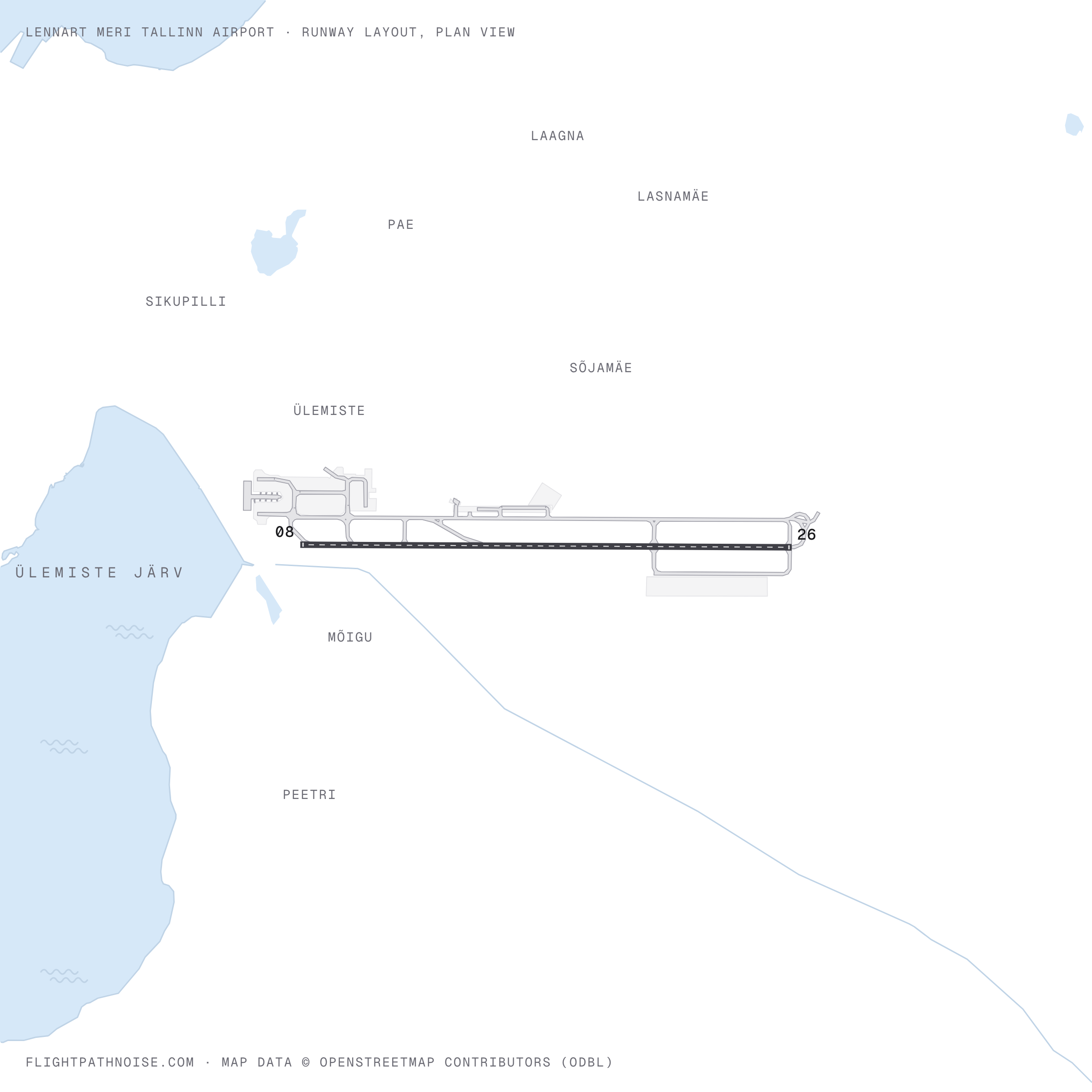
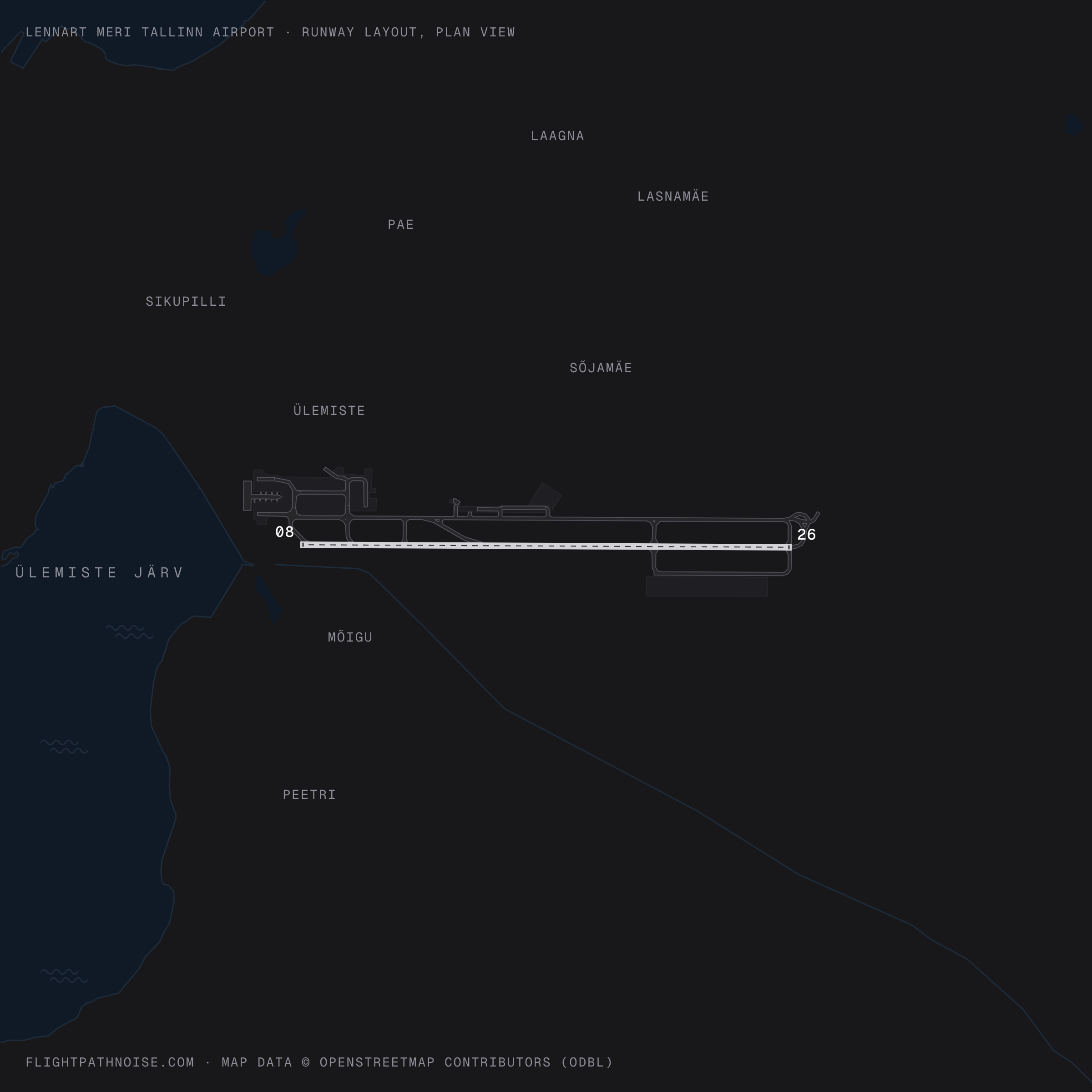
TLL has a single 3,480 m east-west runway (08/26) on the eastern shore of Lake Ülemiste. Takeoffs and landings flow east over the Baltic or west toward inland Estonia, depending on wind. The geometry means most of Tallinn — including Old Town, Kalamaja, Kadriorg, and Pirita — sits north of the runway centerline.
For digital nomads or remote workers settling in Tallinn, Kalamaja and Telliskivi are the natural default for both lifestyle and aircraft-noise reasons. Old Town is also quiet for planes (its historical layout puts it well off any modern flight path), with the bigger noise variables being tram bells and weekend foot traffic.
| Area | Noise | Why |
|---|---|---|
| Mõigu | ✈︎✈︎✈︎ | 500 m south-west of the runway, under the western takeoff path |
| Ülemiste | ✈︎✈︎✈︎ | Immediately north of the runway, lateral aircraft noise during ops |
| Lasnamäe | ✈︎✈︎ | 3 km north; off the centerline but catches some lateral noise |
| Sikupilli | ✈︎✈︎ | 1.5 km north-west of the airport |
| Kadriorg | ✈︎ | 5 km north; well off the corridor |
| Old Town (Vanalinn) | ✈︎ | 5 km north-west, aircraft at altitude overhead |
| Kalamaja / Telliskivi | ✈︎ | 6 km north-west; the nomad-popular creative district |
| Pirita | ✈︎ | 6 km north-east on the coast |
Flight patterns and runway use
TLL uses a single east-west runway (08/26). With prevailing winds from the south-west, runway 26 (west-departing, east-arriving) is the more common configuration — takeoffs head out over the mainland toward Saku, arrivals come in from the Baltic. When wind shifts the airport flips: takeoffs east over the Baltic, arrivals from the west over Mõigu.
The route-density layer above shows the cumulative picture across the last 30 days. You’ll see the bright corridor running east-west through the airport, with much fainter coverage anywhere off that line — confirming the geometry that keeps most of Tallinn quiet.
When is it quietest?
TLL is a relatively low-volume airport — there’s no formal night curfew, but scheduled traffic clusters between 6 AM and 11 PM. Overnight is mostly cargo and the occasional repositioning flight. The 1 AM – 5 AM stretch is genuinely quiet, often with hour-long gaps between movements. Even at peak hours the city-wide soundscape is dominated by ground noise rather than aircraft, except in the runway-adjacent neighborhoods.
For your specific address, drop a pin on the map above to see the hourly profile. Most central addresses will show very few audible flyovers per day; runway-adjacent addresses will show a clear daytime peak.
How to check noise at your specific address
The map above is the answer to “is this spot loud?” Three steps:
- Search your address or postcode in the bar at the bottom of the map.
- Drop a pin — click the location marker that appears.
- Read the noise report that opens in a panel below the map: average daily noise (Leq), peak observed dB, flights per day passing within 2 km, and an hourly breakdown.
The Noise Heatmap layer (orange/red = louder) and the Route Density layer (purple/magenta = busier flight corridors) make the east-west runway pattern obvious. Most addresses outside the immediate Mõigu / Ülemiste / Sikupilli zone will read green — TLL is one of the quietest airports on this site for the residential city around it.
Frequently asked questions
- Which Tallinn neighborhoods are quietest for aircraft noise?
- Kalamaja, Telliskivi, Old Town, Kadriorg, and Pirita all sit north of the runway and well off the east-west flight corridor. They're the practical default for nomads or residents who care about aircraft noise.
- Is Lasnamäe loud from planes?
- Less than its proximity might suggest. The runway runs east-west, so most takeoffs and landings pass east toward the Baltic or west toward inland Saku — not directly over Lasnamäe. There's audible side-aircraft noise, but it's well off the centerline.
- Is Kalamaja affected by aircraft noise?
- Minimally. Kalamaja sits 6 km north-west of the runway and aircraft are at altitude or off the centerline overhead. The bigger noise factors in Kalamaja are passing trains (the rail line cuts through), bars at night, and renovation work — not planes.
- How does Tallinn compare to bigger European airports?
- TLL is small-scale by European standards — Estonia is a small country and the airport handles modest traffic compared to Riga, Helsinki, or any of the regional hubs further west. Per-event aircraft noise can still be loud (a 737 is a 737), but the frequency is low — away from the immediate runway-adjacent neighborhoods, you can go entire days without an audible flyover.
- Should I avoid living near the airport?
- Mõigu, Ülemiste, and the immediate Sikupilli area get measurable runway-side noise during the day. Anywhere else in Tallinn proper — including the entire western and northern arc of the city — is comfortably quiet for aircraft. The 5 km distance to most residential and commercial neighborhoods is enough.
- Does aircraft noise affect Tallinn property values?
- Yes, in the directly-adjacent zones (Mõigu, Ülemiste). Aircraft noise has a measurable per-decibel effect on European property values; properties in the immediate runway corridor trade at a discount. Most of Tallinn's housing stock is far enough north of the runway that the effect is negligible.
Sources and further reading
- Tallinn Airport overview (location, runway, residential proximity) — Wikipedia
- Noise assessment and mitigation schemes for Estonian airports — Aviation journal (Estonia)
- Tallinn neighborhoods for digital nomads — Digital Nomad World
- Tallinn Airport official site — Tallinn Airport
Data updated 2026-10-26 — live ADS-B monitoring, rolling 30-day statistics (methodology). Article text revised 2026-04-29.
Other airports we track
All 173 airports →No airports in this region yet.