
Aircraft noise around Da Nang in October 2026
Loudest neighborhoods near Da Nang: Hai Chau (city centre), Lien Chieu / Hoa Khanh. Quietest: Son Tra Peninsula, Ngu Hanh Son (Marble Mountains). Busiest around noon local time averaging 238 flights/day. Source: Flight Path Noise monitoring data, 30 days to 2026-10-26.

Does Da Nang Airport have a curfew?
No — Da Nang has no formal curfew.
DAD is licensed for 24-hour operations, but in practice scheduled passenger traffic clusters between roughly 5 AM and midnight. Overnight is mostly cargo and the occasional repositioning flight — measurably quieter than the daytime peak.
Da Nang is one of those rare cities where the airport sits right next to the downtown — barely 2 km from the central districts, with the runway running parallel to the Han River. That makes “where to live” more interesting than at most airports: a few kilometres east or north and the noise picture changes completely. This page combines a live ADS-B map of every flight passing DAD with notes on which districts catch the runway and which are shielded.
Which neighborhoods are quietest — and which aren’t
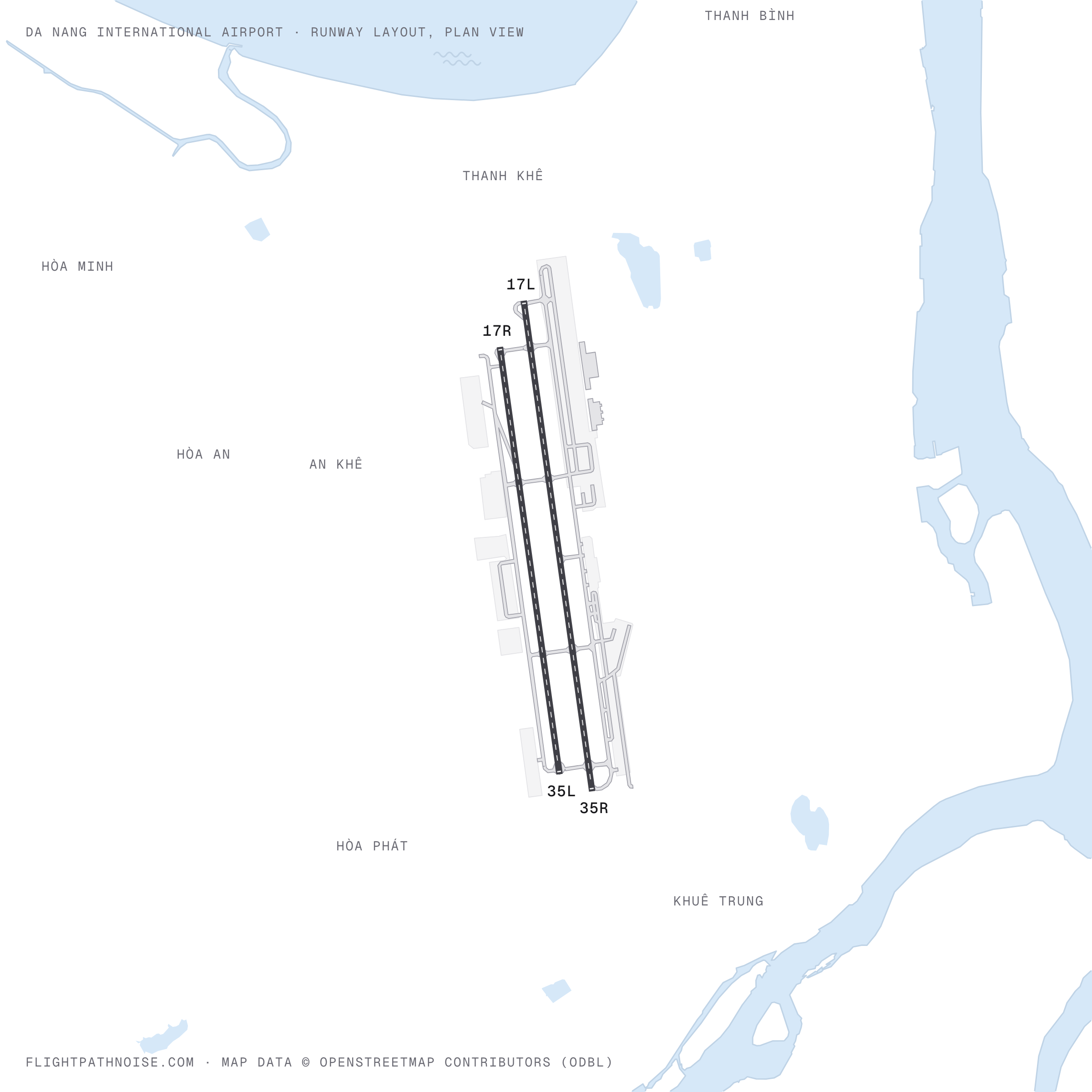
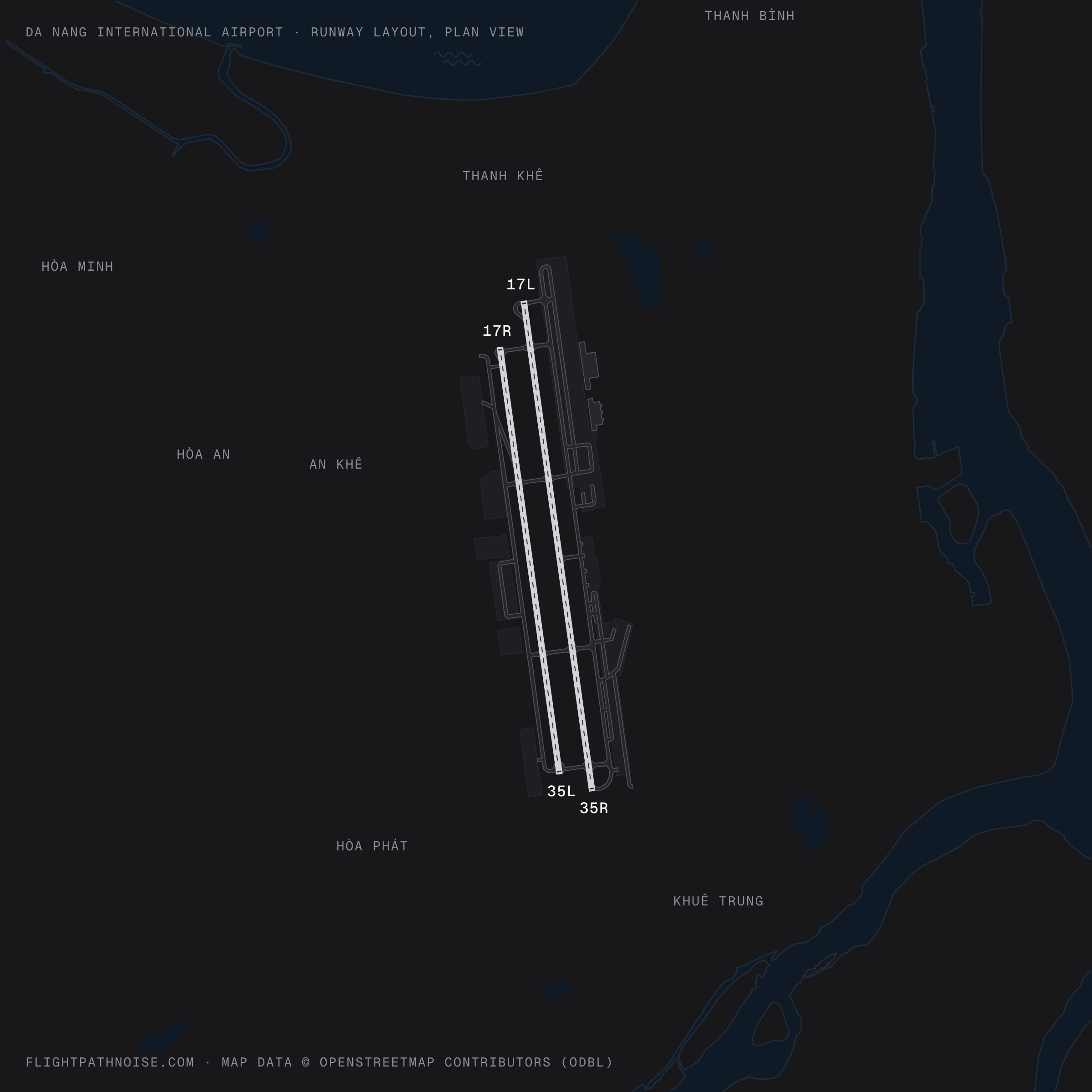
DAD has two parallel north-south runways (designations 17/35) running along the city’s western edge. Takeoffs and landings flow either north (over Lien Chieu and the industrial zones) or south (over Hoa Vang) depending on wind. The beach-side residential strip and Son Tra peninsula sit east of the runway centerline, so they hear aircraft mainly as side noise rather than directly overhead.
If you’re a digital nomad considering Da Nang and aircraft noise is on your list of concerns, the calculus is easy: An Thuong/My An trades aircraft noise for tourist-zone karaoke, while Son Tra trades both for a quieter local-vibe neighborhood with longer commutes. Hai Chau gives you the most authentic city centre but also the most runway-side noise.
| Area | Noise | Why |
|---|---|---|
| Hai Chau (city centre) | ✈︎✈︎✈︎ | Runs alongside the runway; constant side-aircraft noise during operating hours |
| Lien Chieu / Hoa Khanh | ✈︎✈︎✈︎ | Directly north of the runway, under the takeoff corridor on north-flow days |
| Cam Le / Hoa Vang | ✈︎✈︎ | South of the runway; approach corridor depending on wind |
| An Thuong / My An (beach side) | ✈︎✈︎ | 4–5 km east; aircraft audible but softened by distance and the Han River |
| Son Tra Peninsula | ✈︎ | Hills shield the peninsula from runway noise; the quietest popular residential option |
| Ngu Hanh Son (south beach) | ✈︎ | Far enough south that aircraft are well off the runway centerline |
Flight patterns and runway use
Da Nang’s two parallel north-south runways (17L/35R and 17R/35L) service both arrivals and departures, with parallel ops once traffic volume justifies it. North-flow operations send takeoffs out toward Hue and Hanoi over Lien Chieu, with arrivals coming in from the south over Hoa Vang. South-flow flips this. The runway alignment means residential areas to the east (the beach side, including My Khe and An Thuong) sit alongside, not under, the main flight paths.
The route-density layer above shows the cumulative picture: bright bands stretch north and south of the runway centerline, with much fainter coverage to the east where the beach-side neighborhoods are.
When is it quietest?
Scheduled traffic at DAD clusters between roughly 5:30 AM and midnight, peaking mid-morning and early evening. The 1 AM – 4 AM window is genuinely quiet — only occasional cargo flights and the rare repositioning. If you live near the runway, the difference between 11 PM (still busy) and 1 AM (quiet) is noticeable.
For your specific address, drop a pin on the map above and read the hourly breakdown in the noise report. Most beach-side and Son Tra addresses will show a near-flat hourly profile (audible flyovers but not loud); addresses in Hai Chau will show a clear daytime peak.
How to check noise at your specific address
The map above is the answer to “is this spot loud?” Three quick steps:
- Search your address or postcode in the bar at the bottom of the map.
- Drop a pin — click the location marker that appears.
- Read the noise report that opens in a panel below the map: average daily noise (Leq), peak observed dB, flights per day passing within 2 km, and an hourly breakdown so you can see when those flights happen.
The Noise Heatmap layer (orange/red = louder) and the Route Density layer (purple/magenta = busier flight corridors) give you the city-wide context. Most addresses east of the Han River will read green to yellow; addresses west, particularly in Hai Chau, run hotter.
Frequently asked questions
- Is the An Thuong / My An area loud from planes?
- Less than you'd think. Although the airport is only 4–5 km away, the runway is oriented north–south so takeoffs and landings don't pass directly over the beach side. You'll hear flights on quiet evenings, but ambient road and karaoke noise is typically more intrusive (and Da Nang research bears this out).
- Which Da Nang neighborhoods are quietest for aircraft noise?
- Son Tra Peninsula (the hills act as a natural buffer) and the southern Ngu Hanh Son area near the Marble Mountains both sit well off the flight path. Most of the eastern beach strip is also acceptable for noise-sensitive nomads.
- Is Hai Chau noisy from aircraft?
- Yes — Hai Chau is the downtown core and runs right alongside the runway. You won't be directly under takeoffs, but the side-aircraft noise during operating hours is constant. If you take a lot of video calls and prefer quiet, look east of the Han River instead.
- Is the airport still used for military operations?
- It's technically a joint civil-military airfield (shared with the Vietnamese People's Air Force), but military activity is now very limited. Day-to-day noise is overwhelmingly civilian commercial traffic.
- Should I avoid Da Nang entirely if I'm noise-sensitive?
- No — Son Tra and the southern beach areas are notably quiet, and the bigger noise issues for nomads are usually karaoke, construction, and motorbike traffic rather than aircraft. The airport's sandwiched between the city and the mountains, so noise dissipates quickly off the runway centerline.
- How does Da Nang aircraft noise compare to Bangkok or Chiang Mai?
- DAD has roughly 10× CNX's traffic but is much smaller than BKK. The crucial difference is location — Da Nang's airport is *inside* the city in a way Bangkok's isn't, so even moderate traffic feels close. Side-aircraft noise in Hai Chau can rival the heaviest BKK corridor districts despite far fewer flights.
Sources and further reading
- Da Nang International Airport overview — Wikipedia
- Aircraft and road traffic noise annoyance in Da Nang City — Research study
- Da Nang neighborhood guide for nomads — A Way Abroad
- Da Nang Air Base history (joint civil-military) — Wikipedia
Data updated 2026-10-26 — live ADS-B monitoring, rolling 30-day statistics (methodology). Article text revised 2026-04-29.
Other airports we track
All 173 airports →No airports in this region yet.