
Aircraft noise around Bankstown in November 2026
Loudest neighborhoods near Bankstown: Milperra, Georges Hall, Condell Park, Bankstown, Revesby. Quietest: Bass Hill, Revesby Heights, Lansvale. Busiest around 11 AM local time averaging 81 flights/day. Source: Flight Path Noise monitoring data, 30 days to 2026-11-22.

Does Bankstown Airport have a curfew?
No — Bankstown has no formal curfew.
Not a legislated jet-style curfew like Sydney Kingsford Smith. Bankstown is licensed to operate 24 hours, and through-flights plus medical and emergency operations can occur at any time. What is restricted is circuit training — the main noise source. Circuit hours are capped (broadly first light/around 6 AM to 7 PM on weekdays and roughly 8–9 AM to 6 PM on weekends and public holidays), with night and low-level circuit training curtailed. In a 2011 noise-abatement decision the evening circuit finish time was pulled back from 11 PM to 10 PM (10:30 PM during daylight saving).
Bankstown Airport (BWU/YSBK) is Sydney’s busiest general-aviation airport and one of the busiest airfields in Australia by aircraft movements — and almost all of that traffic is light pistons doing repetitive circuit training, not airline jets. The defining noise complaint here isn’t a single loud departure but the relentless drone of Cessnas and helicopters going round and round the circuit, hour after hour, over the densely populated Canterbury-Bankstown suburbs along the Georges River. Because the three short parallel runways run roughly 11/29 (WNW–ESE) and the preferred direction is 29, downwind and base legs swing repeatedly over the suburbs to the south and south-east. The field runs 24 hours but caps circuit-training hours, and in late 2024 CASA consulted on a contested south-east VFR corridor that would have funnelled light traffic over those same suburbs.
Which neighborhoods are quietest — and which aren’t
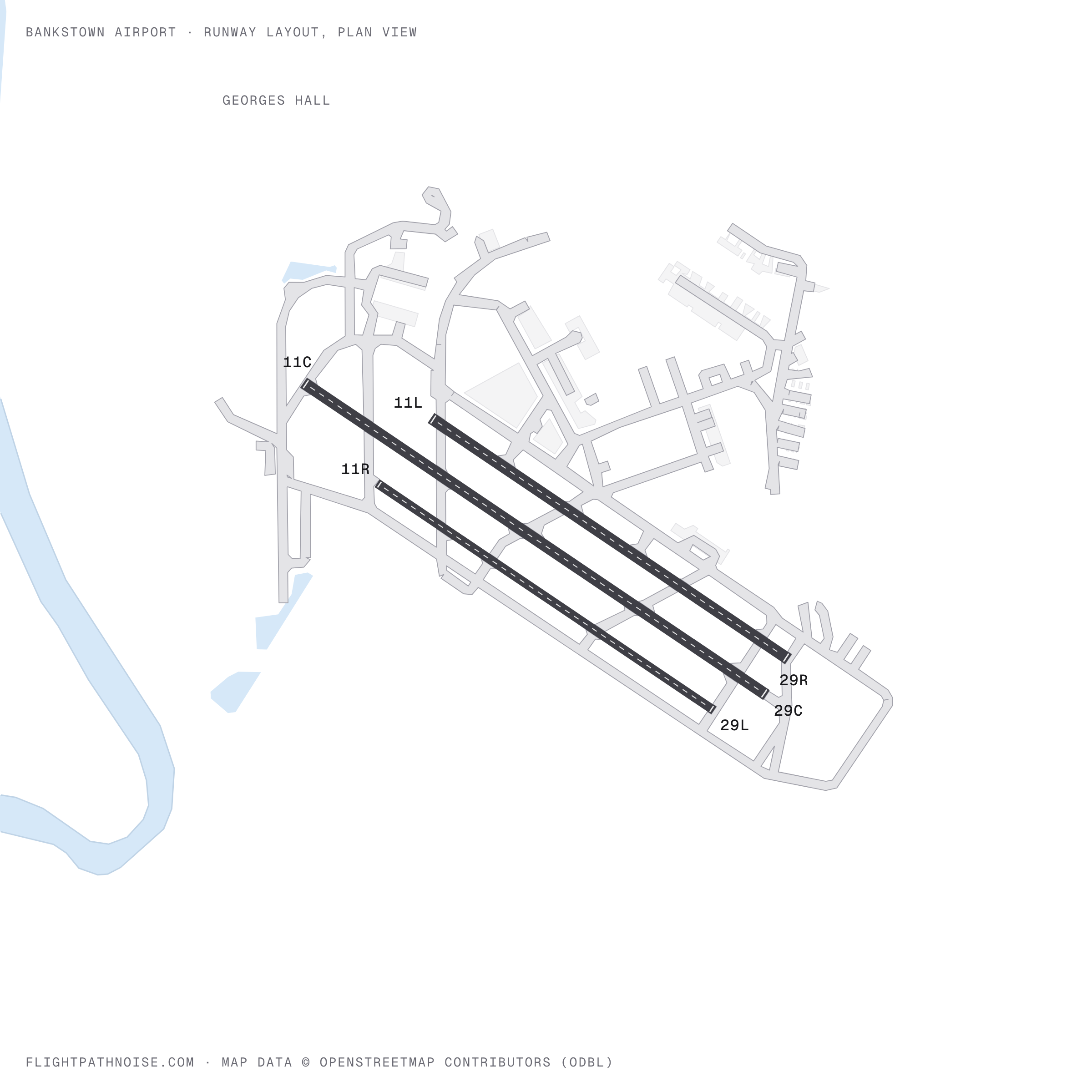
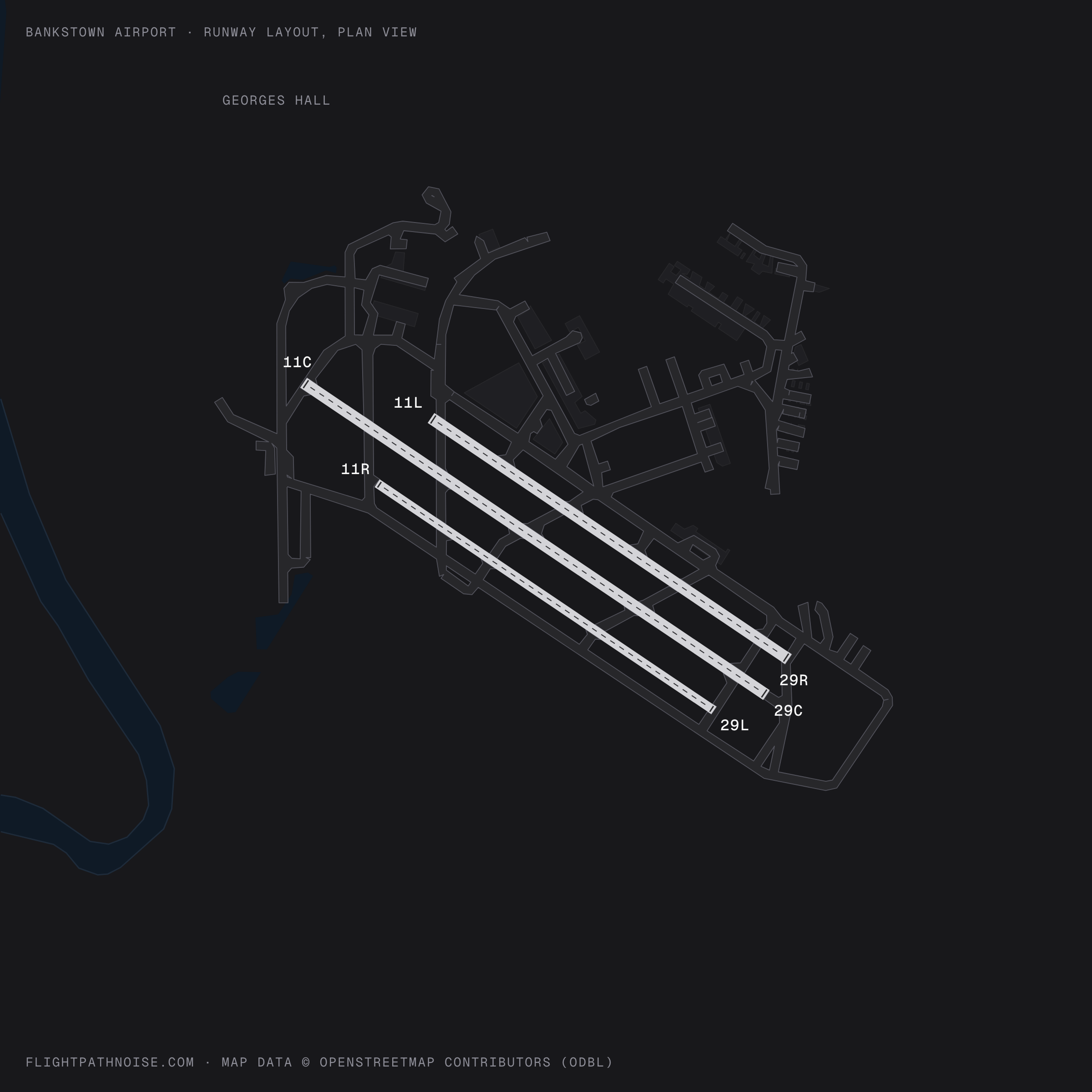
Bankstown has three short, sealed parallel runways: the centre and main strip 11C/29C (~1,416 m × 30 m), the northern 11L/29R (~1,100 m), and the southern 11R/29L (~1,038 m). Runway 29 (heading roughly west-north-west) is the preferred, nominated direction in prevailing winds; 11 is used when winds come from the east or south-east. Right-hand circuits keep the parallel traffic separated, so circuit legs are flown on both the northern and southern sides of the field depending on the runway in use.
The result is that exposure radiates out from the field, with the heaviest overflight on the suburbs immediately ringing it and along the Georges River to the south-east, where the southern-strip circuits sit closest to housing.
If overflight noise is a priority, the practical move around Bankstown is west of the field — Bass Hill, Lansvale and the outer streets of Chipping Norton sit off the busiest circuit legs and only catch lighter, higher transit traffic. The suburbs to avoid for the heaviest exposure are the ones that ring the airport and run down the Georges River to the south-east: Milperra, Georges Hall, Condell Park, Revesby and Padstow. Because the noise is circuit training rather than a fixed jet corridor, exposure varies street by street, so drop a pin on the map above before you commit to an address.
| Area | Noise | Why |
|---|---|---|
| Milperra | ✈︎✈︎✈︎ | Immediately south across the river; under southern-runway circuits |
| Georges Hall | ✈︎✈︎✈︎ | Abuts the northern boundary; under circuit and departure tracks |
| Condell Park | ✈︎✈︎✈︎ | Immediately east; under the eastern downwind/base legs |
| Bankstown | ✈︎✈︎✈︎ | Off the 29 departure / 11 approach line; constant overflights |
| Revesby | ✈︎✈︎✈︎ | Under south-east circuits and the proposed corridor along the river |
| Padstow | ✈︎✈︎✈︎ | Northern Padstow under south-east base legs; recurring complainant |
| Panania | ✈︎✈︎ | South-east along the river; circuit and corridor overflight |
| Chipping Norton | ✈︎✈︎ | On training-area departure/return tracks |
| Picnic Point | ✈︎✈︎ | Further down the river; wider circuits and corridor traffic |
| East Hills | ✈︎✈︎ | South of the river on extended circuit geometry |
| Yagoona | ✈︎✈︎ | Near the 29 climb-out / 11 approach line |
| Bass Hill | ✈︎ | West of the field, off the main 29-end spread |
| Revesby Heights | ✈︎ | Edge of circuit reach; occasional exposure |
| Lansvale | ✈︎ | West-north-west; off the primary circuit legs |
Flight patterns and runway use
Prevailing winds favour operations toward the west-north-west, so Runway 29 is the preferred, nominated runway most of the time; 11 comes into use when winds are from the east or south-east. With three parallel strips and right-hand circuits, the downwind and base legs of the training pattern are flown on both the northern and southern sides of the field depending on which runway is active — which is why suburbs on opposite sides of the airport can both report heavy overflight on different days.
The overwhelming majority of activity is touch-and-go circuit training by light fixed-wing aircraft and helicopters. The rest is departures to the designated training areas to the west and south-west (toward Camden), where aircraft climb to roughly 2,500–4,500 ft before working in those areas and returning. Unlike Sydney Kingsford Smith, there’s no over-water noise-abatement track — Bankstown’s circuits are flown entirely overland, over dense suburbia, which is why the noise footprint feels so constant to residents directly underneath.
The southernmost strip (11R/29L) carries a share of the circuit work, and being the closest runway to the river residential suburbs, its circuits sit lowest over Milperra, Revesby and Padstow. The route-density layer on the map above shows the signature: not a single bright departure corridor like a jet airport, but overlapping rectangular circuit loops on both sides of the field plus a fan of tracks heading west toward the training areas.
In late 2024, CASA consulted on a proposed Southeast VFR Corridor — two one-way, daytime-only visual lanes (surface to 1,500 ft) running south and south-east of the Bankstown control zone. Consulted from 27 August to 22 October 2024, it drew strong responses over safety and mid-air-collision risk and did not proceed as proposed; CASA is exploring alternatives. Had it gone ahead, it would have concentrated more light traffic over Revesby, Padstow, Panania and Picnic Point.
When is it quietest?
Bankstown’s daily noise profile is shaped by the circuit-training hour caps rather than a legislated curfew. The field is licensed 24 hours, but the repetitive overhead circuits — the main complaint — only happen in set daytime windows:
- Overnight (roughly 10 PM – first light): quietest. Circuit training has stopped; only the occasional transit, medical or emergency flight operates. In 2011 the evening circuit finish was pulled back from 11 PM to 10 PM (10:30 PM during daylight saving) as a noise-abatement measure after community pressure.
- Early morning (first light – mid-morning): training schools open and circuit work ramps up; weekday starts are broadly from around 6 AM.
- Midday to late afternoon: the busiest stretch on fine-weather days, with back-to-back touch-and-goes and helicopter training.
- Weekends and public holidays: a later start (roughly 8–9 AM) but often a full day of recreational and training flying through to about 6 PM — for many residents this is the most noticeable period, because they’re home to hear it.
- Evening (after the circuit cap): the repetitive circuits stop, though transit movements can continue.
Weather is the other big variable. Circuit training is a fair-weather, daylight activity, so a run of clear days means more flying, while low cloud, rain or strong crosswinds can quieten the field substantially. Wind direction also flips which side of the field the circuits favour.
For the hourly pattern over your specific address, drop a pin on the map above.
How to check noise at your specific address
The map above answers “is this spot loud?” Three steps:
- Search your address or postcode in the bar at the bottom of the map.
- Drop a pin — click the location marker that appears.
- Read the noise report in the panel below the map: average daily noise, peak observed level, flights per day loud enough to hear there, and an hourly breakdown.
Prefer suburb-level answers? The suburb & postcode noise guide further down this page ranks every measured suburb, searchable by name or postcode.
One caveat specific to Bankstown: it’s a general-aviation field, so a share of light training aircraft may not carry ADS-B transponders and won’t all appear in the tracked data the way an airline fleet does. The Route Density layer (purple/magenta = busier) still makes the circuit pattern obvious — overlapping loops on both sides of the field rather than a single corridor — and the Noise Heatmap layer (orange/red = louder) shows where the southern and eastern circuit legs concentrate over Milperra, Condell Park, Revesby and Padstow. If you’re weighing up an address in those suburbs, check the pin report alongside the time-of-day pattern, since the practical question here isn’t peak loudness but how many hours a day the circuits are overhead.
Suburb & postcode noise guide
All 139 suburbs →Suburbs overflown by Bankstown Airport traffic, ranked by this airport's share (rolling window to 2026-08-21). Each page shows the full picture across every airport and low-flying aircraft in the area.
| Suburb | Postcode | From Bankstown / day | All sources / day | Area rank |
|---|---|---|---|---|
| Chipping Norton (2170) | 2170 | 24 | 27 | #38 |
| Condell Park (2200) | 2200 | 20 | 34 | #27 |
| Milperra (2214) | 2214 | 15 | 23 | #53 |
| Georges Hall (2198) | 2198 | 15 | 22 | #55 |
| Moorebank (2170) | 2170 | 13 | 19 | #70 |
| Revesby (2212) | 2212 | 13 | 29 | #32 |
| Panania (2213) | 2213 | 12 | 24 | #44 |
| Lansvale (2166) | 2166 | 10 | 13 | #97 |
| Yagoona (2199) | 2199 | 9 | 24 | #47 |
| Bass Hill (2197) | 2197 | 9 | 18 | #72 |
| Bankstown (2200) | 2200 | 7 | 19 | #66 |
| Cabramatta (2166) | 2166 | 7 | 13 | #96 |
| Villawood (2163) | 2163 | 6 | 14 | #88 |
| Smithfield (2164) | 2164 | 6 | 10 | #107 |
| Pemulwuy (2145) | 2145 | 6 | 26 | #41 |
| Warwick Farm (2170) | 2170 | 5 | 8 | #117 |
| Prestons (2170) | 2170 | 5 | 7 | #119 |
| Chester Hill (2162) | 2162 | 5 | 19 | #69 |
| Guildford (2161) | 2161 | 5 | 24 | #48 |
| Casula (2170) | 2170 | 5 | 9 | #113 |
| Fairfield (2165) | 2165 | 5 | 7 | #122 |
| Liverpool (2170) | 2170 | 4 | 7 | #120 |
| Canley Heights (2166) | 2166 | 4 | 6 | #133 |
| Parramatta (2150) | 2150 | 4 | 33 | #28 |
| Horsley Park (2175) | 2175 | 3 | 6 | #124 |
| Edmondson Park (2174) | 2174 | 3 | 6 | #135 |
| Merrylands (2160) | 2160 | 3 | 36 | #21 |
| Greystanes (2145) | 2145 | 3 | 24 | #45 |
| Ingleburn (2565) | 2565 | 3 | 5 | #137 |
| Wetherill Park (2164) | 2164 | 3 | 6 | #128 |
| Auburn (2144) | 2144 | 3 | 40 | #19 |
| Granville (2142) | 2142 | 2 | 34 | #23 |
| Glenfield (2167) | 2167 | 2 | 6 | #127 |
| Eastern Creek (2766) | 2766 | 2 | 6 | #136 |
| Lidcombe (2141) | 2141 | 2 | 26 | #39 |
| Toongabbie (2146) | 2146 | 2 | 7 | #123 |
| North Parramatta (2151) | 2151 | 2 | 34 | #26 |
| Sydney Olympic Park (2127) | 2127 | 2 | 16 | #78 |
| South Granville (2142) | 2142 | 2 | 12 | #103 |
| Westmead (2145) | 2145 | 1 | 14 | #91 |
| Oatlands (2117) | 2117 | 1 | 20 | #61 |
Frequently asked questions
- Is Bankstown Airport loud?
- It depends what you mean by loud. Bankstown has no airline jets — it's Sydney's busiest general-aviation and flight-training field, so the noise is light Cessnas, Pipers and helicopters rather than 737s. The complaint here isn't a single loud departure; it's the relentless drone of training aircraft doing circuits, round and round over the same suburbs for hours. Suburbs like Milperra, Revesby, Padstow, Condell Park and Georges Hall sit closest to that pattern. Drop a pin on the map above to see how often aircraft pass over your street.
- Why are planes circling over Revesby and Padstow?
- That circling is circuit training. Student pilots fly a repeated rectangular pattern — take off, climb, downwind, base, final, land or touch-and-go, then go around again. Because the preferred runway is 29 (heading west-north-west) and Bankstown runs right-hand circuits on its parallel strips, the downwind and base legs swing repeatedly over the suburbs to the south and south-east along the Georges River, which is exactly where Revesby and Padstow sit. The same aircraft can pass overhead every few minutes for an entire lesson.
- What are Bankstown Airport's circuit training hours?
- Circuit training is limited to set daytime windows — broadly from first light (around 6 AM) until about 7 PM on weekdays, and roughly 8–9 AM until 6 PM on weekends and public holidays, with night and low-level circuit work restricted. These are operator and Airservices operating limits rather than a statutory curfew. The airport tightened its evening finish times in 2011 after sustained community noise pressure. Outside these hours the field still operates for transit, medical and emergency flights, so it's never fully silent, but the repetitive overhead circuits stop.
- Which suburbs around Bankstown Airport are quietest?
- Suburbs west of the field and off the Georges River circuit legs get the least overflight — Bass Hill, Lansvale and the outer edges of Chipping Norton. The most consistently affected are the suburbs ringing the airport and running down the river to the south-east: Milperra, Georges Hall, Condell Park, Revesby and Padstow. Because the noise is circuits rather than a fixed departure corridor, exposure can vary block by block. Drop a pin on the map above to see your specific address.
- How do I report aircraft noise from Bankstown Airport?
- Aircraft noise complaints go to Airservices Australia's Noise Complaints and Information Service (NCIS), online or by phone on 1800 802 584. Ground-noise matters — engine run-ups, taxiing, maintenance — are handled by the airport operator, Aeria Management Group. Logging a complaint matters here, because community pressure is what drove the 2011 evening circuit cutback and shaped responses to the 2024 corridor proposal.
- What was the Bankstown southeast VFR corridor consultation?
- In 2024 CASA consulted on a proposed Southeast VFR Corridor — two one-way, daytime-only visual flight lanes running surface to 1,500 ft south and south-east of the Bankstown control zone, over suburbs along the Georges River. The consultation ran from 27 August to 22 October 2024 and drew strong responses, including safety and mid-air-collision concerns. As of early 2025 it did not proceed as proposed; CASA is exploring alternatives, with broader consultation expected. If it had gone ahead it would have funnelled more light traffic over Revesby, Padstow, Panania and Picnic Point.
- Why is Milperra so affected by Bankstown Airport noise?
- Milperra sits immediately south of the airport, just across the Georges River, directly beneath the southern runway's circuits and approaches. The southernmost strip (11R/29L) is the one whose circuit legs sit closest to the river residential suburbs, so Milperra catches both the low approach and base-leg traffic from training flights. Drop a pin on the map above to see the overflight count for your part of Milperra.
Sources and further reading
- Bankstown Airport — Wikipedia — Wikipedia
- Sydney Bankstown Airport runways (YSBK) — OurAirports
- Proposed Bankstown Airport Southeast VFR Corridor — Civil Aviation Safety Authority (CASA)
- Bankstown Airport bows to noise complaints — Australian Flying
- Bankstown and Camden Airport — Training areas — Airservices Australia
- Making a complaint about aircraft noise (NCIS) — Airservices Australia
Data updated 2026-11-22 — live ADS-B monitoring, rolling 30-day statistics (methodology). Article text revised 2026-06-12.
Other airports we track
All 174 airports →No airports in this region yet.