San Diego neighbourhood noise pages
30 San Diego neighborhood pages show overflights along the approach and departure paths, with ZIP codes and airline traffic split from military flying.
On this page
San Diego is the first city in the United States to get local noise pages on Flight Path Noise. Today we’re publishing 30 of them, listed and ranked at /united-states/san-diego/. They use local wording, so they’re called neighborhood pages and list ZIP codes instead of postcodes.
Following the approach and departure paths
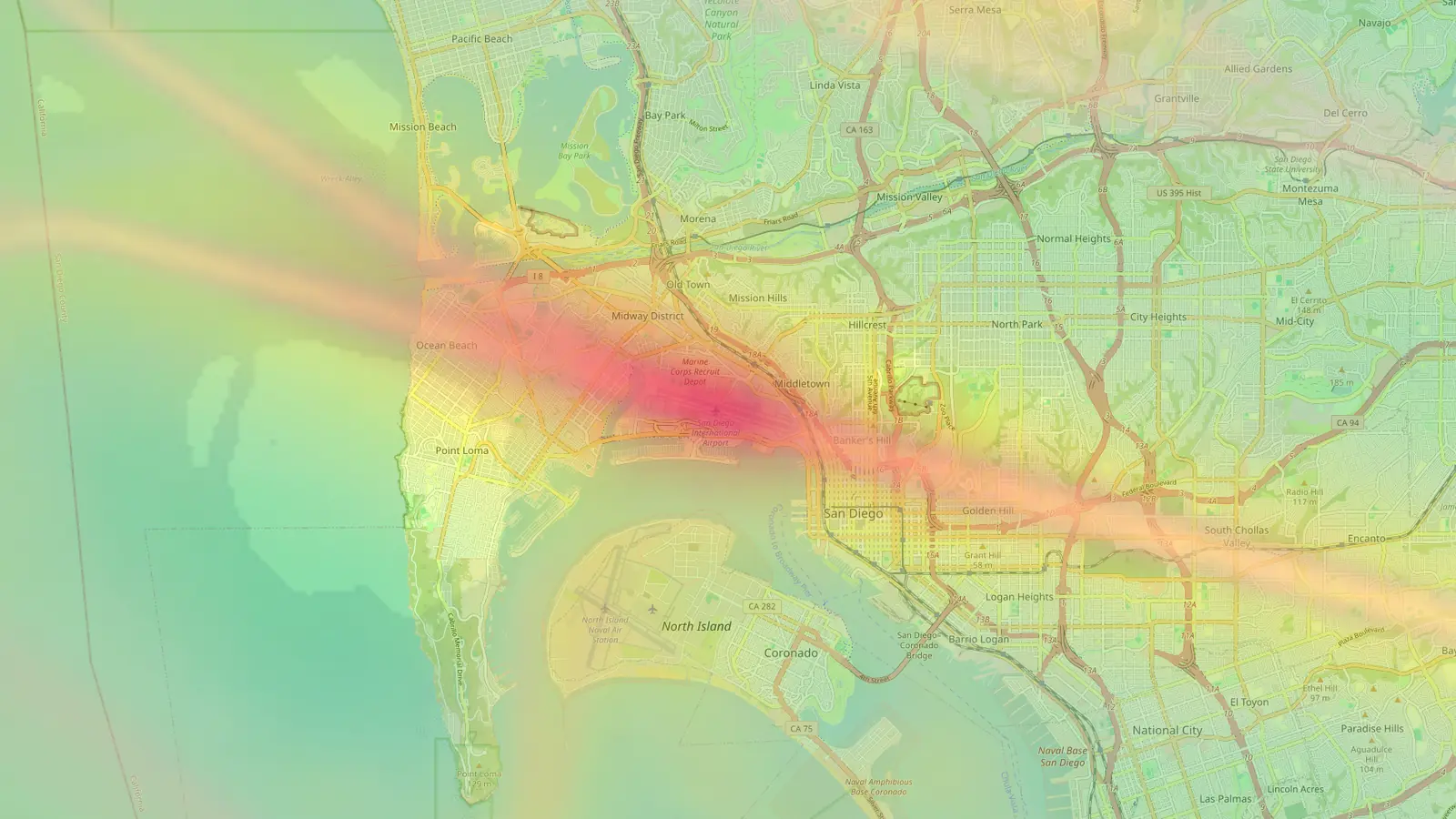
San Diego International has a single runway, 5 km from downtown. Prevailing winds favour landing and taking off towards the west about 80% of the time, so arrivals usually come in from the east and departures leave over Point Loma. That makes the noise pattern unusually easy to read on a map, and the pages follow it.
Arrivals line up for the runway out over Mount Hope, then descend over Golden Hill and South Park, cross Balboa Park, and pass a few hundred feet above the apartment blocks of Bankers Hill on the last mile before touchdown. Mount Hope tops the ranking, with about 300 overflights on a typical day.
Departures climb out to the west over Loma Portal, then Point Loma Heights, and cross the coast at Ocean Beach while still climbing.
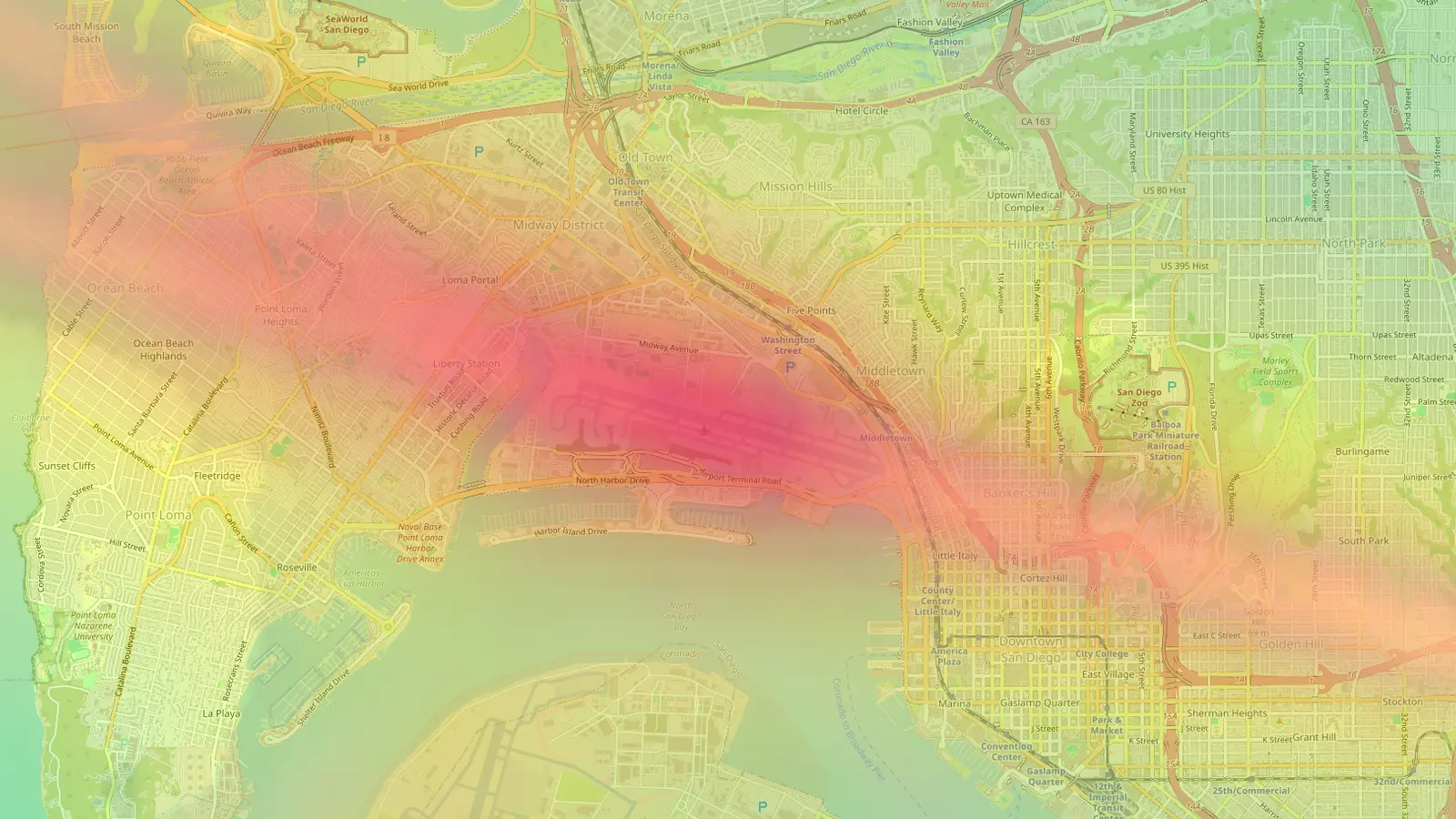
Each page shows overflights on a typical day, the typical height of those aircraft, how much of the traffic is low, the share of arrivals, and when the first and last movements usually happen, along with an hourly pattern and a map of the neighbourhood over the noise heatmap. Overflight counts and heights come from recorded flight tracks. Noise levels are modelled estimates based on aircraft type, height and distance, so they’re best used to compare one neighbourhood with another.
Airline traffic and military flying, shown separately
San Diego has a lot of flying that has nothing to do with the airport. Naval Air Station North Island sits just across the bay, Marine Corps Air Station Miramar is to the north, and Montgomery-Gibbs Executive Airport handles general aviation in the middle of the city.
The pages keep these apart. The “Where the noise comes from” section shows San Diego International traffic in one block, and military and general-aviation aircraft in another. That matters in places like Coronado, where most low overflights are military traffic from North Island, not airliners. It matters in Kearny Mesa too, where most of the traffic is military and general-aviation flying around Montgomery-Gibbs and Miramar. Without the split, those neighbourhoods would look like they sit under the airport’s flight paths when they don’t.
How neighbourhoods were chosen
We started with neighbourhoods close to the airport that see regular low overflights, and gave priority to where the most people live. We then made sure the neighbourhoods directly under the approach and departure paths were included, even where they’re smaller.
One page is there for a different reason. North Park doesn’t pass the overflight test, but it sits beside the approach. Its page shows that the corridor passes to the south, so overflights there are rare.
The figures cover flights recorded from late June to late September 2026.
An updated curfew answer for San Diego International
We’ve also corrected the curfew answer on the San Diego International page. The airport has a mandatory departure curfew: aircraft may not take off between 11:30 PM and 6:30 AM. Arrivals aren’t restricted, so planes can land at any hour, and late-night noise over Golden Hill, Balboa Park and Bankers Hill comes from delayed arrivals. The answer is now marked partial, and the page explains how late departures are reviewed and fined.
If you’re looking at a particular street, open the San Diego International map and drop a pin on the address. The pin report gives flights, heights and an hourly breakdown for that exact point.
Frequently asked questions
- Does San Diego International have a curfew?
- Partly. Aircraft may not take off between 11:30 PM and 6:30 AM, with exemptions for emergencies and some delays, but arrivals can land at any hour. Late-night noise over the approach corridor comes from arriving flights.
- Why is North Park included if it's quiet?
- North Park sits right beside the approach path, so it's a natural question. The page shows that the corridor passes to its south, over Golden Hill and South Park, so overflights in North Park itself are rare.
Airports and places mentioned
Related updates
61 airports: Sydney, Melbourne and 49 more cities
Flight Path Noise now covers 61 airports in 34 countries, including our first Australian airports and 50 cities where the airport sits close to home.
Hourly noise at each airport's loudest neighbourhood
Airport pages now show the hourly noise level at each airport's loudest residential area, for the busiest hour and the loudest hour of the day.
Brisbane suburb noise pages
30 new suburb noise pages for Brisbane combine Brisbane Airport and Archerfield traffic, from Tingalpa and East Brisbane to Hamilton and Bulimba.